All-Hands Meeting: Meaning, Agenda Template, and How to Run One Worth Attending (2026 Guide)
Multiply the number of people in your company by one hour of salary. That is the minimum price of every all-hands meeting you run, before you count preparation time, the projects paused to attend, and the focus lost afterwards. For a 100-person company, a monthly all-hands can easily cost more than a full-time hire per year.
Which makes it strange how casually most all-hands are treated. A deck gets assembled the night before, leadership talks at the team for fifty minutes, three brave people type questions into the chat, and everyone leaves with the same information they could have read in a memo. Meanwhile the people in other time zones watch a recording at 2x speed, and the teammates who joined in another language catch maybe half of it.
It does not have to be that way. A good all-hands is the highest-leverage communication a company has: it is the one moment when everyone hears the same story, sees the same numbers, and can ask leadership anything. This guide covers what an all-hands meeting actually is, how it differs from a town hall, how often and how long to run one, a copy-paste agenda template, engagement tactics that work, and how to run one when your team is spread across offices, time zones, and languages.
⚠️ This article was independently compiled based on publicly available information and user feedback as of August 2026.
Table of Contents
- What is an all-hands meeting?
- All-hands vs town hall vs staff meeting
- Why most all-hands meetings fail
- How often and how long should an all-hands be?
- The all-hands agenda template
- How to make an all-hands engaging
- Running a remote, hybrid, or global all-hands
- After the meeting: the recap is half the value
- Common all-hands mistakes to avoid
- FAQ
- Conclusion
What is an all-hands meeting?
An all-hands meeting is a recurring meeting where the entire company (or an entire department) comes together so that leadership can share updates, celebrate progress, and answer questions directly. The name comes from the naval command "all hands on deck", the call for every sailor, regardless of rank or role, to report to the deck of the ship. The corporate version keeps that spirit: everyone in one (physical or virtual) room, no hierarchy filters between the people making decisions and the people affected by them.
A well-run all-hands does three jobs that no other channel does as well:
- Alignment. Everyone hears the same priorities, in the same words, at the same time. Strategy that only lives in a doc gets interpreted; strategy said out loud to everyone gets understood.
- Transparency. Numbers, wins, and misses shared openly build more trust than any values poster. The Q&A is where transparency gets tested for real.
- Connection. Especially in remote and distributed companies, the all-hands is often the only moment the whole organization experiences together. Demos, shoutouts, and new-face introductions turn an org chart into people.
Notice what is not on that list: detailed status reporting. The moment an all-hands becomes a sequence of departmental status updates, it stops earning its cost. Status belongs in writing; the all-hands is for the things that benefit from being experienced together.
All-hands vs town hall vs staff meeting
The terms get used interchangeably, and in many companies they genuinely mean the same thing. Where a distinction exists, it usually looks like this:
| All-hands meeting | Town hall | Staff meeting | |
|---|---|---|---|
| Who attends | The whole company or department | The whole company, sometimes with external guests | One team and its manager |
| Primary direction | Leadership shares, everyone participates | Q&A-centric, leadership answers | Operational, two-way |
| Typical cadence | Weekly to monthly | Monthly to quarterly | Weekly |
| Typical content | Strategy, metrics, demos, wins, Q&A | Big announcements, open questions | Tasks, blockers, coordination |
| Size | 10 to 10,000+ | Usually larger organizations | 3 to 15 |
The practical rule: a town hall leans toward listening (leadership answers what the audience asks), while an all-hands leans toward sharing plus dialogue. A staff meeting is a different animal entirely, a working session for a single team. If your company uses "town hall" for what this article calls an all-hands, nothing below changes.
Why most all-hands meetings fail
Before fixing the format, it helps to name the failure patterns. Most bad all-hands suffer from at least two of these five.
The broadcast trap. Leadership talks for the entire hour, and "any questions?" gets ninety awkward seconds before the close. If nobody can influence the meeting while it happens, it should have been a video message people could watch at their convenience.
Slide karaoke. Fifteen department slides, each read aloud by a different manager who is presenting to prove their team exists rather than to tell the company something it needs. Attendees learn nothing they could not have skimmed in five minutes.
The silent Q&A. Questions are invited live, on the spot, with the CEO watching. Unsurprisingly, nobody asks the real ones. The absence of hard questions is not a sign of alignment; it is usually a sign that asking feels unsafe.
The time zone and language tax. The meeting runs at headquarters-friendly hours, in headquarters' language, at native speed. Everyone else either sacrifices their evening, watches a recording nobody discusses, or attends live while understanding a fraction of what is said. The people furthest from HQ, who need the alignment most, get the least of it.
The memory hole. No notes, no recap, no record of what was asked and answered. Two weeks later, people quote three different versions of the same announcement, and the questions that were "taken offline" are never heard from again.
The rest of this guide is essentially the antidote to these five patterns.
How often and how long should an all-hands be?
There is no universal cadence; the honest answer depends on company size, pace of change, and how distributed the team is. Sensible defaults:
| Company profile | Suggested cadence | Length |
|---|---|---|
| Startup under ~50 people | Weekly or biweekly | 30 min |
| Scale-up, 50 to 250 people | Biweekly or monthly | 45 to 60 min |
| 250+ people | Monthly | 60 min |
| Very large or listed company | Monthly or quarterly, plus quarterly deep-dive | 60 to 90 min |
| Fast-moving crisis or pivot | Temporarily more frequent | Short and focused |
A few principles behind the table:
- Small companies benefit from high frequency. When everything changes weekly, a monthly all-hands is a history lecture. Keep it short and keep it regular.
- Large companies benefit from discipline. With hundreds of attendees, every extra ten minutes is a serious cost. Monthly, tightly produced, beats weekly and improvised.
- Consistency beats duration. A reliable 45 minutes every month builds more trust than a sprawling 2-hour session that happens whenever leadership remembers.
- Protect the Q&A share. Whatever the length, if less than a quarter of the meeting is dialogue, the format is drifting back toward broadcast.
The all-hands agenda template
A strong all-hands agenda is predictable in shape and fresh in content: people should know the rhythm and be surprised by what is in it. Here is a 60-minute template you can copy into your meeting doc and adapt.
# All-Hands – [Company] – [Date]

## Welcome & wins (5 min)
- New joiners introduced by name
- Shoutouts: 2-3 specific wins, with the people behind them

## The numbers (10 min)
- Same 3-5 metrics every time, trend vs last period
- One sentence per metric: what moved and why

## The main story (15 min)
- ONE topic that matters this period: strategy shift,
  product launch, market change, reorg
- Told by the person closest to it, not always the CEO

## Demo or deep-dive (10 min)
- A team shows real work: shipped feature, customer story,
  behind-the-scenes of a project

## Q&A (15 min)
- Pre-submitted questions first (collected anonymously)
- Then live questions
- Unanswered questions get owners and a written follow-up

## Closing (5 min)
- The one thing to remember
- Where the notes and recording will live
How to use it well:
- Keep the metrics section stable. The fastest way to make numbers meaningless is to show different ones each time. Same charts, same order, every meeting; the story is in the trend.
- One main story, not four. If everything is important, nothing is. Push the second and third topics to writing or to the next session.
- Rotate the stage. When only executives present, the all-hands reinforces hierarchy instead of dissolving it. A demo from the people who built the thing beats a summary slide from their VP.
- Collect questions before the meeting, anonymously. This single change transforms most Q&As. People ask what they actually want to know, and leadership can prepare honest answers instead of improvising defensively.
How to make an all-hands engaging
Engagement is not about gimmicks; it is about giving people a reason to be present rather than just logged in. Tactics that consistently work:
- Start with people, not metrics. Introducing new joiners and celebrating specific wins in the first five minutes sets a human tone and rewards punctuality.
- Make shoutouts specific. "Thanks to the platform team for a great quarter" lands as filler. "Ana and Jonas cut deploy time from 40 minutes to 6" lands as recognition.
- Use live polls sparingly and honestly. One or two real questions ("How clear is the new pricing? 1-5") beat a trivia quiz. Show the results and react to them on the spot.
- Let hard questions live. When an uncomfortable pre-submitted question is read aloud and answered honestly, psychological safety rises for the entire company. When it is visibly skipped, everyone notices.
- End with one memorable sentence. People forget slides within an hour. Give them the single takeaway you want repeated in team channels afterwards.
- Vary the demo slot. Customer stories, support call recordings (with consent), a day-in-the-life of a warehouse shift: anything real from the edge of the company outperforms another roadmap slide.
Running a remote, hybrid, or global all-hands
For distributed companies, the all-hands is both more important and harder. It is more important because it may be the only shared moment the company has. It is harder because time zones, hybrid rooms, and languages all tax it. What helps:
- Rotate the time slot, or run two sessions. A permanent HQ-friendly slot tells everyone else where they stand. Alternating between two times, or repeating a compact session for the other hemisphere, is a fairness signal that costs little.
- Design for the remote attendee first. If the meeting works for someone alone on a laptop, the conference room will be fine too. The reverse is never true: hybrid rooms full of laughter at inaudible jokes are alienating.
- Take the language tax seriously. In global companies, a large share of attendees follow the all-hands in their second or third language, at native speed, with idioms and inside jokes. They understand less, ask less, and disengage first. Live translated captions change who gets to participate.
- Assume absence. Someone is always on leave, at a customer, or asleep. The meeting is not finished until there is a record that absent people can actually use, which is more than a 60-minute recording nobody rewatches.
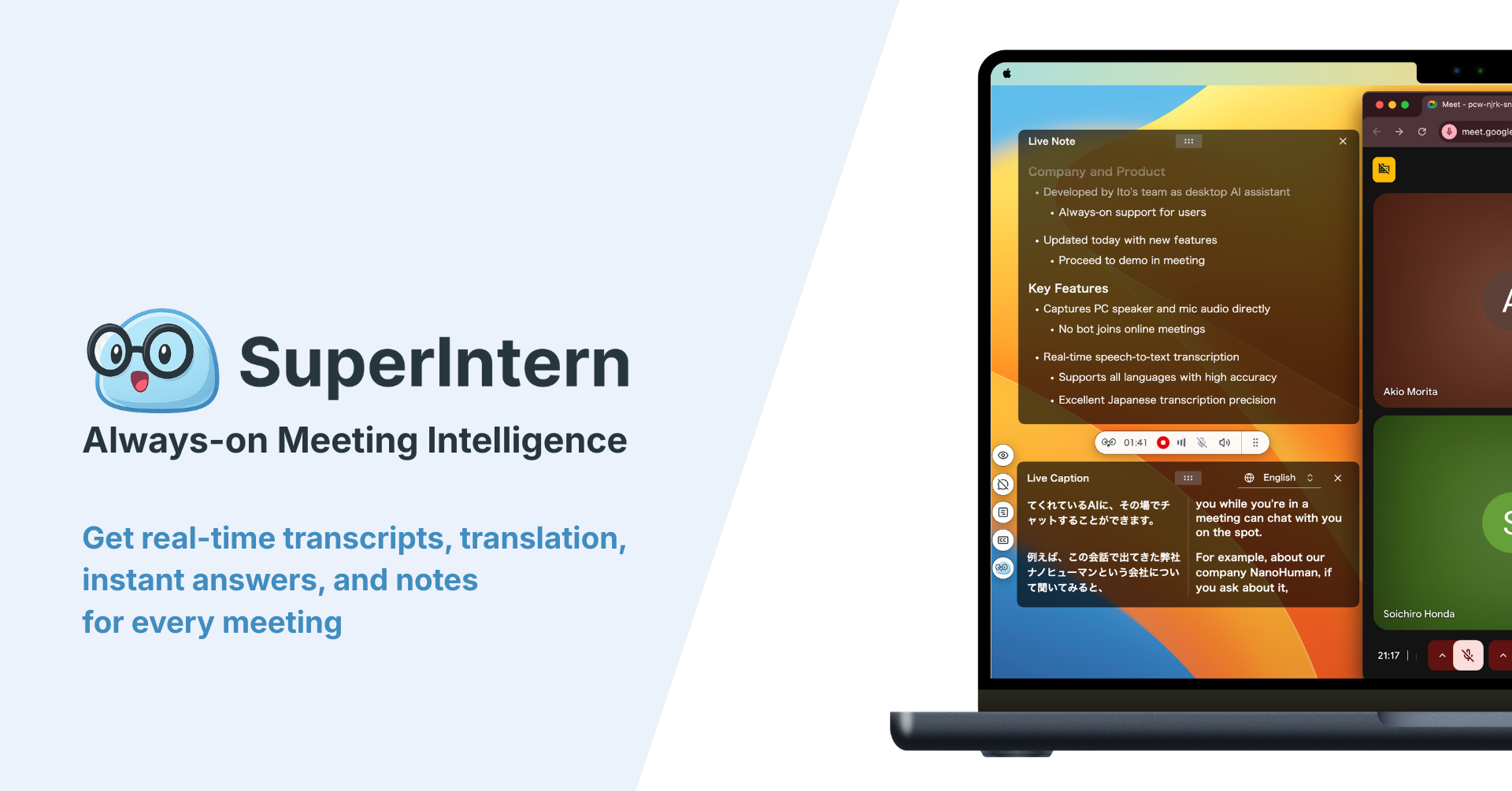
This is where a real-time AI meeting assistant earns its place in the all-hands stack. SuperIntern is a botless desktop app that captures the meeting directly from your computer's audio: no bot joins the call, no "Recording Bot has entered the meeting" moment in front of the whole company, and it works the same whether your all-hands runs on Zoom, Google Meet, Microsoft Teams, Webex, or in a physical room.

For a global all-hands specifically, that changes three things:
- Live captions and translation in 50+ languages. Every attendee follows the CEO's update in their own language, in real time, instead of reconstructing it afterwards. The colleagues who used to nod along silently get to actually participate in Q&A.
- Notes that structure themselves. With AI Canvas, you describe the all-hands format once ("capture announcements, metrics highlights, every Q&A question with its answer, and follow-up items with owners") and every session fills that same structure live.

- A recap that writes itself. After the meeting, the summary can be generated in any language your teams read, and the built-in AI chat answers "what did we say about the pricing change?" for anyone who missed it. You can also upload the recording of a session that was not captured live and get the same searchable notes.
After the meeting: the recap is half the value
The all-hands ends when the recap ships, not when the call closes. A meeting this expensive deserves a written artifact that outlives it:
- Publish notes within 24 hours. Announcements, metric highlights, and every Q&A pair, in the channel where the company actually reads. Absent teammates and future new joiners will thank you.
- Answer the leftovers in writing. Every question that was "taken offline" gets a named owner and a written answer in the same recap thread. This is the single strongest signal that asking questions is worthwhile.
- Localize the recap. If your teams read in three languages, a recap in three languages costs minutes with AI summaries and buys real inclusion.
- Watch two numbers. Live attendance (or live participation rate) and questions submitted per session. Falling questions usually precede falling attendance; both are earlier warnings than any engagement survey.
- Feed the next agenda. Recurring question themes are your employees telling you what the next main story should be.
Common all-hands mistakes to avoid
- Reading out what could have been a memo. Share pre-reading before, use the live time for dialogue and stories.
- Fifteen status slides. Departmental status belongs in writing. One main story per session.
- Live-only Q&A. Without anonymous pre-submission, you get softballs and silence.
- Ignoring the language gap. "Everyone here speaks English" is usually "everyone here stays quiet in English". Captions and translated recaps fix more disengagement than any icebreaker.
- HQ-only scheduling. A permanently inconvenient time slot is a monthly reminder of who matters.
- Skipping the meeting when the news is bad. Cancelling the all-hands in a rough quarter destroys exactly the trust it was building. Hard periods are when the format proves itself.
- No record. If nothing is written down, the meeting happened differently in everyone's memory.
FAQ
What does "all hands" actually mean?
It is short for the naval command "all hands on deck": every member of the ship's crew, whatever their rank or watch, was to report on deck immediately. Companies borrowed the phrase for meetings where the entire crew, from interns to the CEO, is expected in the same room.
What is the difference between an all-hands and a town hall?
In practice the terms often describe the same meeting. Where companies distinguish them, the all-hands is the regular full-company rhythm (updates, demos, Q&A) while a town hall is more Q&A-centric and often tied to bigger, less frequent announcements. Pick one name, define it, and use it consistently.
How often should we hold all-hands meetings?
Weekly or biweekly for small startups, monthly for most companies beyond ~50 people. The deciding factor is the pace of change: the cadence is right when there is always genuinely new content and it never feels like filler.
How long should an all-hands meeting be?
30 minutes for small teams, 45 to 60 minutes for most companies, and only up to 90 for quarterly deep-dives. Reserve at least a quarter of the time for Q&A regardless of total length.
Who should run the all-hands?
A consistent host (often the CEO, a founder, or a chief of staff) owns the rhythm, but the stage should rotate: metrics from finance, the main story from whoever is closest to it, demos from the teams doing the work. One voice for continuity, many voices for content.
Is an all-hands meeting mandatory?
Most companies treat it as strongly expected rather than policed. The healthier lever is making it worth attending and making absence cheap: with a same-day recap, translated notes, and answered Q&A, someone at a customer meeting or in a distant time zone misses the experience but none of the information.
How do we get people to actually ask questions?
Collect questions before the meeting through an anonymous form, answer the uncomfortable ones first, and follow up in writing on anything left open. Live-only Q&A in front of the whole company selects for confidence, not for the questions that matter.
Conclusion
An all-hands meeting is the most expensive hour on the company calendar, and one of the few rituals that can genuinely align a whole organization. The difference between the two outcomes is structure: a stable agenda with one main story, metrics that repeat, a stage that rotates, anonymous pre-submitted Q&A, scheduling and language choices that include the whole company, and a written recap that ships within a day.
If your team spans languages and time zones, the biggest single upgrade is usually invisible in the meeting itself: live translated captions for the people attending in their second language, and structured notes that turn one hour of talking into a record everyone can search, in the language they think in. That is precisely the job a botless assistant does quietly in the background while your all-hands finally gets to be about the conversation.
Try SuperIntern Free: no bot in your all-hands, live captions in 50+ languages, and a structured recap ready the moment the meeting ends.