Assertive Communication: Definition, Techniques, and Examples for Work (2026 Guide)
Most of us know the feeling: you accept a task that doesn't fit in your week, you leave a meeting replaying the thing you didn't say, or you finally speak your mind but in a tone that sets the conversation on fire. Between staying silent and blowing up, there seems to be no middle ground.
That middle ground exists, and it has a name: assertive communication. It is not a personality trait but a skill you can train, with concrete techniques and phrases you can prepare in advance. In this guide you'll see what assertive communication actually is, the four communication styles and how to recognize your default, the traits and rights behind assertiveness, six techniques with examples, how to say no at work without damaging the relationship, exercises to practice, and the most common mistakes people make when they start.
⚠️ This article was independently compiled based on publicly available information and user feedback as of September 2026.
Table of Contents
- What is assertive communication?
- The 4 communication styles: passive, aggressive, passive-aggressive, and assertive
- Traits of assertive communication and the assertive rights
- Assertive communication, effective communication, and active listening
- The 6 assertive communication techniques
- Examples and ready-to-use phrases
- How to say no at work
- Assertive communication in meetings
- Exercises and a 4-week training plan
- Common mistakes when practicing assertiveness
- How AI helps you train your assertiveness
- Frequently asked questions
- Conclusion
What is assertive communication?
Assertive communication is the ability to express what you think, feel, and need in a clear, direct, and respectful way: standing up for your position without attacking the other person, and without abandoning it just to avoid conflict. The word comes from the Latin "asserere", to affirm: affirming yourself without negating the other person.
The concept comes out of behavioral psychology between the 1950s and 1970s, from the assertiveness training of Andrew Salter and Joseph Wolpe and the later work of Robert Alberti and Michael Emmons, who framed it as an alternative that is just as firm as aggression but far healthier. Half a century later, assertiveness shows up in every serious leadership program, for a practical reason: teams where people can disagree without fear make better decisions.
It's worth being clear about what assertiveness is not. It is not saying everything you think with no filter: that has a different name. It is not a formula for winning every argument: sometimes the assertive outcome is an explicit, well-managed disagreement. And it is not toughness: the most assertive people are usually the ones who least need to raise their voice.
The 4 communication styles: passive, aggressive, passive-aggressive, and assertive
The fastest way to understand assertiveness is to compare it with the three other classic styles. Almost everyone uses all four depending on the day and the person; the useful question is which one is your default under pressure.
| Style | Implicit motto | What it sounds like | Typical cost |
|---|---|---|---|
| Passive | "You matter, I don't" | "It's fine, I'll handle it..." | Overload, accumulated resentment, invisibility |
| Aggressive | "I matter, you don't" | "This is wrong, that's not how it's done" | Fear around you, information that stops reaching you |
| Passive-aggressive | "I won't say it, but I'll make you pay" | "No, no, it's fine, whatever you think..." (then the sarcasm) | Confusion, distrust, conflicts that never end |
| Assertive | "We both matter" | "I see a problem with X, I propose Y, what do you think?" | Momentary discomfort, relationships that improve |
Two nuances the tables usually leave out. First: the passive style isn't kindness, it's postponement. What goes unsaid today comes back a month later as an outburst or a resignation letter. Second: the aggressive style sometimes gets short-term results, which is exactly why it persists; the bill arrives later, when the team stops telling you about problems in time.
Assertiveness is the only one of the four styles that protects both the relationship and the message. That's why it costs more effort: it demands knowing exactly what you want to say and saying it while taking care of the other person, two jobs instead of one.
Traits of assertive communication and the assertive rights
How do you recognize someone who communicates assertively? These six traits capture the essentials.
- They speak in the first person. "I see", "I need", "I'm concerned about", instead of "you always". The message describes their experience, not the other person's character.
- They describe facts, not judgments. "The report arrived two days late" instead of "you're hopeless with deadlines". Facts can be discussed; judgments can only be denied.
- They make concrete requests. An assertive request has a what, a who, and a when: "can you send me the draft by Thursday noon?".
- They hold their message calmly. They can repeat their position without raising their voice and without apologizing for having one.
- They listen to the response. Assertiveness without listening is just a firm monologue. You state your position and explore the other person's.
- They mind the delivery. Calm tone, eye contact, no irony. In assertive communication, the how is part of the what.
The assertiveness training tradition sums up the foundation of all this in the so-called assertive rights. Some of the most cited, in a workplace version:
- You have the right to express your opinion and to disagree.
- You have the right to say "no" without feeling guilty.
- You have the right to ask for what you need (and others have the right to decline).
- You have the right to change your mind when new information arrives.
- You have the right to make mistakes and to take responsibility for them.
- You have the right to say "I don't know" and "I don't understand".
The list works in both directions: these are your rights and also the rights of the person in front of you. That's the difference from aggression, which claims its own rights while trampling everyone else's.
Assertive communication, effective communication, and active listening
The three terms travel together in every soft-skills training and are easily confused. They are not synonyms: each answers a different question.
| Concept | Question it answers | Focus |
|---|---|---|
| Assertive communication | Did I express my position clearly and respectfully, without attacking or going silent? | The sender's style |
| Effective communication | Did the message arrive, get understood, and produce the intended effect? | The outcome of the exchange |
| Active listening | Did I truly understand what the other person said and feels? | Receiving the message |
In practice they work as a circuit: you listen actively to understand the terrain, you state your position assertively, and you verify that the message produced the effect you intended. A team can be very assertive and still communicate terribly if nobody listens; or great at listening but incapable of saying an uncomfortable truth. This guide covers the assertive piece; the other two have their own guides linked in the table.
The 6 assertive communication techniques
These six techniques cover most workplace situations. The first three help you build your message; the last three help you hold it when pressure arrives.
- I-messages. The basic structure of assertiveness: fact + effect + request, in the first person. "When the agenda arrives the same day (fact), I don't have time to prepare the numbers (effect). Could we close it the day before? (request)". Compare that with "you never give us notice", which opens with a judgment and closes the conversation.
- The DESC method. The extended version for difficult conversations, in four steps: Describe the fact, Express how it affects you, Specify a concrete change, and state the positive Consequences of that change. "The last two deliveries arrived unreviewed (D). That forces me to redo them at night (E). I propose a quick review before sending (S). That way we avoid the end-of-month scramble (C)".
- Saying no with an alternative. The assertive "no" names the real reason and, when one exists, offers an honest alternative: "I can't take this project this week. I can start Monday, or if it's urgent, which of my current tasks should we deprioritize?". No invented excuses, which get found out, and no resigned "yes", which you pay for later.
- Broken record. Calmly repeating your core message, in the same or similar words, when the other person keeps pushing. "I understand it's urgent, and I can't deliver it before Thursday". Two or three calm repetitions defuse most pressure without escalating the tone.
- Fogging. When facing an aggressive or exaggerated criticism, acknowledge the part that may be true without swallowing the whole package: "It's true the deadline mattered and we were late. I don't agree that the team doesn't care about the client". You accept the fact and reject the judgment.
- Assertive postponement. When a conversation catches you heated or without data, postponing is an answer, not an escape: "I'd rather answer with the numbers in front of me. Can we look at it first thing tomorrow?". Assertiveness doesn't require answering everything on the spot; it requires actually coming back to the topic.
None of these techniques require charisma or a special temperament. They require preparation, especially at the beginning: the assertive phrase rarely comes out on its own under pressure, and preparing it before the conversation isn't cheating, it's training.
Examples and ready-to-use phrases
Theory fades; phrases stick. Five frequent workplace situations, with the passive, the aggressive, and the assertive version.
| Situation | Passive version | Aggressive version | Assertive version |
|---|---|---|---|
| Another task lands on your full plate | "Okay, sure, I'll fit it in somehow" | "Can't you see I'm buried already?" | "I have three deliverables due Friday and a fourth doesn't fit. Which one do we prioritize?" |
| Disagreeing with the plan in a meeting | (silence, then hallway comments) | "That plan makes no sense" | "I see a risk: we depend on a vendor with no confirmed date. How do we cover that?" |
| Being repeatedly interrupted | (stop talking) | "Will you let me finish?" | "Let me close this thought, and then I want to hear you" |
| Asking for a raise or review | (waiting to be noticed) | "Give me a raise or I'm gone" | "This year I took on X and Y with these results. I'd like to discuss revisiting my salary band" |
| Feedback to a colleague who joins meetings late | (put up with it, complain to others) | "You're always late, as usual" | "The last three standups started 10 minutes late waiting for you. What's going on? How do we fix it?" |
Notice the pattern in the assertive column: a concrete fact, the effect or risk, and a request or question that hands the ball back constructively. No put-downs, and no apologizing for existing.
One longer example, of the kind that happens every week. Your manager messages you at 6:40 pm: "I need the analysis first thing tomorrow". The passive answer is staying until midnight; the aggressive one, a curt "impossible". The assertive version sounds like this: "I can't get to it today: I'm on the client A close until 7 pm. I can have it ready by noon tomorrow, or send you just the key takeaways tonight and the full detail tomorrow. Which do you prefer?". A clear limit, two real alternatives, and a shared decision. That's assertiveness applied: less heroism, more clarity.
How to say no at work
Saying no is the final exam of assertiveness, and where the difference between styles shows most. A four-step method that works in most cases:
- Acknowledge, without irony. "Thanks for thinking of me for this."
- Say the no with the real reason. "I can't take it this week: I'm closing the migration and it's eating my afternoons." One true, short reason; three paragraphs of explanation sound like an excuse.
- Offer an alternative if one exists. "I can start Monday, or Marta knows this area if it's urgent." If no alternative exists, don't invent one.
- Close without reopening. The classic mistake is adding "well, if it's really urgent, let me know...", which undoes the previous three steps. If the other person insists: broken record, same message, same calm.
Two notes on context. With your direct manager, a "no" usually works better as a priority negotiation than as a flat refusal: "yes to this, what do we drop?". And in strongly hierarchical work cultures, form carries more weight: the same boundary can be set with more preamble while staying just as clear. Assertiveness isn't one universal tone; it's clarity plus respect, adjusted to context.
Assertive communication in meetings
Meetings are where a lack of assertiveness gets most expensive: the question nobody asks, the risk nobody names, and the disagreement saved for the hallway all cost money. Some concrete practices:
- Claim your turn out loud. In fast meetings, waiting for the perfect gap equals not speaking. "Before we close this point, I'd like to add something" is a complete assertive sentence.
- Disagree with the content, not the person. "I see a problem in the estimate" opens a debate; "what you're saying makes no sense" opens a war. Assertive disagreement attacks ideas and protects people.
- Name what's happening in the room. Part of the assertive job is meta-communication: "We've spent twenty minutes on a five-minute agenda item" or "I think we're deciding without the data we asked for last week".
- Voice your disagreement before the final decision. Silence in a meeting reads as agreement. If you disagree, the meeting is the moment: the hallway disagreement arrives late and smells passive-aggressive.
- On video calls, dial up the explicitness. Without full body language, turn-taking and disagreement need words: "I'd like the floor", "I want to push back on this", "I need two minutes to think". What you do with your body in person, you say out loud online.
There is also a silent prerequisite: to disagree well you need to be in the conversation, not on your keyboard. The person typing the minutes rarely challenges anything. We'll come back to that in the AI section.
Exercises and a 4-week training plan
Assertiveness trains like any other skill: with small repetitions in low-risk situations before jumping to difficult conversations. Four proven exercises:
- The swallowed-words log (solo, starting today). For one week, note every situation where you kept quiet about something you wanted to say or accepted something you wanted to refuse. No self-judgment: just the data. The list tells you exactly where to train.
- One I-message a day. Pick one small situation each day and formulate a complete I-message: fact, effect, request. Writing counts: chat is an excellent low-risk gym for assertiveness.
- The small no. Practice the four-step method on low-cost refusals: the meeting with no agenda, the favor that isn't yours to do, the call that could be a message. The big "no" comes out better once the small ones are routine.
- Transcript review (advanced). After an important meeting, review the transcript and find your own contributions: how many started with an apology ("sorry, just a tiny thing...")? How many times did you soften your position until it dissolved? Did you disagree in the room or stay silent? Real data cures self-image faster than any course.
In order, over one month:
| Week | Exercise | Goal |
|---|---|---|
| Week 1 | Swallowed-words log | Locate your difficult situations and people |
| Week 2 | One I-message a day | Automate the fact + effect + request structure |
| Week 3 | The small no | Lose the fear of refusing in low-risk settings |
| Week 4 | Transcript review | Measure your real assertiveness in meetings, with data |
Common mistakes when practicing assertiveness
- Confusing assertiveness with harshness. The newly converted sometimes debut their boundaries like someone showing off a new hammer. Firmness without care for the relationship is aggression with a new vocabulary.
- Being assertive only downward. Setting limits with the intern while going quiet with the director isn't assertiveness, it's hierarchy. The real training happens upward and with peers.
- Apologizing until the message dissolves. "Sorry to bother you, this might be silly, but..." Three apologies before the message tell the other person that even you don't believe it.
- Always choosing the public moment. Difficult feedback in the team meeting humiliates more than it communicates. Assertiveness includes choosing the channel: delicate topics in private, team-wide topics in the room.
- Expecting immediate results. Your environment takes time to recalibrate. The first refusals from a habitually passive person surprise and even annoy; by the third, they've become your new normal for everyone.
- Using the techniques as weapons. Broken record as a way to never listen, or fogging as sarcasm, turn dialogue tools into trenches. Assertiveness defends your position and the conversation at the same time.
How AI helps you train your assertiveness
There's a part of assertiveness no tool can do for you: setting the boundary, saying the no, holding the disagreement. And there are two parts where AI helps more than you'd expect: freeing your attention during the conversation, and giving you real data about how you actually speak.
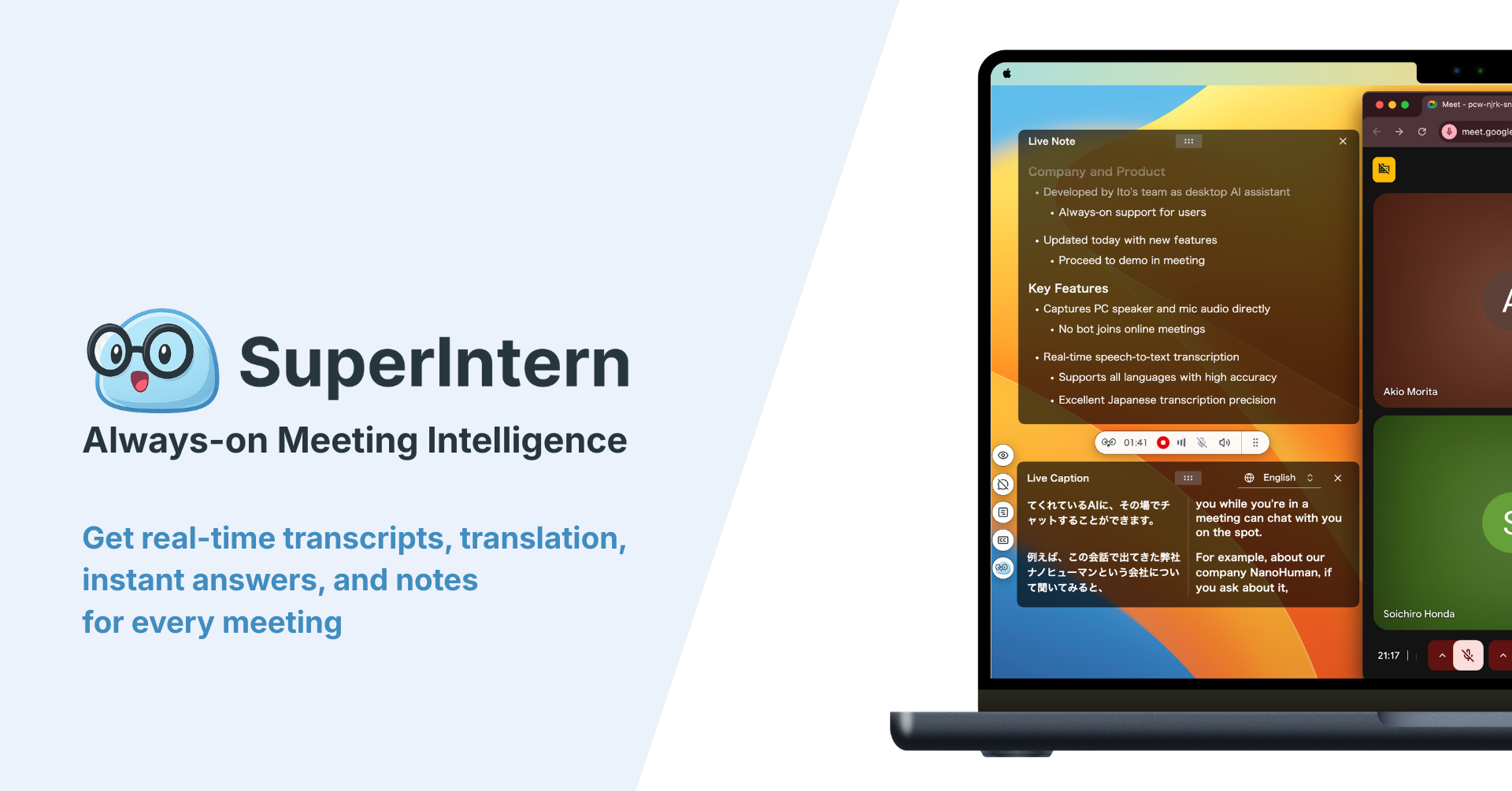
SuperIntern is a botless desktop app for Mac and Windows that captures audio directly from your device: no bot joins the call, so it works the same in Zoom, Google Meet, Microsoft Teams, Webex, and in-person meetings.

For training assertiveness specifically, three pieces matter:
- Live notes that write themselves. The AI Canvas builds a structured note in real time (decisions, tasks, open points) following whatever structure you describe in plain language. With your hands free from the minutes, your attention goes back where assertiveness needs it: following the conversation, claiming your turn, and disagreeing in time.
- Speaker-labeled transcripts to see yourself from the outside. The transcript identifies who said what, so the advanced exercise in the training plan runs on data: how many of your contributions started with an apology, how much you spoke versus how much you swallowed, whether your disagreement was voiced in the room or never existed. Few things teach as much as reading yourself being passive.
- Real-time subtitles and translation. Being assertive in your second language is doubly hard: the cognitive load of the language eats the energy you need for the boundary. With subtitles and translation across 50+ languages, that load drops and your clarity returns.
The limits, stated honestly: AI won't say the "no" for you, and the difficult conversation you're postponing will still be there. What it removes is the toll that makes it harder: the minutes that distract you, the selective memory, and the lack of data about your own style. There's a free plan, so you can try it in your next meeting at no cost.
Frequently asked questions
What is assertive communication, in a nutshell?
It's expressing what you think and need in a clear, direct, and respectful way, without attacking the other person and without going silent to avoid conflict. It rests on concrete techniques (I-messages, DESC, broken record) and improves with deliberate practice.
What are the most common assertive communication techniques?
Six cover most situations: I-messages, the DESC method, saying no with an alternative, the broken record, fogging, and assertive postponement. The first three build the message; the last three hold it under pressure.
Can you give an example of assertive communication at work?
When a new task lands on a full plate: "I have three deliverables due Friday and a fourth doesn't fit. Which one do we prioritize?". It names the fact, states the effect, and returns a constructive question, without the resigned "yes" or the reproach.
What's the difference between assertive and effective communication?
Assertiveness describes the sender's style: expressing your position clearly and respectfully. Effectiveness describes the outcome: the message arrives, is understood, and produces the intended effect. They complement each other, together with active listening.
How can I become more assertive at work?
Start small: one week logging what you swallow, one I-message a day, and low-risk refusals before difficult conversations. Reviewing your meeting transcripts to count apologies, interruptions, and voiced disagreements speeds it up with real data.
Is being assertive the same as being blunt?
Not quite. Bluntness without care for the relationship reads as aggression and usually closes the conversation. Assertiveness is direct about content and careful about form: concrete facts, first person, and respect for the other person's position.
How do I say no to my boss without looking bad?
Turn the refusal into a priority negotiation: "I can take it, what do we deprioritize to make it fit?". You name your limit with the real reason, offer honest alternatives, and leave the final decision shared. It's a no to the impossible, not a no to the person.
Conclusion
Assertive communication is not a trait you're born with: it's the skill of defending your position while protecting the relationship, and it's built from concrete pieces. I-messages, facts before judgments, requests with dates, a method for saying no, and two or three techniques to hold the message under pressure. Nothing on that list requires a personality transplant.
Start with the one-week log: knowing what you swallow and with whom is worth more than any theory. And in your meetings, leave the minutes to AI so you can invest your attention where no tool can reach: saying, calmly and in time, what you actually think.
Try SuperIntern Free : Botless live meeting notes, so AI writes while you hold your ground.