Brainstorming That Actually Works: Rules, Techniques, Steps, and a Template (2026 Guide)
Almost everyone has sat through a brainstorming session that produced no ideas worth keeping. Someone writes a question on the whiteboard, the two most extroverted people talk for forty minutes, everyone else nods, and the meeting ends with three vague concepts nobody ever looks at again. The usual conclusion, "brainstorming doesn't work," is wrong. What doesn't work is the improvised version.
A well-run brainstorm is a different animal: a deliberate structure that separates generating ideas from judging them, gives quiet voices the same floor time as loud ones, and ends with a short list of ideas selected on explicit criteria, each with an owner and a next step.
This guide covers what brainstorming actually is and where it comes from, how to run a session step by step, seven techniques to choose from depending on your situation, a template you can copy today, the mistakes that quietly ruin most sessions, and how to capture every idea without assigning anyone to be the scribe.
⚠️ This article was independently compiled based on publicly available information and user feedback as of August 2026.
Table of Contents
- What is brainstorming?
- How to run a brainstorming session: 6 steps
- 7 brainstorming techniques and when to use each
- A copy-paste brainstorming template
- 5 mistakes that kill a brainstorm, and their fixes
- Brainstorming with remote and multilingual teams
- A pre-session checklist
- Capturing every idea without a scribe: the AI workflow
- Frequently asked questions
- Conclusion
What is brainstorming?
Brainstorming is a group creativity technique built on one core principle: separating two incompatible mental activities, generating ideas and judging them. During the generation phase, every idea counts and none gets criticized. Only afterwards, in a distinct phase, does the group evaluate, combine, and select.
The term was popularized by Alex Osborn, an advertising executive and co-founder of the agency BBDO, in his book "Applied Imagination" (1953). Osborn had noticed that conventional meetings suffocated new ideas because every proposal was evaluated the moment it was born, and he formulated four rules that remain the foundation of any serious session.
Osborn's 4 classic rules
- Defer judgment. No "we tried that already" or "there's no budget" during generation. Criticism has its moment, and it comes later.
- Go for quantity. The goal is the raw number of ideas. The first twenty are usually the obvious ones; the interesting ones show up once the obvious is already on the table.
- Welcome wild ideas. An impractical idea often contains the seed of a practical one. Taming a wild idea is easier than amplifying a timid one.
- Build on the ideas of others. "Yes, and..." turns a pile of individual suggestions into collective reasoning.
It's also worth knowing what decades of later research have added: groups that take turns talking generate fewer ideas than the same people writing in silence, because while one person speaks, nobody else can think (researchers call this production blocking). That's why the best modern sessions combine silent individual writing with group discussion, instead of just opening the floor and hoping.
How to run a brainstorming session: 6 steps
Budget 45 to 60 minutes for a group of four to eight people.
Step 1: Frame the right question (before the session). A brainstorm succeeds or fails in its prompt. "Ideas to improve the product" is too broad; "how do we cut the price" is too narrow. The format that works best is "How might we...?": specific about the problem, open about the solution. Send the question a day ahead; people's best ideas tend to arrive in the shower, not in the room.
Step 2: Set the frame (5 min). Restate the question, announce the four rules, and set an explicit quantity target: "we want 40 ideas in the next 20 minutes." A numeric goal gives people permission to offer half-baked ideas, which is exactly what you want.
Step 3: Silent individual generation (10 min). Everyone writes their own ideas independently, on sticky notes or in a shared document. This phase is the one improvised sessions skip, and it contributes the most ideas: it removes production blocking and protects people who won't compete for airtime.
Step 4: Share and build (15 min). Ideas are shared in rounds, one person and one idea at a time. The facilitator invites building: "can anyone take this one step further?" This is where talking earns its keep, because combinations across different people's ideas are the ones nobody would have produced alone.
Step 5: Cluster and select (10 min). Group related ideas and name each cluster. Then vote: the simplest scheme gives each person three votes. To decide among finalists, an impact-versus-effort matrix quickly separates the attractive from the viable.
Step 6: Assign next steps (5 min). A brainstorm without next steps is entertainment. Every selected idea leaves the room with an owner and one small concrete action: "run a one-week test," "estimate the cost," "show the prototype to three customers."
7 brainstorming techniques and when to use each
The classic session is not the only tool. These seven variants cover most real situations:
| Technique | How it works | Best fit |
|---|---|---|
| Classic brainstorming | Free group generation under the 4 rules | Small, high-trust groups with a good facilitator |
| Brainwriting 6-3-5 | 6 people write 3 ideas in 5 minutes, then pass the sheet | Groups with dominant voices or quiet profiles |
| Reverse brainstorming | Ask "how could we make this worse?" then invert the answers | Stuck teams or overly familiar problems |
| SCAMPER | 7 systematic prompts: substitute, combine, adapt, modify, put to other uses, eliminate, rearrange | Improving an existing product or process |
| Mind mapping | Visual branching from a central problem | Exploring a new topic and spotting connections |
| Crazy 8s | 8 sketches in 8 minutes per person | Interface ideas, design, visual concepts |
| Starbursting | Generate questions (what, who, when, where, how, why) before answers | Stress-testing a chosen idea and finding gaps |
Three usage notes:
- Brainwriting is the cheapest upgrade. If you change only one thing about your sessions, add the ten minutes of silent writing. The research is consistent: groups that write first generate more ideas and more varied ones.
- Reverse brainstorming unlocks skeptical rooms. People struggle to propose improvements but love listing everything that could go wrong. "How would we make sure no customer ever renews?" produces a long list that, inverted, is a retention plan.
- SCAMPER needs a concrete object. It doesn't work on abstract questions; it shines when there's a product, a page, or a process in front of the group to run through the seven operations.
A copy-paste brainstorming template
Paste this into your shared document and use it as the session script:
# Brainstorm - [Topic] - [Date]
Question: How might we [specific problem]?
Participants: [names]

## Session rules
- Judgment is deferred; critique comes later
- Target: [40] ideas in [20] minutes
- Wild ideas welcome; build on each other's ideas

## Phase 1: Individual ideas (10 min, in silence)
- [one idea per line]

## Phase 2: Sharing and combinations (15 min)
- [new ideas that emerged from building on others]

## Phase 3: Clusters and voting (10 min)
- Cluster A [name]: [ideas] - votes: [n]
- Cluster B [name]: [ideas] - votes: [n]

## Selected ideas and next steps
- [ ] [Idea] - Owner: [name] - Next step: [small concrete action] - Due: [MM/DD]
Two usage notes:
- The question sits at the top on purpose. If you can't write it in one line in the "How might we...?" format, the session isn't ready to be scheduled.
- The last section is the one that matters. A template full of ideas with an empty next-steps section is the most common failure mode, and the most silent one.
5 mistakes that kill a brainstorm, and their fixes
- Judging during generation. A single "that wouldn't work" early in the session visibly shrinks what people dare to propose afterwards. The facilitator's job is to stop critique on the spot and park it for the evaluation phase.
- Starting with talk instead of writing. If the session opens with free discussion, the first idea spoken out loud anchors the whole room, and the output converges toward whatever the highest-status person said. Silent writing first is the antidote.
- Inviting too many people. Beyond eight participants, per-person airtime collapses and the session turns into a presentation. For big topics, split into parallel groups of four or five and merge the results.
- Ending without selecting. Closing with "great material, we'll review it later" throws the session away. Selection and next-step assignment happen inside the meeting, while the context is still fresh.
- Not recording the discussion. Whiteboard photos can't be searched, and whoever gets assigned to take notes misses half the conversation. The idea combinations, usually the most valuable output, live in the spoken discussion nobody wrote down. The AI workflow below solves exactly this.
Brainstorming with remote and multilingual teams
Remote brainstorming has a bad reputation it no longer deserves. The modern format actually fits remote better than a conference room: silent writing works naturally in a shared document, dot voting is one click, and nobody has to decipher handwriting on a whiteboard.
Three adjustments make it work:
- Shared document before video call. Generation happens in writing, cameras on but microphones muted. The video call is reserved for the building and selection phases, which are conversational.
- Explicit turns during sharing. Interruptions cost more on a call, and silences feel awkward sooner. A round with a fixed order gives everyone their space without negotiating for the floor.
- In multilingual teams, the barrier isn't creativity but language. Proposing a half-formed idea already takes courage; doing it in a second language, in front of the team, takes double. Real-time captions and translation let each person propose in the language they think in, and that single difference changes who participates.
A pre-session checklist
When a brainstorm goes wrong, the outcome was usually decided before it started. Run through these eight points before sending the invite:
- Does the question fit on one line in the "How might we...?" format?
- Was the question sent to participants at least one day ahead?
- Are there four to eight participants, including at least one person from outside the problem's team?
- Is the silent writing phase scheduled, with a shared document or sticky notes ready?
- Is there a designated facilitator who is not the most senior person in the room?
- Have the numeric idea target and the generation time limit been announced?
- Is the selection method decided (votes per person, impact-versus-effort matrix)?
- Are at least ten minutes of the agenda reserved for assigning owners and next steps?
One tip for the first session in this format: announce the rule change explicitly. If the team expects the usual improvised brainstorm, the opening silence feels odd for about two minutes, and then becomes the part nobody wants to give up.
Capturing every idea without a scribe: the AI workflow
The structural weak point of any brainstorm is the record. Written ideas survive on the sticky notes, but the most valuable part of the session, the combinations and nuances that emerge in conversation, evaporates when the meeting ends. And appointing a scribe means removing that person from the creative work.
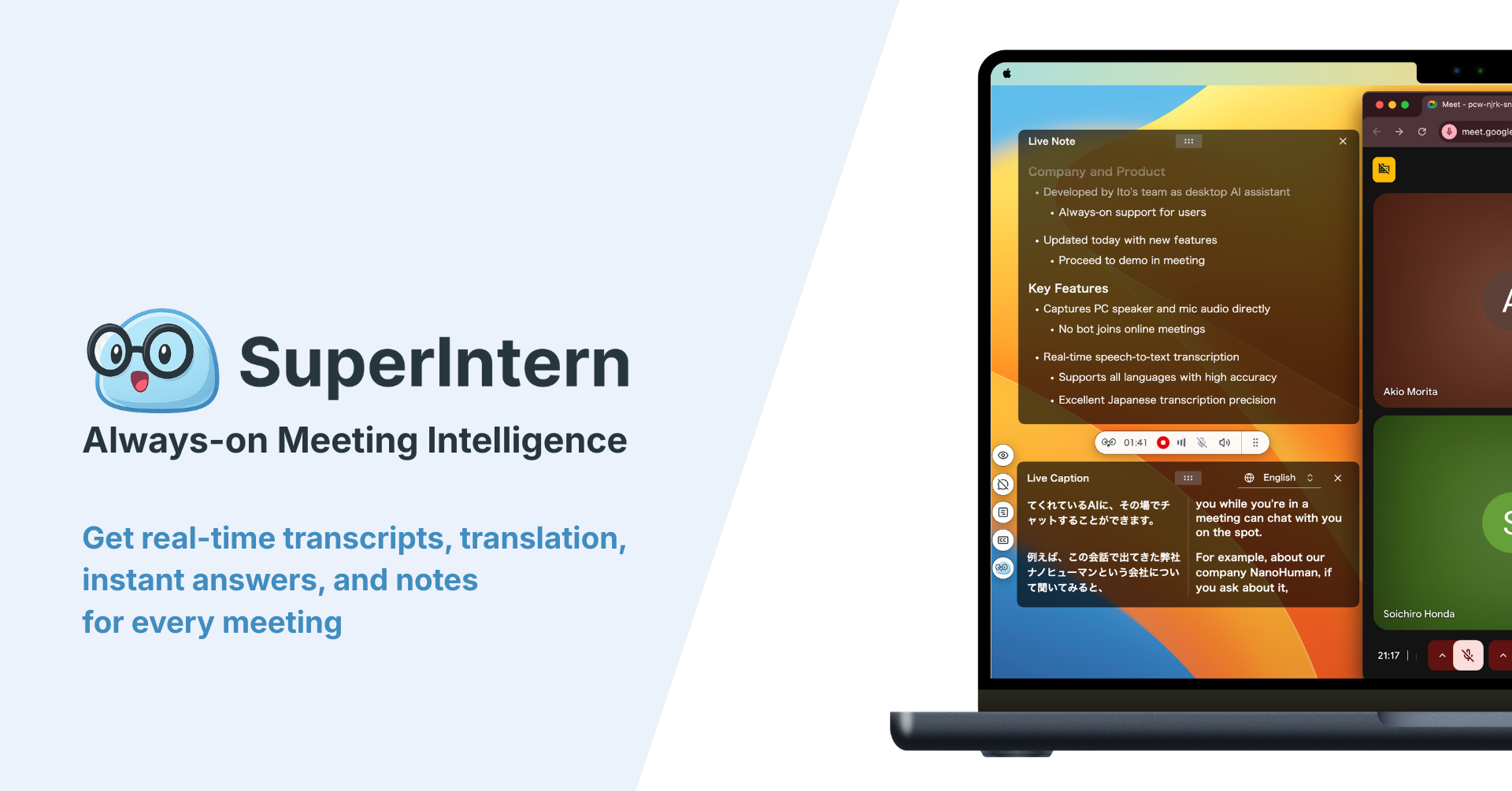
This is where a real-time AI meeting assistant fits. SuperIntern is a botless desktop app (Mac and Windows) that captures the meeting directly from device audio. No bot joins the call, so it works the same whether your session runs on Zoom, Google Meet, Microsoft Teams, or Webex, or the group is standing at a physical whiteboard with a laptop listening.

For a brainstorm specifically:
- Teach AI Canvas your format once. Describe it in plain language: "This is a brainstorming session. Record every idea proposed, cluster related ones, and list selected ideas separately with their owner and next step." Every session after that fills itself in live, in that structure.
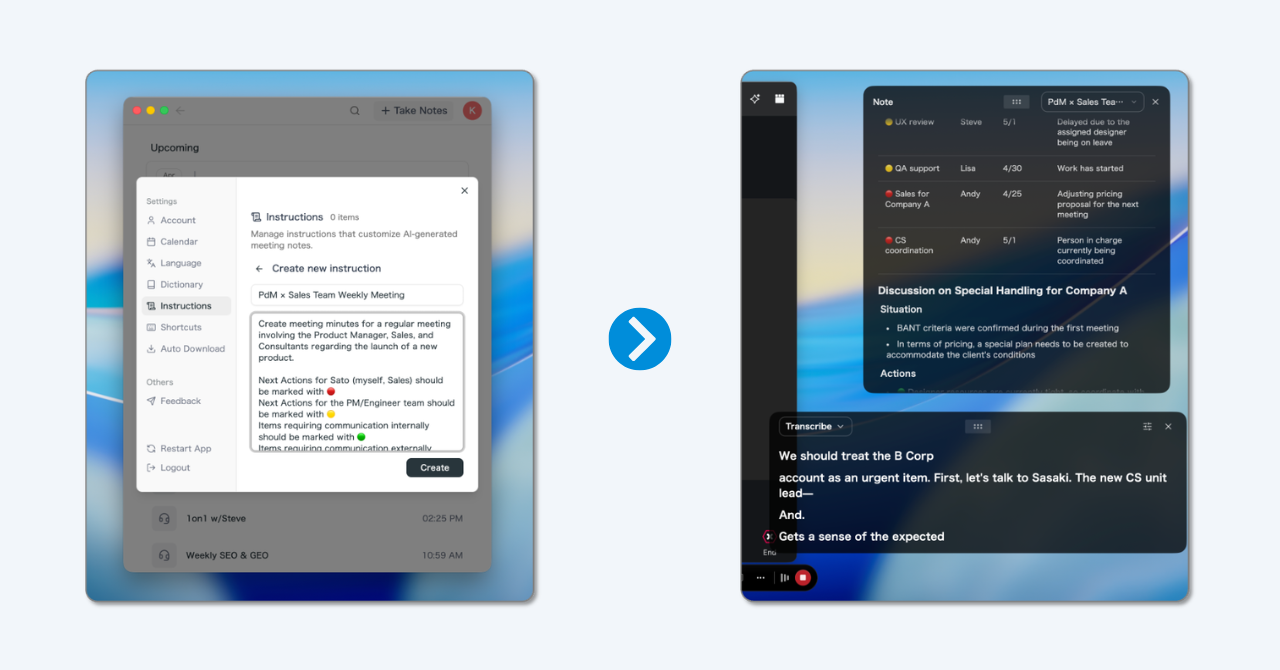
- Nobody plays scribe. The whole group participates in the creative work, which is what the meeting was called for.
- Spoken ideas don't get lost. The "yes, and we could also..." someone says while another person presents gets recorded in real time, with its author identified through speaker diarization.
- The evaluation phase has raw material. After the session, ask the AI chat: "List every idea from the session grouped by theme, and flag the ones that got the most positive reactions."
- Multilingual teams propose in their own language. Real-time translation across 50+ languages lets each person think out loud in their own words, and everyone gets the summary in theirs.
One honest caveat: SuperIntern is a desktop app focused on live meetings and their notes. It doesn't replace a visual sticky-note whiteboard or a project tracker; many teams pair it with their usual whiteboard and use SuperIntern MCP to turn selected ideas into tickets from agents like Claude. There's a free plan, so trying it in your next session costs nothing.
Frequently asked questions
What is brainstorming and what is it for?
It's a group creativity technique that separates idea generation from evaluation. It exists to produce a high volume of options for a specific problem, with the whole group participating, before deciding on explicit criteria which ones to pursue.
What are the 4 rules of brainstorming?
Formulated by Alex Osborn: defer judgment, go for quantity, welcome wild ideas, and build on the ideas of others. They all serve the same purpose: protecting the generation phase from premature criticism.
How many people should take part?
Four to eight. Below four you lack perspectives; above eight, per-person participation time collapses. For large groups, the effective pattern is parallel subgroups that merge their results.
How long should a session last?
45 to 60 minutes, with the generation phase capped at 20 to 25. Idea generation is intense and burns out fast; two short sessions a few days apart produce more than one two-hour marathon.
Which is better, brainstorming or brainwriting?
They don't compete: brainwriting (writing ideas in silence) is the best opening phase of a modern brainstorm. Silent writing generates more and more varied ideas, and the group discussion afterwards combines and amplifies them. Use both, in that order.
Does brainstorming work alone?
Yes, and it's a good complement. Individual generation avoids group anchoring, which is why the silent phase exists at all. What the group session adds is cross-building: combinations no single person would have reached. The ideal is alternating both.
Conclusion
Brainstorming isn't broken; the improvised version is. The conditions for a session that produces results fit on one hand: a well-framed "How might we...?" question, silent individual writing before anyone talks, the four rules actually enforced, selection by votes and matrix inside the meeting itself, and an owner plus next step for every chosen idea.
And the record that holds it all together no longer requires sacrificing anyone: a botless AI assistant captures every idea, spoken or built on someone else's, while the entire group does what the meeting was called for: thinking.
Try SuperIntern Free : no bots in your meetings, every idea captured live in your format, and the selected ones turned into next steps.