Decision-Making at Work: Process, Frameworks, and How to Decide Better (2026 Guide)

Think about the last important decision your team made. Can you say who made it, which options were on the table, and why that one won? If your honest answer is "sort of," you are in the majority. In most organizations decisions get made, forgotten, reopened, and litigated all over again, and every lap costs meetings, energy, and trust.
Decision-making is a skill you can structure and train, not a talent reserved for executives with good instincts. This guide covers what decision-making actually is, why deciding as a group is so hard, the seven-step process, the most useful frameworks (from the weighted decision matrix to DACI), the biases that distort judgment, how to run a decision meeting that ends with an actual decision, and how to record it so nobody reopens it three weeks later.
⚠️ This article was independently compiled based on publicly available information and user feedback as of September 2026.
Table of Contents
- What is decision-making?
- Why deciding at work is so hard
- The decision-making process in 7 steps
- Types of decisions and how to classify them
- Frameworks and techniques for better decisions
- Who decides: assigning decision authority
- Biases and mistakes that sabotage decisions
- The decision meeting: how to prepare and run it
- The decision log almost nobody keeps
- How AI helps teams decide better in meetings
- Checklist: is this decision actually made?
- Frequently asked questions
- Conclusion
What is decision-making?
Decision-making is the process of identifying a problem or opportunity, generating and evaluating alternatives, and committing to a course of action along with its consequences. The key word is process. Deciding is not the instant someone says "let's do this." It is everything that leads up to that moment and everything that happens right after, when the decision gets communicated, recorded, and executed.
At work, that definition has an immediate practical consequence. If deciding is a process, it can be designed: who participates, what information is needed, how much deliberation the stakes deserve, and who has the final call. Teams that decide well are not the ones with the smartest person in the room. They are the ones that made that design explicit.
It is worth being clear about what decision-making is not. It is not the pursuit of certainty: almost no work decision offers it, and waiting for it has a cost of its own. It is not getting everyone to agree: full consensus is one method among several (and one of the most expensive), not the goal. And it is not a purely rational act. Decades of decision psychology show that intuition, emotion, and bias are always in the room; the question is whether you manage them or they manage you.
Why deciding at work is so hard
Deciding alone is hard enough. Deciding as a team adds three layers of friction that explain most of the stalls.
- Nobody knows who decides. This is the number one cause of the never-ending decision. When authority is unassigned, every meeting ends in "let's keep discussing," because nobody has the mandate to close. The debate repeats with the same arguments until someone senior cuts it short, often late and with less information than the team already had.
- The information is scattered. The person who knows the customer is not in the meeting, the person who knows the technical cost was not invited, and the decision gets made with half the map. The typical outcome is not an obviously bad decision but a reasonable decision built on incomplete premises, which falls apart weeks later.
- Deciding has a social cost. Every real decision leaves options discarded and people less than happy. Postponing avoids that cost today, which is why postponing is so tempting: indecision dresses up as prudence. But not deciding is also a decision, usually in favor of the status quo, with nobody accountable for it.
On top of these frictions sits a quieter problem: most organizations have no memory of their decisions. Something gets decided in a meeting, the minutes never capture it (or never exist), and a month later the same question is back on the table. The symptom is easy to recognize. If your team is debating something and you have the distinct feeling you have had this exact conversation before, you do not have a judgment problem. You have a record-keeping problem.
The decision-making process in 7 steps
The classic decision-making process has seven steps. You do not need the full version for every decision (we will get to calibration shortly), but knowing it lets you diagnose where yours breaks down.
- Define the decision. State in one sentence what is being decided, by when, and what happens if nothing is decided. "Choose the support vendor for 2027 by October 15" is a decision; "talk about the support situation" is not. Half of all failed decision meetings fail right here, before they start.
- Gather the relevant information. Data, constraints, prior experience, and above all the people who hold context. The useful question is "what information would change my choice?", which is different from "what information exists?". Chasing all available information is the recipe for paralysis.
- Generate alternatives. At least three real options, almost always including "do nothing," which is the baseline everything else gets compared against. If only one option is on the table, there is no decision to make, only a ratification.
- Evaluate the alternatives. Against explicit criteria: cost, risk, reversibility, timeline, strategic fit. This is where the frameworks in the next section live, from the pros-and-cons list to the weighted matrix.
- Choose. Someone with assigned authority picks an option and states it with the same clarity as step 1: what we do, what we discard, and why. This step takes minutes if the previous four happened. It takes months if you try to skip them.
- Communicate and execute. An uncommunicated decision does not exist. The people affected need to know what was decided, why, and what changes for them. This is also the moment to record the decision (section 9), because the oral version degrades at the speed of everyone's memory.
- Review the outcome. On a concrete date, compare what you expected with what happened. Not to assign blame, but to calibrate the team's judgment. Organizations that never review their decisions repeat their mistakes with impressive punctuality.
The order matters less than the existence of each step. In practice you iterate: evaluating alternatives surfaces new information, and communicating reveals stakeholders nobody had considered. What does not work is collapsing everything into one improvised conversation, which is exactly what the average decision meeting does.
Types of decisions and how to classify them
Running the full process on every decision would be absurd: choosing a meeting room does not deserve a weighted matrix. The skill that comes before deciding well is classifying the decision so it gets the process it deserves. Two axes are enough.
| Axis | Question | Practical consequence |
|---|---|---|
| Reversibility | Can we walk it back at an acceptable cost? | Reversible: decide fast and learn. Irreversible: invest in analysis |
| Impact | How many people, how much money or time does it touch? | Low: the closest person decides. High: raise the deliberation and the record |
Crossing the two axes gives four cases with different treatments.
- Reversible, low impact: the person closest to the problem decides on the spot, no meeting. The expensive mistake here is over-process: pulling five people into a room for something fixable in an afternoon.
- Reversible, high impact: decide fast, but with an explicit review date. Many product and process decisions live here: the cost of being wrong is lower than the cost of deliberating for months.
- Irreversible, low impact: decide with a light check (a second opinion, a night's sleep) and move on.
- Irreversible, high impact: this is where the full process belongs, with documented alternatives, explicit criteria, and a clear decider. Key hires, long contractual commitments, architecture that is hard to undo.
This classification, popularized in the tech world as one-way versus two-way doors, has an immediate use in meetings. When a discussion drags on, asking "is this decision reversible?" tends to unblock it within a minute. If it is, the cost of continuing to debate has already exceeded the cost of trying and correcting.
Frameworks and techniques for better decisions
No framework decides for you. What good frameworks do is make the reasoning visible, and visible reasoning can be debated, corrected, and recorded. These are the ones that earn their keep at work, ordered from least to most effort.
| Technique | What it is | When to use it |
|---|---|---|
| Pros and cons | List advantages and drawbacks of each option | Simple decisions with 2 clear options |
| The 5 whys | Ask "why" in a chain down to the root cause | Before deciding: verify the problem is the problem |
| Impact-effort matrix | Sort options by value delivered and cost to execute | Prioritizing initiatives or a backlog |
| Weighted decision matrix | Score options against weighted criteria | Choosing between 3+ comparable options (vendors, tools, candidates) |
| Opportunity cost | Ask what you give up by choosing each option | Time and resource allocation decisions |
| Premortem | Imagine the decision failed and explain why | Irreversible, high-impact decisions |
Two deserve detail because they carry most of the value.
The weighted decision matrix turns a circular argument into a table. You list the criteria that matter (say: price, support quality, migration effort), assign each a weight, and score every option against every criterion. The final score matters less than the side effect: the team has to agree first on which criteria matter and how much, which is where the real disagreement was hiding. When two people champion different options, it is almost always because they weight criteria differently without saying so.
The premortem attacks group optimism. Before confirming an important decision, the team steps into an imaginary future where the decision turned out to be a disaster, and each person spends two minutes writing down why it failed. The format is the point: by treating failure as given, skeptics are freed from seeming disloyal, and risks surface that a normal round of "does anyone see any problems?" would never have produced.
Who decides: assigning decision authority
The question "who decides this?" resolves more stalls than any analytical technique. There are four basic models of authority, and the common mistake is not choosing the wrong one. It is not choosing any.
- One person decides (autocratic). Fast and clear. Right for urgent, reversible, or low-impact decisions. The risk is obvious: quality depends on the information in a single head.
- One person decides after consulting (consultative). The decider gathers input from the people with context, then chooses and answers for it. This is the best trade-off for most team decisions: it taps distributed information without diluting accountability.
- Majority decides (voting). Useful for breaking ties between equivalent options or for collective quality-of-life calls. Dangerous for technical decisions: the most-voted option is not necessarily the best-informed one.
- The group decides by consensus. Everyone must be able to live with the outcome. Maximum buy-in, maximum cost: reserve it for decisions that need everyone's active commitment to work.
For decisions that cross teams, the DACI model puts names on the roles: the Driver (who pushes the process forward), the Approver (who approves, exactly one person), Contributors (who supply input), and Informed (who must hear the outcome). Half an hour filling in a DACI at the start of a project saves weeks of "I thought your team was deciding that." The golden rule, framework or not: before options get debated, everyone should be able to answer who decides, and by what method.
Biases and mistakes that sabotage decisions
Cognitive biases are not the failures of careless people. They are the brain's normal operation applied to contexts where it works against you. You do not remove them with willpower; you compensate for them with process. These five ruin the most work decisions.
- Confirmation bias. We seek and overweight information that confirms what we already believed. Antidote: assign someone to argue the opposite option explicitly, or ask "what evidence would change my mind?" before looking at the evidence.
- Sunk cost. We keep investing because we have already invested so much, even when the future does not justify it. Antidote: ask "if we were starting from zero today, would we choose this?". If the answer is no, the past investment is not a reason. It is a loss that already happened.
- Anchoring. The first number or proposal on the table conditions everything after it. Antidote: collect estimates or positions in writing before anyone speaks, especially before the most senior person speaks.
- Groupthink. The desire for harmony silences doubts, and the group converges on an option several members privately thought was bad. Antidote: the premortem, opinion rounds that start with the most junior voices, and a decider who actively asks for risks rather than for agreement.
- Analysis paralysis. Mistaking volume of information for rigor and postponing the choice indefinitely. Antidote: the classification from section 4 (if it is reversible, decide now) and an explicit deadline agreed when the decision is defined.
One important nuance: the goal is not to decide without intuition. In domains where you have real experience and frequent feedback, intuition is compressed information and deserves a seat at the table. The problem is intuition without a record. If you never write down what you expected, you will never know whether your instinct is good or you just remember the times it was.
The decision meeting: how to prepare and run it
Most team decisions get made (or fail to get made) in meetings, and the decision meeting has rules of its own that set it apart from a status update or a brainstorm.
Before the meeting. The invitation states what is being decided, who decides, and by what method ("we decide X; Ana decides after hearing the team"). A short document with the context, the options, and a recommendation goes out early enough to be read. If the options are not ready, the meeting is exploratory, not a decision meeting, and it is worth calling it that so you do not burn the expectation of closure.
During the meeting. A simple script avoids the two classic deaths (the eternal return to context, and diffuse debate):
- Restate the decision and the method in one minute.
- Clear up questions about the document without rebuilding the context from scratch.
- Walk the options and their risks, giving dissenters an explicit turn.
- Decide with the announced method, in the meeting itself whenever possible.
- Close out loud: what was decided, why, who does what, and when it gets reviewed.
Closing out loud is the most skipped step and the cheapest. Thirty seconds of "so, we are going with A for reasons B and C; Marta preps the migration by the 10th; we review the first Friday of December" prevent every attendee from leaving with their own version of the agreement. If nobody can state the decision in one sentence at the end of the meeting, there was no decision.
After the meeting. The decision gets recorded where the team can find it (next section) and communicated to affected people who were not in the room. Speed matters: every day without communication is a day of diverging versions in circulation.
The decision log almost nobody keeps
The decision log is the tool with the best effort-to-benefit ratio in this entire guide, and the least used. It is simply a list of the team's relevant decisions, each in this minimal format:
Decision: We migrate support to vendor Acme starting January.
Date: 2026-09-17
Decider: Ana (consultative, after a round with support and finance)
Discarded alternatives: renew current vendor (price), bring in-house (timeline)
Reasons: 20% lower annual cost, equivalent SLA, migration doable in 6 weeks
Review: first week of March 2027, metric: median response time
Six lines per decision produce three outsized effects. First, decisions stop getting reopened: when someone asks "why do we do it this way?", the answer is a link, not another meeting. Second, the reasoning becomes auditable: reviewing in March what you expected in September turns every decision into training data for the team's judgment. Third, new members inherit the context: the log is the institutional memory no org chart captures.
The reason almost nobody keeps one is equally well known: in the moment of deciding, everything feels unforgettable, and writing feels like bureaucracy. The practical fix is to stop depending on discipline. Attach the log to the meeting notes themselves, so capturing the decision is not an extra task but a byproduct of the meeting. Which is exactly where AI changes the game.
How AI helps teams decide better in meetings
AI does not make decisions for you, and you should distrust anyone selling the opposite. What it does well is remove the manual work from the parts of the process that fail for lack of time: the record, the memory, and the traceability of what was said.
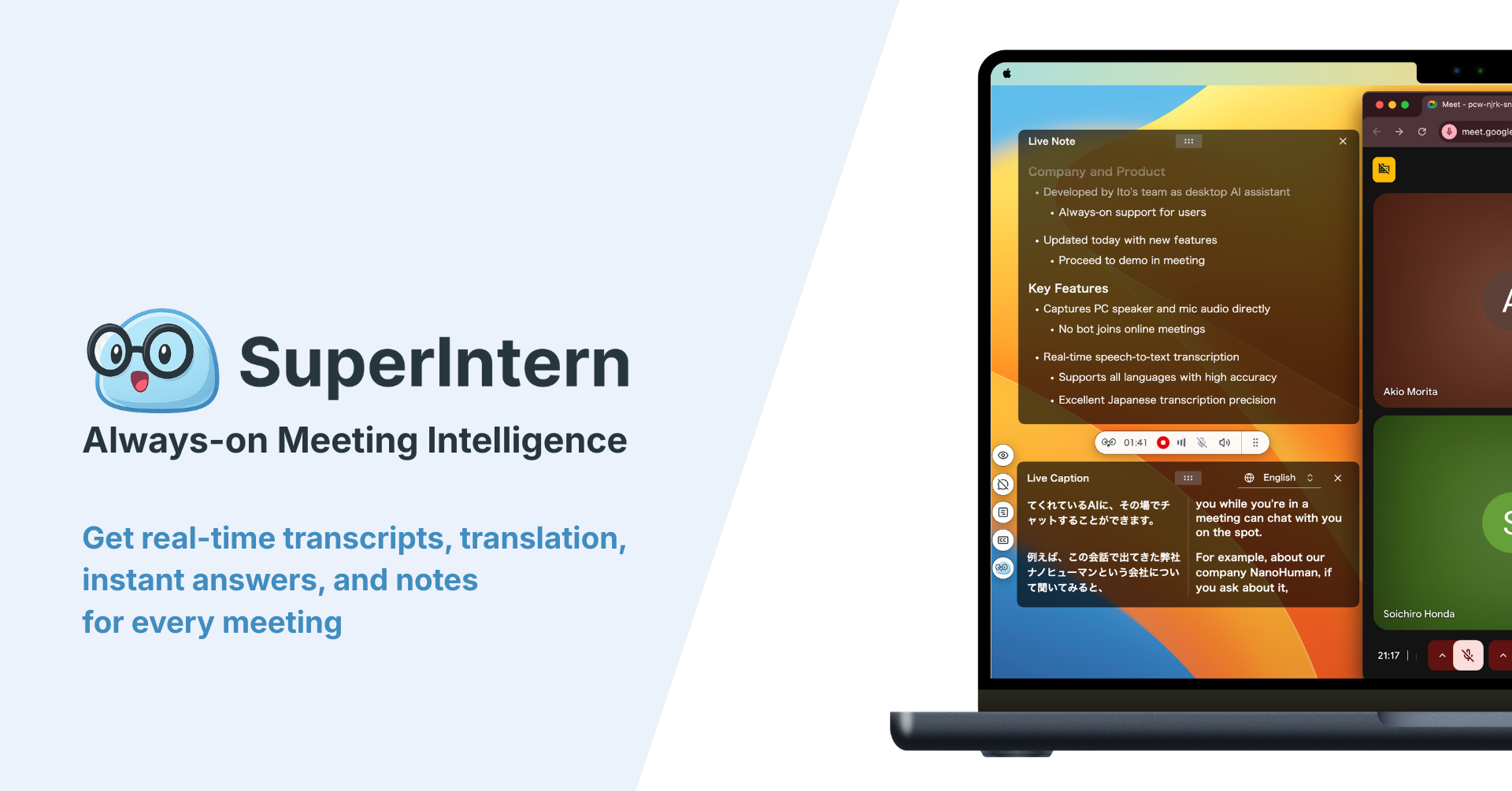
SuperIntern is a botless desktop app for Mac and Windows that captures audio directly from the device: no bot joins the call, so it works the same in Zoom, Google Meet, Microsoft Teams, Webex, and in-person meetings. For decision-making specifically, it contributes three pieces.

- A live record with decisions captured as they happen. The AI Canvas builds the meeting note in real time as the conversation moves, and you define its structure in plain language: "capture every decision with its discarded alternatives, the owner, and the review date." The decision log from the previous section stops being homework after the meeting and starts writing itself during it, with the team's hands and attention free to deliberate.
- Speaker-attributed transcription for reconstructing the reasoning. When someone asks three months later why an option was discarded, the transcript with speaker identification takes you back to the exact moment of the discussion, instead of rebuilding it from memory (everyone with their own).
- Post-meeting chat over your meetings. Natural-language questions like "what did we decide about the support vendor, and who owns it?" get answered from the actual content of your meetings, turning your history of notes into an institutional memory you can query.
For international teams there is one more piece: real-time subtitles and translation in 50+ languages, so participating in the deliberation does not depend on each person's English level. A decision debated in a language half the team follows with effort is a decision made with half the information. There is a free plan, so you can try it in your next decision meeting at no cost.
Checklist: is this decision actually made?
Before calling a decision closed, run through these ten points. Eight or more and the decision is genuinely made; fewer, and it has good odds of coming back to the table.
- Can anyone on the team state the decision in one sentence?
- Was it clear from the start who decided and by what method?
- Were at least three alternatives considered, including doing nothing?
- Were the selection criteria made explicit before choosing?
- Did dissenting voices speak before the favorite option was known?
- Was the decision classified by reversibility and impact to calibrate the process?
- Is it recorded in writing with reasons, discarded alternatives, and an owner?
- Was it communicated to affected people who were not in the conversation?
- Does it have a review date and a metric to evaluate the outcome?
- Could you say what future evidence would force you to reconsider it?
If you check fewer than half, start with points 2 and 7: assigning the decider and recording the decision are the two habits that most improve everything else.
Frequently asked questions
What is decision-making, in short?
It is the process of defining what is being decided, gathering the relevant information, generating and evaluating alternatives, choosing with clear authority, communicating the choice, and reviewing the outcome. The key is treating it as a designable process, not a moment of inspiration.
What are the steps of the decision-making process?
Seven: define the decision, gather information, generate alternatives, evaluate them against explicit criteria, choose, communicate and execute, and review the outcome on a concrete date. Not every decision deserves the full process: calibrate by reversibility and impact.
What decision-making techniques and frameworks exist?
The most useful at work are the pros-and-cons list, the 5 whys, the impact-effort matrix, the weighted decision matrix, opportunity-cost analysis, and the premortem. For distributing authority across teams, DACI defines who drives, who approves, who contributes, and who gets informed.
How do teams decide without endless discussions?
Three measures resolve most stalls: assign who decides and by what method before the debate starts (consultative works for most cases), classify the decision by reversibility so reversible ones do not get overanalyzed, and close every meeting by stating out loud what was decided, who does what, and when it gets reviewed.
What is a decision log and what should it include?
A written list of the team's relevant decisions. Each entry includes the decision in one sentence, the date, who decided and how, the discarded alternatives, the reasons, and the review date with its metric. It keeps decisions from being reopened and turns the team's experience into queryable memory.
Which biases hurt work decisions the most?
Confirmation bias, sunk cost, anchoring, groupthink, and analysis paralysis. They are not removed by willpower but compensated by process: collecting written positions before discussion, running a premortem, or putting a deadline on deliberation.
Can AI make decisions for a team?
No, and that is not its job. What AI does well is carry the process: capturing decisions and their reasons in a live meeting note, transcribing who said what so the reasoning can be reconstructed, and answering questions afterward about what was decided. The deliberation and the accountability remain human.
Conclusion
Deciding well is not about having better instincts. It is about designing the process: classify the decision before analyzing it, assign who decides and by what method, make the criteria explicit, compensate for biases with mechanics rather than willpower, and close every decision with a record that keeps it from being reopened monthly.
Of everything above, the two habits with the fastest payoff are the simplest: no discussion starts without an answer to "who decides this?", and no meeting ends without the decision stated out loud and in writing. For the second one you no longer need a note-taker: let AI keep the minutes and the log, and spend the meeting on the one thing no tool does for you, which is thinking.
Try SuperIntern Free : Botless live meeting notes that capture every decision while your team deliberates.