
English Interview Prep Guide: How AI Translation Tools Ease Listening Anxiety (2026)

In an increasingly global job market, English-language interviews are unavoidable for anyone targeting multinational companies or global teams. Yet many candidates carry the same set of worries.
"I have an English interview with a foreign company coming up, and I cannot sleep thinking about what they will ask."
"During an online interview, I could not understand the interviewer's English and my mind went blank."
"I prepared my answers, but on the day, nerves took over and the English would not come out."
Preparation and practice are obviously critical for an English interview. But no matter how much you prepare, the anxiety of "what if I cannot understand them on the day?" never fully goes away.
This article walks you through the fundamentals of English interview preparation and then shows how an AI real-time translation tool can ease the anxiety during the interview itself. If you are aiming for a role at a multinational or global company, this guide is for you.
⚠️ This article was independently compiled based on publicly available information and user feedback as of January 2026.
Table of Contents
- Why English Interviews Feel So Stressful
- Foundations: How to Prepare Before the Interview
- Common English Interview Questions and How to Answer Them
- Practice Methods That Actually Work
- Still Worried? AI Translation Tools as an Option
- Recommended AI Translation Tools for English Interviews
- Summary
1. Why English Interviews Feel So Stressful
Anxiety about English interviews usually boils down to three things.
Worry 1: Doubts about your listening
The most common fear is "I might not catch what the interviewer is saying." Native speakers speak at roughly 120 to 150 words per minute. Catching every word while parsing meaning in real time takes a substantial level of English ability for non-native speakers.
In online interviews, audio degradation and latency make this even harder.
Worry 2: Doubts about your speaking
Even if you understand the question, expressing your own thoughts in English is another matter. Questions you could answer instantly in your native language take longer to assemble in English, and nerves can make familiar words disappear from your mind.
Worry 3: Handling unexpected questions
You can rehearse the questions you anticipate, but what about the ones you did not? Many global companies deliberately ask off-script questions to assess situational judgment and communication.
2. Foundations: How to Prepare Before the Interview
A successful English interview starts long before you log on. Here is what to do beforehand.
2-1. Research the company and industry thoroughly
Understand the company and the industry inside out. The company's website and careers page will explain its mission, ideal candidate profile, and business areas.
Use this to identify what to emphasize about yourself and what questions to anticipate. For multinational companies, check the English-language site and press releases too, so you also pick up industry-specific terminology.
2-2. Organize your self-analysis in English
You should also prepare your self-pitch and reasons for applying in English. But do not memorize answers word for word. Interviewers can tell when someone is reciting, and they want to see whether you can speak in your own words.
A better approach is to organize the following points as English keywords:
- Your strengths (with specific stories and numbers)
- Skills you have built in previous roles
- Why you want to work at this company specifically
- Your future career vision
With keywords in mind, you can respond naturally from any angle the question takes.
2-3. Learn industry-specific English vocabulary
Business English includes plenty of jargon and acronyms. Make a list of the words and phrases relevant to your industry and confirm their meaning and usage.
Vocabulary for your job function or the position you are applying for is essential. Knowing the right technical terms (for engineering roles) or sales terminology (for commercial roles) adds credibility to what you say.
3. Common English Interview Questions and How to Answer Them
Here are the questions you should be ready for, with tips on how to handle each.
3-1. Self-introduction (Tell me about yourself)
Common phrasings:
- "Could you tell me a little about yourself?"
- "Please introduce yourself briefly."
Tip: Cover education, then work history, then achievements and skills, then where you want to go next, in about 2 to 3 minutes. Focus on professional content, not personal life.
3-2. Strengths and weaknesses
Common phrasings:
- "What are your strengths?"
- "What is your biggest weakness?"
Tip: For strengths, use concrete examples backed by numbers. Multinational companies tend to be results-oriented, so it is important to show clearly how you have delivered outcomes.
For weaknesses, do not just name the weakness. Pair it with what you are doing to address it.
3-3. Reasons for applying (Why do you want to work here?)
Common phrasings:
- "Why are you interested in this position?"
- "Why do you want to join our company?"
Tip: Draw on your company research to explain "why this company" and "how your skills will contribute" in specific terms. Avoid surface-level reasons like "because it is global" or "because it is famous."
3-4. Questions for the interviewer (Do you have any questions?)
At the end of almost every interview, you will be asked if you have any questions. Treat this as another chance to make an impression.
Suggested questions:
- "What does a typical day look like in this role?"
- "What are the biggest challenges facing the team right now?"
3-5. What to do when you cannot understand
If you miss a question, it is fine to ask the interviewer to repeat it. Asking again is not rude; it shows you want to communicate accurately.
Useful phrases:
- "Could you say that again, please?"
- "I'm sorry, I didn't catch that. Could you repeat the question?"
4. Practice Methods That Actually Work
Once the prep is done, practice out loud.
4-1. Sharpen your ear with shadowing
Shadowing is one of the most effective ways to improve listening. You play an English audio clip and repeat it almost immediately as you hear it. It is the same technique used to train simultaneous interpreters.
YouTube interview videos and TED Talks are good source material. Aim for 10 to 15 minutes a day.
4-2. Mock interviews
Practice in a real interview format. Options include:
- Online English lessons: Ask the teacher to play the interviewer
- AI interview practice apps: Tools like Steach and SpeakViz support AI-driven practice
- Friends or colleagues: Get an English-speaking friend or coworker to help
AI practice apps are especially handy because you can practice solo, anytime, anywhere.
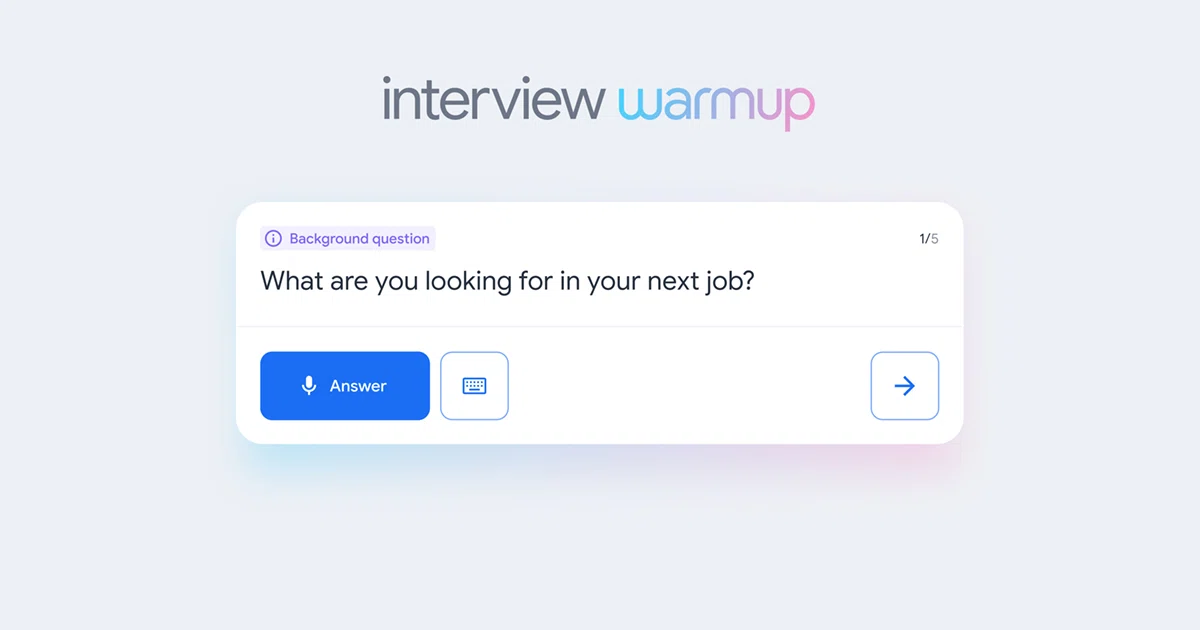
Google Interview Warmup is also worth trying. Google offers it as a free English interview practice tool you can use straight from the browser with no email registration. You answer by speaking, and the AI analyzes your response, highlighting work-related terms to help build vocabulary.
4-3. Record yourself
Record audio or video of your practice and watch it back. You will quickly notice your verbal habits and areas to improve, including pace, volume, eye contact, and facial expression.
5. Still Worried? AI Translation Tools as an Option
We have covered the fundamentals so far. But the lingering fear of "what if I cannot understand them on the day?" is hard to shake completely.
For online interviews especially, AI real-time translation tools can substantially reduce that anxiety.
What is an AI real-time translation tool?
An AI real-time translation tool instantly transcribes everything said during a meeting or interview, then translates it into your language and displays it on screen like subtitles.
This means that even if you are not confident about your listening, you can still follow what the interviewer is saying in real time.
Why use one for an interview?
Benefit 1: Listening anxiety disappears
With the interviewer's words shown as subtitles, you can still follow the content even if you missed parts of it. The fear of "what if I cannot understand them?" stops getting in the way of your focus.
Benefit 2: Help with speaking in English
Some tools include an AI chat that already has full context of the meeting. You can ask in your native language, "How should I answer this question?" and receive example English responses on the spot.
Benefit 3: Easier post-interview review
Because the conversation is recorded, you can review it afterwards. "I should have answered that question this way" becomes feedback you can apply to your next interview.
One caveat: treat it as a safety net, not a crutch
AI translation tools are assistive by nature. Ultimately, you still need to communicate in English yourself.
The best approach is to do the prep and practice properly, and use the tool as a safety net in case you miss something on the day.
6. Recommended AI Translation Tools for English Interviews
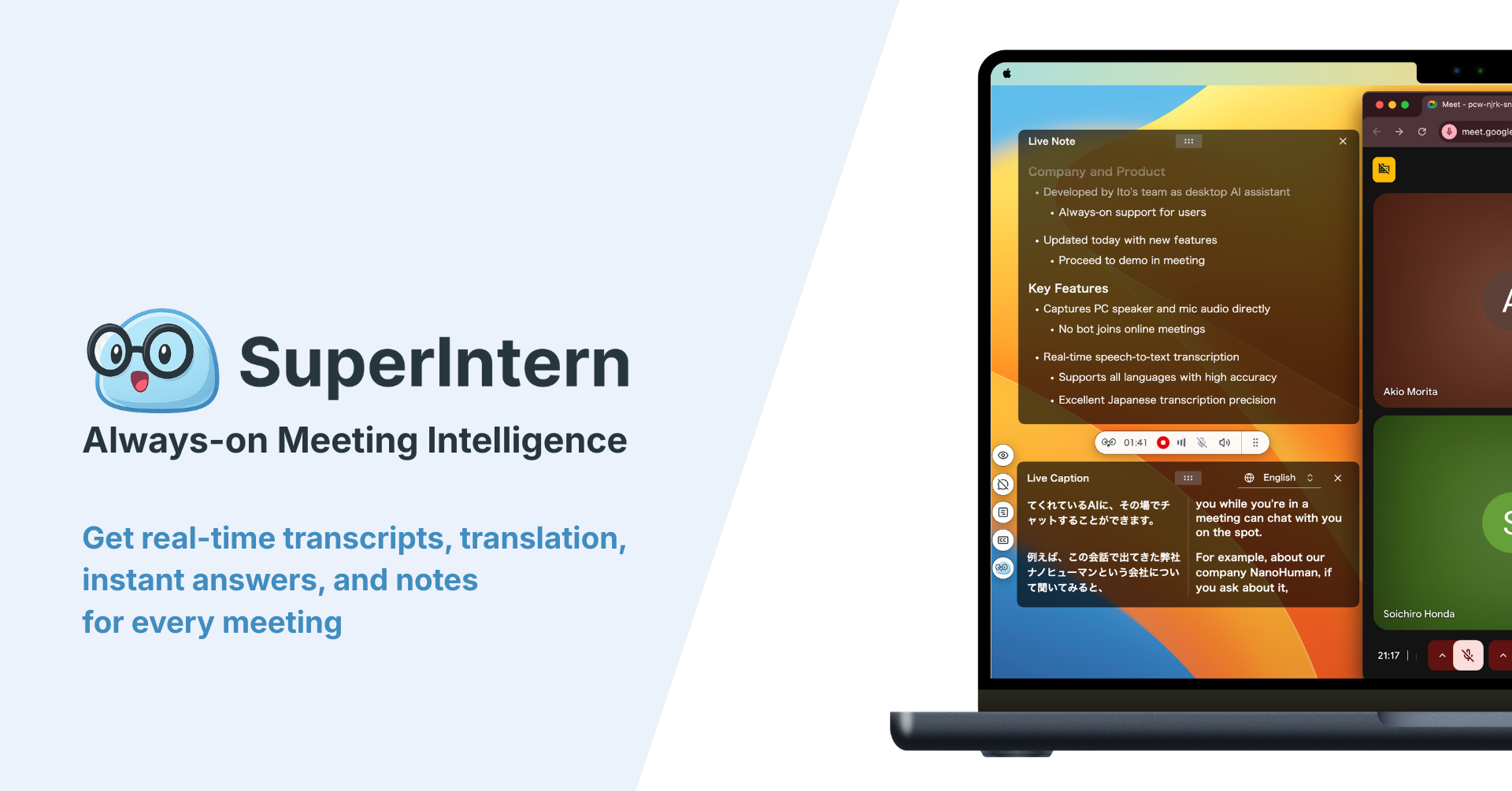
Among the AI real-time translation tools that work for online interviews, SuperIntern stands out because its botless design means the interviewer never sees that you are using a translation tool.
About SuperIntern
Highlights of SuperIntern

- No bot joins the meeting, so the interviewer cannot tell you are using a translation tool
- Hidden from the other side during screen sharing, so you can use it with peace of mind
- Captures audio directly from your PC, so it works with all major online meeting tools (Zoom, Google Meet, Teams). If you can bring a laptop to an in-person interview, it works there too
- Supports 50+ languages with high-accuracy real-time translation
- Simultaneous English plus your-language subtitles so you can read the original and the translation side by side
Features that are especially useful in an interview
- Real-time translated subtitles: Display the interviewer's English instantly as translated subtitles. Anything you missed is still visible.
- AI chat: Ask the AI, which already understands the context of the meeting, "How should I answer this question?" and get example English answers immediately.
- Custom dictionary: Pre-register the company name, product names, and industry jargon for better translation accuracy.
Notes
- Available on Mac and Windows.
- Windows version is available on the Microsoft Store.
You can start for free with no credit card required, so give it a try first.
7. Summary
Key takeaways for English interview preparation:
Before the interview
- Research the company and industry thoroughly
- Organize your self-analysis as English keywords
- Build industry-specific English vocabulary
For common questions
- Prepare self-introduction, strengths and weaknesses, reasons for applying, and your own questions
- Use specific examples and numbers
Practice methods
- Train listening with shadowing
- Use AI practice apps and mock interviews
- Record yourself to get an outside view
If anxiety still lingers
- Use an AI real-time translation tool as a safety net
- SuperIntern is a strong choice thanks to its botless design that stays invisible to the interviewer
English interviews are hard, but with proper preparation they are absolutely manageable. And as a backup for the unexpected, smart use of AI tools is a perfectly valid choice.
We are rooting for everyone aiming for a role at a multinational or global company.