Focus Group: What It Is, How to Run One, Questions and a Discussion Guide Template (2026)
A well-run focus group tells you in two hours what a survey never will: why people think what they think, in their own words. A badly run one hands you the opinion of the loudest person in the room and labels it "the market."
The difference is rarely the research idea. It is the preparation, the moderation, and what happens afterward to everything that was said. This guide covers what a focus group is, when to use one and when not to, the common types, how to run one in seven steps, sample questions by phase, a copy-ready discussion guide, and how to record and analyze sessions without losing the quotes that matter.
⚠️ This article was independently compiled based on publicly available information and user feedback as of November 2026.
Table of Contents
- What is a focus group?
- Focus groups vs. in-depth interviews vs. surveys
- When to use a focus group, and when not to
- Types of focus groups
- Roles in the session: moderator, note-taker, observers, participants
- How to run a focus group in 7 steps
- Sample focus group questions
- Discussion guide template
- Moderation techniques for difficult moments
- How to record and analyze focus group sessions
- Common mistakes
- FAQ
- Conclusion
What is a focus group?
A focus group is a qualitative research method in which a moderator brings together a small group of people, usually 6 to 10, for a guided conversation about a product, service, idea, or experience, typically lasting 60 to 120 minutes. The goal is not to count how many people hold an opinion. It is to understand how they reason about it, which words they use, what worries them, and where they disagree.
What makes the format distinctive is interaction. In a one-on-one interview, the participant answers the interviewer. In a focus group, participants respond to each other: one raises a problem, another qualifies it, a third admits the opposite happens to them. That friction surfaces arguments and nuances nobody would have voiced alone.
Focus groups are used in market research, product development, UX, communications, political research, public health, and academia. The variations differ, but the building blocks repeat:
- A specific research objective. One or two business questions the session must help answer.
- Carefully screened participants. People who share the relevant profile (for example, customers who canceled in the last three months).
- A discussion guide. The script of topics and questions, ordered from general to specific.
- A moderator. Someone who steers the conversation without steering the answers.
- A faithful record. Recordings, transcripts, and notes that let you analyze what was said, not what people remember.
Focus groups vs. in-depth interviews vs. surveys
The three methods often sit in the same project. Picking the right one depends on what you need to learn:
| Focus group | In-depth interview | Survey | |
|---|---|---|---|
| Data type | Qualitative, group | Qualitative, individual | Quantitative |
| Question it answers | How and why does this group think this way? | How does this person experience the problem, in detail? | How many people think this, and in what proportion? |
| Participants per session | 6 to 10 (4 to 6 online) | 1 | Hundreds or thousands |
| Typical length | 60 to 120 min | 45 to 90 min | 5 to 15 min |
| Strength | Interaction, contrasting views, customer language | Depth, sensitive topics, complete stories | Statistical representativeness |
| Weakness | Groupthink, dominant participants | Cost per participant | Doesn't explain why |
| Relative cost | Medium | Medium to high | Low to medium |
A common sequence: interviews or focus groups first to discover the themes and vocabulary, then a survey to measure how much each theme matters. Reversing the order tends to produce surveys whose answer options don't match how customers actually talk.
When to use a focus group, and when not to
Focus groups work well for:
- Exploring a poorly understood problem before designing a solution or a survey.
- Testing concepts, messages, or creative and seeing what people actually take away.
- Capturing customer language to reuse in the product, website, or campaigns.
- Understanding reactions to a change (pricing, packaging, a feature) and the reasoning behind them.
- Generating hypotheses to validate later with quantitative data.
They are not the best choice for:
- Measuring purchase intent or preference share. Ten people are not a sample. Use a survey.
- Intimate or socially sensitive topics (health, personal finances, workplace conflict), where group pressure inhibits honesty. Use individual interviews.
- Testing interface usability. What people say they would do in a group rarely matches what they do alone in front of a screen. Run usability tests.
- Validating a decision already made. If the team only wants confirmation, the moderator will steer toward it, consciously or not.
Types of focus groups
| Type | How it works | When to choose it |
|---|---|---|
| Classic in-person | 6 to 10 people in a room, often with a one-way mirror or camera for observers | Physical products, taste tests, packaging, when body language matters |
| Online synchronous | A video call (Zoom, Google Meet, Teams) with 4 to 6 participants | Geographically spread participants, busy B2B profiles, tighter budgets |
| Online asynchronous | A private forum or community over several days, with staged tasks and prompts | Topics that need reflection, or usage diaries |
| Mini group | 3 to 5 participants | Hard-to-recruit profiles (executives, physicians) or topics that need more depth per person |
| Dual moderator | One moderator manages flow while the other makes sure every topic is covered | Long guides or technical sessions |
| Dueling groups | Two subgroups with opposing positions (for example, current and former customers) | Understanding objections and the arguments on each side |
| Client-participant | A member of the internal team observes visibly or asks questions at the end | When stakeholders need to hear customers directly |
In practice, most product and marketing teams now run synchronous online sessions and add an in-person group when there is something to touch or try.
Roles in the session: moderator, note-taker, observers, participants
Moderator. Opens the session, sets the ground rules, works through the guide, probes, balances participation, and keeps time. The hardest part of the job is staying neutral: no visible enthusiasm for any answer, no finishing participants' sentences.
Note-taker. Captures verbatim quotes, reactions, disagreements, and moments when the group changes its mind. On small teams this is often the person who owns the study. If nobody takes this role, the moderator tries to take notes while moderating and does both badly.
Team observers. Product, marketing, or leadership follow along without intervening. Give them a sheet with the research questions and ask them to note what surprises them, not what confirms what they already believed.
Participants. People who fit the profile and don't know each other. Avoid recruiting anyone who joined another focus group in the last six months: "professional respondents" answer the way they think they're expected to.
How to run a focus group in 7 steps
1. Define the objective and research questions. Write one sentence about the decision that depends on the study ("decide whether to launch the discounted annual plan or the family plan") and two to four questions the session must answer. Anything in the guide that doesn't serve those questions should go.
2. Design the profile and the number of groups. Define inclusion and exclusion criteria, and put segments that behave differently (new versus long-time users, for example) in separate groups. As a rule of thumb, plan at least two or three groups per segment: a theme that appears in one group might be chance; one that appears in three is a pattern.
3. Recruit with a screener. Use selection questions that don't reveal which profile you want, so people can't game them. Over-recruit by one or two per group, because there are always no-shows. Set the incentive in advance and communicate it clearly.
4. Write the discussion guide. Structure it as a funnel: opening, general topics, core topics, stimuli (concepts, prototypes, ads), and closing. Assign minutes to each block. There's a template below.
5. Prepare logistics and recording. Room or platform, stimulus materials, consent form, recording and transcription setup, and who takes notes. Do a full technical rehearsal the day before, especially audio: a room with eight voices and a badly placed microphone produces hours of unusable recording.
6. Moderate the session. Open with the ground rules (no right answers, disagreement is welcome, one person at a time), get everyone to say something in the first five minutes, and follow the guide without turning it into an interrogation. Use silence and probes: "What do you mean by that?", "Does anyone see it differently?"
7. Analyze and report. The same day, hold a 30-minute team debrief on first impressions. Then, working from transcripts, code the themes, compare them across groups, and select representative quotes. The final deliverable answers the research questions from step 1. It does not retell the session in chronological order.
Sample focus group questions
These follow the order of a typical guide. Adapt them to your topic; the example is a subscription service.
Opening (icebreaker)
- Tell us your first name and which subscription you use the most, of any kind.
- What was the last thing you signed up for online, and why?
Introductory questions
- When you think about subscription services, what comes to mind first?
- How do you decide whether a subscription is "worth it"?
Transition questions
- Think about the last time you canceled a subscription. What happened in the weeks before?
- What made you hesitate before canceling?
Key questions
- What would a service have to offer for you to never consider canceling?
- I'm going to show you two plan options. What do you understand from each one? Which would you choose, and why?
- What feels like a fair price for this? What would feel like a rip-off?
- If you had to explain this to a friend in one sentence, what would you say?
Closing questions
- Of everything we discussed, what matters most to you?
- Is there anything we didn't ask that you'd like to add?
Two rules when writing them: open questions instead of yes/no, and no leading questions ("Wouldn't you agree the annual plan is more convenient?"). Question 11 is especially useful for analysis because it forces the group to prioritize in their own words.
Discussion guide template
Copy this template into your notes tool and adapt it. It's built for a 90-minute session.
# Discussion guide – [Project] – Group [#] – [Date]
Moderator: [Name]   Note-taker: [Name]
Format: [In person / online: platform]
Group profile: [Screening criteria]
Consent to record and transcribe: [Yes, how it was collected]

## Study objective
- Decision that depends on the study:
- Research questions: 1) ... 2) ... 3) ...

## 1. Welcome and ground rules (5 min)
- Moderator introduction and general purpose
- Recording and data use
- No right answers, disagreement welcome, one at a time

## 2. Opening (10 min)
- Round of introductions with an easy question

## 3. General context (15 min)
- Question:
- Possible probes:
- Notes and quotes:

## 4. Core topic A (20 min)
- Question:
- Possible probes:
- Notes and quotes:
- Disagreements observed:

## 5. Core topic B / stimuli (25 min)
- Material shown:
- First reaction (before discussion):
- Notes and quotes:

## 6. Closing (10 min)
- "Of everything we discussed, what matters most?"
- "Anything we didn't ask?"

## 7. Team notes (right after)
- Top three findings:
- Surprises:
- Adjustments for the next group:
A tip for block 5: ask each participant to write their reaction to a stimulus on paper or in the chat before discussing it aloud. That captures the individual view before the group reshapes it.
Moderation techniques for difficult moments
| Situation | What to do |
|---|---|
| One participant dominates | Thank them and redirect by name: "Thanks, Chris. Maria, how do you see it?" Avoid holding eye contact with the dominant person. |
| Someone stays silent | Ask them an easy, direct question early on and validate the answer. Online, the chat helps people who won't unmute. |
| Everyone agrees too quickly | Introduce the opposite view: "Other people have told us the opposite. Why do you think they'd say that?" |
| The conversation drifts | Acknowledge and park it: "I'll note that for the end," then return to the guide. |
| Vague answers ("it's fine," "I like it") | Ask for a concrete example: "When was the last time that happened to you?" |
| An expert (or self-styled expert) intimidates others | Remind the group you want experiences, not technical opinions, and ask others about theirs. |
| Several people talk at once | Pause calmly and set turns. Beyond group dynamics, this protects the recording: overlapping speech is the hardest thing to transcribe. |
The most underrated tool is silence. Waiting five seconds after an answer often brings out the most interesting part.
How to record and analyze focus group sessions
This is where many studies lose their value. A 90-minute group produces somewhere around 12,000 to 15,000 spoken words from several people at once. A note-taker captures a fraction of that, biased toward what seemed important in the moment. Video recordings without transcripts are almost never rewatched in full.
A recording and analysis flow that works:
- Record and transcribe with speaker identification. Without knowing who said what, you can't tell whether an idea came from one person or half the group.
- Take structured notes per guide block during the session, so every group is documented in the same shape.
- Debrief as a team the same day, with the notes in front of you.
- Code the transcripts. Tag passages with themes (for example, "perceived price," "moment of cancellation," "trust") and add new tags as they emerge.
- Compare across groups. A theme-by-group matrix shows what's a pattern and what's an anecdote.
- Select quotes that represent each theme, with the participant's anonymized profile next to them.
Steps 1 and 2 are where an AI meeting assistant fits. SuperIntern is a desktop app that transcribes your computer's audio in real time, with automatic speaker identification, without adding a bot to the call. It works the same for an online focus group on Zoom, Google Meet, or Teams as for an in-person session picked up by your laptop or an external microphone.
How it applies to a focus group specifically:
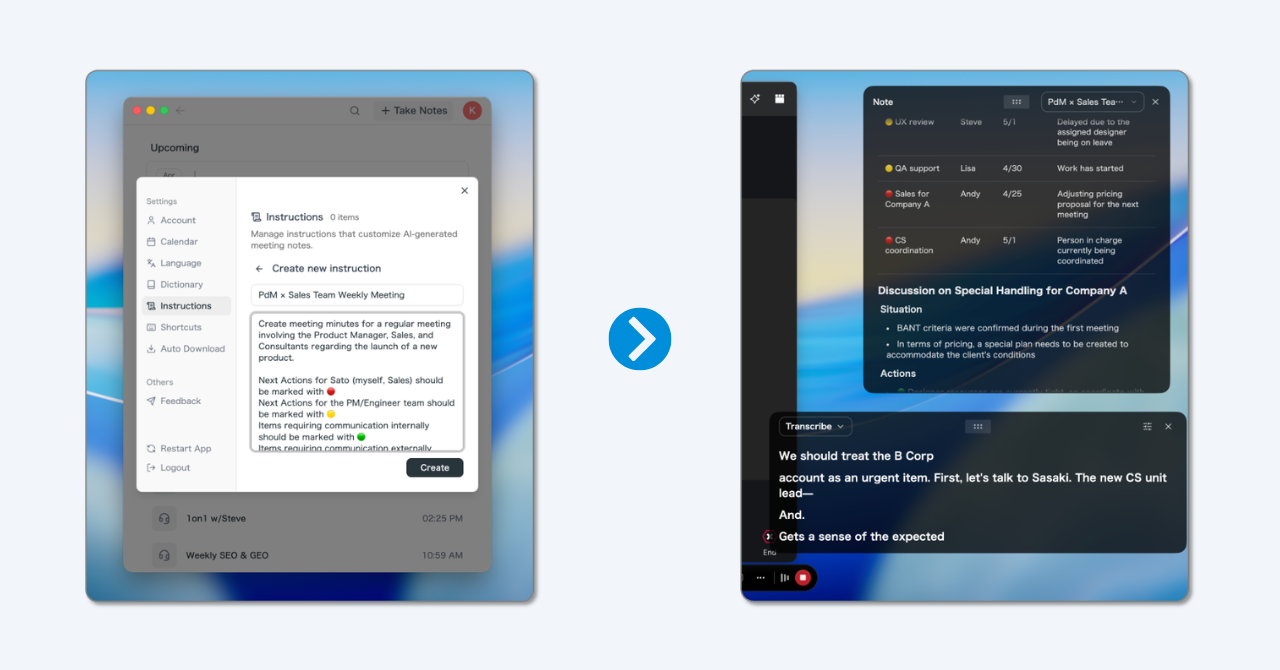
- Your guide becomes the structure of your notes. With AI Canvas you define the blocks of your discussion guide once (context, core topics, stimuli, closing), and notes fill in that same shape while the group talks. The note-taker shifts from transcribing to watching dynamics and disagreements.
- No visible bot. In an online session, a bot called "Notetaker" in the participant list reminds everyone they're being analyzed. Recording from the desktop app avoids that distraction. It doesn't replace telling participants about the recording.
- Custom dictionary. Brand names, competitor products, or industry terms transcribe correctly if you add them before the session.
- AI chat across sessions. After three or four groups, questions like "Which pricing objections came up in every group?" or "What words did people use to describe canceling?" are answered from the transcripts of all the meetings, with quotes you can verify.
- Multilingual studies. When research runs across countries, real-time translation lets an observer follow a session in another language, and summaries can be generated in the team's language.
Three honest caveats. First, in person, audio quality decides everything. With eight people in a room, a microphone in the middle of the table works far better than a laptop in the corner, and overlapping speech will remain imperfect in any transcript. Second, SuperIntern is a tool for capturing and querying conversations, not qualitative data analysis software of the kind research teams use to code large volumes of interviews; on large studies, the two coexist. Third, the final analysis is human. AI finds and groups quotes, but deciding what a pattern means and which decision it supports is the team's job.
| Handwritten notes | Video recording, no transcript | AI note-taker (e.g. SuperIntern) | |
|---|---|---|---|
| Faithful record of what was said | Partial and biased | Complete, but hard to search | Full transcript with speakers |
| Team attention during the session | Split | Free | Free to watch dynamics |
| Same note structure for every group | Depends on discipline | No | Yes, with an AI Canvas template |
| Find a theme across sessions | Reread everything | Rewatch hours of video | Chat across all meetings |
| Body language and visual reactions | Whatever the observer writes down | Yes | No (audio only) |
Consent and data protection
Tell participants that the session is recorded and transcribed, who will access the data, what it will be used for, and how long it will be kept, and collect written consent before you start. Privacy rules vary: the GDPR applies to participants in the EU and UK, and several US states require all parties to consent to a recording. When you present results, anonymize quotes. A profile ("woman, 34, customer for two years") is enough.
Common mistakes
- Using focus groups to measure. "70% of the group preferred design B" with ten people is not data. It's an anecdote with a percentage sign.
- Running a single group. What one group says can depend on that afternoon's chemistry. Plan several per segment.
- Mixing profiles that shouldn't be together. Managers and their reports, or current customers and angry former ones, shape each other's answers.
- Overlong guides. Twenty questions in 90 minutes leaves four minutes per question and no depth. Ten well-explored questions are better.
- Enthusiastic moderation. Nodding hard at answers that confirm the hypothesis teaches the group what to say.
- Observers who intervene. Once the internal team starts defending the product, the group stops being candid.
- Analyzing from memory. A summary written three days later without transcripts reflects the session the team wanted to see.
- Chronological reports. "First they talked about X, then Y" doesn't help anyone decide. Organize the report by research question.
FAQ
What is a focus group, in short?
It's a moderated conversation with a small group of people (usually 6 to 10) who share a profile, designed to understand their opinions, motivations, and language around a product, service, or topic. It's a qualitative method: it explains why, it doesn't measure how many.
How many people should be in a focus group?
Six to ten is the usual range in person. Online, four to six tends to work better because turn-taking is harder on a video call. Mini groups of three to five are used for hard-to-recruit profiles or topics that need more depth.
How many focus groups do you need?
It depends on how many segments you study, but plan at least two or three groups per segment. Teams usually stop when new groups no longer surface new themes, which qualitative researchers call saturation.
What's the difference between a focus group and a group interview?
A group interview is mostly the interviewer asking and each person answering in turn. A focus group is designed for participants to discuss with each other, and that interaction is part of the data. The moderator guides the conversation rather than collecting individual answers.
Can you run a focus group online?
Yes, and it's very common. It works well with groups of four to six, slightly shorter sessions (60 to 90 minutes), cameras on, and one team member dedicated to tech support. Use the chat to capture individual reactions before the discussion.
Can you record and transcribe a focus group?
Yes, as long as you inform participants, collect written consent, and handle the data according to the applicable privacy laws. A transcript with speaker identification is the foundation of good analysis, because it lets you compare who said what across groups.
How do you analyze focus group results?
Working from transcripts, code passages by theme, compare themes across groups to separate patterns from anecdotes, and pick representative quotes. The final report answers the research questions defined at the start and ends with implications for the decision.
Conclusion
Focus groups are still one of the fastest ways to hear customers in their own words and to watch their opinions collide. Their value depends on three things: a clear objective that shapes the guide, neutral moderation that gives everyone room to speak, and a faithful record that lets you analyze what was actually said.
The third is the most neglected and, today, the easiest to fix. Build the guide as a funnel, plan several groups per segment, record and transcribe with consent, and analyze by theme rather than by order of appearance. Do that, and every session leaves you with something more useful than an impression.
Try SuperIntern Free: real-time transcription with speaker identification, notes that follow your discussion guide, and AI chat to find patterns across sessions, with no bots in the call.