Jour Fixe Meaning: How to Run Recurring Team Meetings That Earn Their Slot (2026)
If you work with a German, Austrian, or Swiss team, sooner or later an invite lands in your calendar titled "Jour fixe". It sounds French, it is pronounced roughly "zhoor feex", and nobody in the meeting is speaking French. Meanwhile, every company on earth runs the same thing under a different name: the weekly sync, the standing meeting, the recurring team check-in.
This guide covers both angles. First the short version: what jour fixe actually means, where the term comes from, and why German business culture loves it. Then the part that matters in any language: how to run a recurring meeting that keeps earning its place in the calendar, instead of surviving on inertia. You will get an agenda template and a minutes template you can copy, a checklist for deciding whether a standing meeting should live or die, and a way to get meeting minutes written live, without assigning a note-taker every week.
⚠️ This article was independently compiled based on publicly available information and user feedback as of July 2026.
What does jour fixe mean?
Jour fixe is French for "fixed day". In business use, it means a recurring meeting that happens at a fixed time, with a fixed group of people: every Monday at 10 a.m., every first Thursday of the month, always the same circle. A jour fixe can be a team sync, a project alignment call, or a standing meeting between a company and an external partner such as an agency.
The twist: modern French speakers do not use the term for meetings at all. The phrase comes from 19th-century salon culture, where hosts kept a fixed weekday reserved for receiving guests. As a meeting term it survives mainly in German-speaking business culture, a pseudo-French loanword much like "Handy", the German word for a mobile phone that no English speaker would recognize. In international teams, the same format is simply called a recurring meeting, standing meeting, or weekly.
If a German colleague invites you to a jour fixe, expect a regular alignment meeting with a stable cast, usually 30 to 60 minutes, focused on coordination and decisions rather than deep work. Declining it casually reads as opting out of the collaboration, so if the cadence does not work for you, propose a different rhythm rather than skipping silently.
Quick reference: the term at a glance
| Question | Answer |
|---|---|
| Literal translation | "Fixed day" (French) |
| Pronunciation | zhoor FEEX (the final "e" is silent) |
| What it means in practice | A recurring meeting at a fixed time with a fixed group |
| Where it is used | Mostly German-speaking business culture (Germany, Austria, Switzerland) |
| English equivalents | Recurring meeting, standing meeting, weekly sync |
| Typical length | 30–60 minutes |
Jour fixe vs. other meeting formats
Not every topic belongs in the fixed slot. Comparing the common formats makes it easier to decide what goes into the recurring meeting and what should live elsewhere:
| Format | Cadence | Length | Purpose | Typical attendees |
|---|---|---|---|---|
| Jour fixe / weekly sync | Weekly to monthly, fixed slot | 30–60 min | Ongoing alignment, decisions, unblocking | Team, project group, client and vendor |
| Daily standup | Every workday | 15 min | Quick sync, surfacing blockers | Delivery team |
| One-on-one | Weekly to biweekly | 30 min | Private conversation between manager and report | Two people |
| Project review | At milestones | 60–90 min | Evaluate results, correct course | Project team plus stakeholders |
| Retrospective | Per sprint or quarter | 60–90 min | Improve how the team works | Team |
Two rules of thumb follow. First: status updates nobody needs to discuss do not belong in the recurring meeting; they belong in a document or a chat channel. Second: anything personal or confidential belongs in the one-on-one, not in the group slot.
Recurring meetings: the most expensive habit in your calendar
Whatever you call it, the recurring meeting has one defining property: it happens whether or not there is something to discuss. That is its strength, and its failure mode.
The strength: a fixed slot removes coordination overhead. Nobody has to find a time that works for six people every single week, and nobody has to judge whether an issue is "worth a meeting". Topics have a reliable place to land, which is exactly what distributed and remote teams lack most.
The failure mode: recurring meetings outlive their purpose by default. A one-off meeting needs a reason to exist. A standing meeting needs a reason to stop existing, and nobody wants to be the one who cancels it. Run the math once: six people, 60 minutes, every week is more than 300 person-hours a year. That investment deserves an owner, an agenda, and an audit.
A recurring meeting earns its slot when:
- decisions involving several people come up continuously, as in projects with many moving parts
- collaboration with an external partner needs a dependable communication channel
- topics would otherwise be negotiated in endless email threads and die there
- the team is remote or distributed and needs a fixed place to align
Cut or thin it out when:
- the agenda has been nearly empty three times in a row (switch to biweekly or monthly)
- it consists only of status updates a shared document could replace
- the same two people talk while everyone else listens
- real decisions consistently happen outside the meeting anyway
A simple test: cancel one occurrence and watch what happens. If nobody misses it, you have your answer. If questions and topics pile up immediately, the meeting has proven its value.
How to run a jour fixe that works
The quality of a recurring meeting is decided mostly in the 24 hours before and after it, not in the room.
Before: collect the agenda. The agenda should be built by the team, not the organizer. A shared document where everyone adds topics by the day before changes the dynamic completely: whoever adds a topic has thought it through. If the document stays empty, shorten or cancel the occurrence. An empty agenda is not a failure, it is information.
During: decisions before status. Start with the items that need a decision or a discussion, not with the round-robin update. The classic "let's go around the room" spends the meeting's freshest attention on content that works fine asynchronously. Give each topic a rough timebox and name the desired outcome up front: a decision, input, or just awareness.
At the end: say the outcomes out loud. Reserve the last five minutes for results. Who does what by when? What was decided? Read the list out once. It takes three minutes and prevents the most common source of meeting frustration: different memories of the same meeting.
After: minutes the same day. Meeting minutes that arrive two days later are read by no one. Speed beats prose. How to get that without anyone typing all meeting, in a moment.
Agenda template for recurring meetings
Copy this into a shared document or your notes tool. It is deliberately short: a standing meeting needs structure, not bureaucracy.
# Jour fixe / Weekly [team or project] – [date]

## Decisions needed (first!)
- [Topic] – Raised by: [name] – Desired outcome: [decision / feedback]

## Discussion topics
- [Topic] – Raised by: [name] – Time needed: [10 min]

## Quick updates (5 minutes total, max)
- [Information only, no discussion needed]

## Follow-up check
- Action items from last time: done?

## Outcomes (fill in during the meeting)
- Decisions:
- Action items: [ ] Owner – Task – Due date
Three notes on using it well:
- "Decisions needed" sits on top on purpose. Whatever requires a decision gets the fresh attention of the first minutes.
- Quick updates are batched and capped. Anything that takes longer than a minute is either a discussion topic or belongs in a document.
- The follow-up check closes the loop. A recurring meeting builds trust when last week's commitments are visibly checked this week. That only works with reliable minutes.
The minutes problem, multiplied by every week
Recurring meetings expose a structural weakness: they happen every week, so minutes are due every week. And because the meeting is routine, writing them becomes the unloved routine chore that rotates around the team or silently stops happening. Two weeks later the classic argument starts: "Didn't we agree that...?"
A lean minutes template lowers the barrier:
# Minutes – Jour fixe / Weekly [team or project] – [date]
Attendees: [names]

## Decisions
- [What was decided, by whom, and why]

## Topics discussed (1–2 lines each)
- [Topic]: [key points, open questions]

## Action items
- [ ] [Owner] – [Task] – [Due date]

## Deferred to next meeting
- [Topic]
But even the best template leaves the core problem in place: someone has to write during the meeting and is therefore only half present, or everyone stays in the conversation and the minutes get reconstructed from memory at 6 p.m.
Live minutes without a note-taker: the AI workflow
Recurring meetings with a stable structure are the ideal case for an AI meeting assistant. SuperIntern is a bot-free desktop app for Mac and Windows that captures the conversation directly from your computer's audio. No bot joins the call, which matters in a jour fixe with clients or external partners: the other side never has to admit a stranger into the participant list. And because it works from device audio, it is platform-independent: Teams, Zoom, Google Meet, Webex, or an in-person meeting room all work the same way.

For a recurring meeting, that means:
- Your minutes template fills itself in. With AI Canvas you describe the format once, for example: "This is a weekly team sync. Capture decisions with reasoning, discussed topics as bullet points, action items with owners and due dates, and deferred topics." Every following occurrence is written live in exactly that structure.
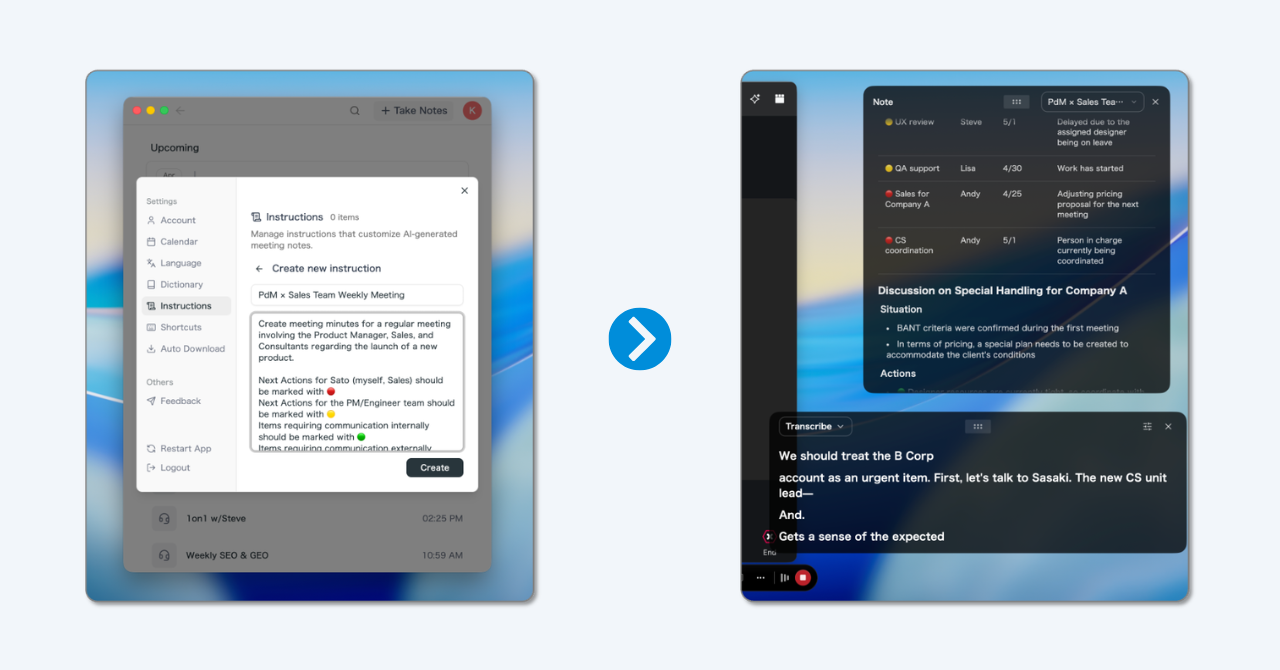
- Nobody is the note-taker anymore. Notes build up during the conversation while every participant stays in the discussion. The rotating chore simply disappears.
- Minutes are ready when the meeting ends. Instead of reconstructing them in the evening, you review for two minutes and share while the content is fresh for everyone.
- The follow-up check has a source of truth. Before the next occurrence, open last week's minutes and see instantly which commitments are still open. The built-in AI chat also answers questions across meetings, like "What did we decide about the budget in the last four weeklies?"
- Language stops being a barrier. For international recurring meetings, SuperIntern translates the conversation in real time across 50+ languages, and your summary arrives in your working language regardless of what was spoken.
In fairness: SuperIntern is a desktop app focused on live meetings and their follow-up, not a full project management suite with ticket tracking. Most teams connect it to agents like Claude and ChatGPT via SuperIntern MCP and manage their tickets in Jira, Linear, or Notion through those tools' MCP integrations. There is a free plan, so the workflow costs nothing to test in your next weekly.
Common mistakes in recurring meetings
- The meeting has no owner. Without facilitation the session drifts. The role can rotate, but it must exist.
- Status round instead of agenda. If the default opener is "let's go around the room", status fills the time that decisions needed.
- The slot keeps growing. First 30 minutes, then 45, then 60. Length is not quality. Cut back and let the pressure sharpen the agenda.
- The guest list keeps growing. Every person added "just to listen in" silently doubles the cost. Whoever has no agenda items and makes no decisions gets the minutes instead.
- No minutes, no accountability. Without written outcomes, a recurring meeting is a chat. The impact comes from following up.
- The zombie meeting. The project ended, the weekly lives on. Standing meetings need an expiry date or a regular existence check.
Checklist: is your recurring meeting healthy?
Run through these eight questions once a quarter. Three or more "no" answers mean the format, cadence, or attendee list needs surgery.
- Is there a filled agenda before every occurrence?
- Does the meeting start with decisions rather than status?
- Does it end on time or early?
- Are action items captured with owners and due dates?
- Do the minutes reach everyone the same day?
- Does each meeting start by checking last week's commitments?
- Do more than two people speak regularly?
- Would anyone miss the meeting if it were cancelled?
Conclusion
The Germans are onto something with the jour fixe: a fixed slot removes coordination overhead, creates reliability, and gives topics a home. It only turns into a time sink when routine replaces substance. The remedies are unglamorous and effective: an agenda filled in advance, decisions before status, a punctual ending, and minutes that reach everyone the same day and get checked the week after.
The most tedious link in that chain, the minutes, no longer needs a human. A bot-free AI assistant fills your recurring meeting template live during the conversation, captures decisions and action items as they are spoken, and lets everyone in the room do what the meeting is actually for: discussing and deciding.
Try SuperIntern Free – no bot in your meeting, live minutes in your own structure, and a reliable record of every recurring meeting.