Kickoff Meeting: How to Run a Project Kickoff That Actually Starts the Project (Agenda + Templates) 2026

Every project gets exactly one first impression. The kickoff meeting is the moment when a budget, a brief, and a list of names either become a team or quietly fail to. Post-mortems of troubled projects are remarkably repetitive: whatever exploded in month three as "unclear ownership" or "scope creep" was almost always unclear on day one. It just went unnoticed for ninety minutes.
That is what makes the kickoff the cheapest steering tool a project will ever have. A decision that costs five minutes here costs an escalation meeting in week twelve. And yet many kickoffs consist of a slide marathon, a round of introductions, and the sentence "we'll sort out the details separately."
This guide covers what a kickoff meeting actually needs to accomplish: the definition, the five outcomes that must exist when the room empties, a field-tested 90-minute agenda, checklists for before, during, and after, two templates you can copy, the most common mistakes, and how to walk out of the kickoff with the minutes already written.
⚠️ This article was independently compiled based on publicly available information and user feedback as of August 2026.
Table of Contents
- What Is a Kickoff Meeting?
- The 5 Outcomes a Good Kickoff Must Deliver
- Types of Kickoff Meetings Compared
- Kickoff Meeting Agenda: The 90-Minute Structure
- Checklist: Before, During, and After the Kickoff
- 2 Kickoff Templates to Copy
- Common Kickoff Meeting Mistakes
- From Kickoff to Minutes, Automatically
- Frequently Asked Questions
- Conclusion
What Is a Kickoff Meeting?
A kickoff meeting is the official start of a project, where everyone involved builds a shared understanding of the goal, scope, roles, timeline, and ways of working. The term comes from football: the kickoff is the moment the ball goes into play. Translated to projects, planning happens before the kickoff; work happens after it.
On spelling: "kickoff," "kick-off," and "kick off" all appear in the wild. American style guides generally prefer "kickoff" as the noun, British English leans toward "kick-off," and "kick off" (two words) is the verb. Any of them will be understood; just stay consistent within your own documents.
Two boundaries make the definition sharp. First, the kickoff is not a planning meeting. Budget, rough mandate, and core team should already exist. The kickoff moves that knowledge out of two or three heads and into the whole team, converting a plan into a commitment. Second, it is not a ceremony. If nobody behaves differently after the meeting than before it, you held a celebration, not a kickoff.
In practice, there are two base flavors with different tones:
- The internal kickoff: team, project lead, and sponsor get aligned. Open questions, risks, and doubts belong on the table here, explicitly.
- The external kickoff with a client, agency, or vendor: alignment plus trust-building, expectation-setting, and rules of engagement. Many teams run it in two stages: clarify internally first, then present a unified front externally.
The 5 Outcomes a Good Kickoff Must Deliver
Whether a kickoff worked is not measured by the mood in the room but by five concrete outcomes. When people leave, every participant should give the same answer to these five questions:
- Why does this project exist, and how will success be measured? Not "build a new website," but "raise support self-service resolution from 20 to 40 percent by Q2." Without a measurable goal, every future scope debate becomes a matter of taste.
- What is in scope, and what is explicitly out? The not-list is more valuable than the list. "The relaunch does not include the online shop" is the sentence that prevents a conflict in week eight.
- Who holds which role, and who decides? Accountable, contributing, informed, and the tie-breaker. The most common project killer is not conflict; it is the silent assumption that someone else is handling it.
- Which milestones and deadlines apply? Rough is fine: three to five stages with dates. The detailed plan is the project lead's homework, not the kickoff's.
- How will we work together? Meeting cadence, chat channel, where documents live, how decisions get recorded, and who takes the minutes (or which AI meeting assistant does). Unglamorous, but this operating agreement saves friction every single week.
Everything else, team building, motivation, a shared lunch, is welcome garnish. These five outcomes are the mandatory part.
Types of Kickoff Meetings Compared
The word "kickoff" covers very different events, with very different requirements:
| Type | Participants | Typical length | Focus | Notable trait |
|---|---|---|---|---|
| Internal project kickoff | Core team, project lead, sponsor | 60-90 min | Goal, scope, roles, ways of working | Open risk discussion encouraged |
| External kickoff (client/agency) | Both project teams, client | 60-120 min | Expectations, rules of engagement, contacts | Trust-building, usually more formal |
| Sprint/phase kickoff | Delivery team | 15-30 min | Sprint goal, priorities | Lightweight, recurring |
| Sales kickoff (SKO) | Sales organization | Half day to full day | Annual targets, strategy, motivation | Event character, not a working meeting |
| Workshop kickoff | Workshop group | 15-30 min | Expectations, rules, flow | Opening act of a larger format |
This guide focuses on the first two, the internal and the external project kickoff. For recurring formats like sprint starts, a slimmed-down version of the agenda below is enough.
Kickoff Meeting Agenda: The 90-Minute Structure
Ninety minutes is a good frame for a mid-sized project: long enough for real clarification, short enough to hold attention. The agenda follows a simple dramaturgy: first the why, then the what, then the how.
- Welcome and goal of the meeting (project lead, 5 min). One sentence is enough: "By the end, we share one picture of the goal, scope, roles, and next steps."
- Background and project goal (sponsor, 10 min, information). Why this project, why now, and how success will be measured. This slot belongs to the sponsor personally: if leadership will not explain the why in person, the team learns it cannot be that important.
- Introductions with role context (everyone, 10 min). Not résumés, but "here is my contribution to this project, and here is what you can come to me for." For teams that know each other, compress to two minutes.
- Scope: what is in and what is out (project lead, 15 min, decision). The key deliverables and the explicit not-list. This is where the most valuable objections of the whole meeting surface, so budget discussion time.
- Roles and decision paths (project lead, 10 min, decision). Who is accountable, who contributes, who gets informed, who breaks ties. A simple role matrix in a shared doc is enough.
- Milestones and timeline (project lead, 15 min, decision). Three to five milestones with dates, known dependencies, and vacation windows. No Gantt chart deep-dive.
- Ways of working and communication (project lead, 10 min, decision). Recurring meetings, channels, document home, minutes policy, escalation path.
- Risks and open questions (everyone, 10 min, input). Asking "what could make this project fail?" is worth more now than in any retrospective later. Open items get owners and due dates.
- Next steps and close (project lead, 5 min, decision). The tasks for week one, each with a name and a date. No kickoff should end with "so, we'll get started then."
For an external kickoff, insert a block called "client expectations" between items 2 and 4, and move the candid risk discussion into your internal prep session.
Checklist: Before, During, and After the Kickoff
As with any recurring meeting, the session itself is only half the job. The other half lives in the days before and after.
Before the kickoff (1 to 2 weeks out):
- Project mandate, goal, and budget confirmed with the sponsor (the kickoff announces; it does not negotiate)
- Participant list set: full core team, sponsor present, no passive spectators
- Agenda with time boxes and expected outcomes sent no later than the day before
- Pre-read distributed: mandate, scope draft, rough timeline (two pages maximum)
- Draft role matrix prepared, to be confirmed or corrected in the meeting
- Tech and minutes question settled: who or what records the decisions?
During the kickoff:
- Open with the goal of the meeting, not with slides
- Capture every decision visibly (shared doc or live note, not private scribbles)
- Actively invite dissent on scope and roles: "Who sees it differently?" Silence is not agreement
- Park open items with an owner and a date instead of debating them to death
- Protect the last five minutes for next steps, even if another topic has to be cut
After the kickoff (within 24 hours):
- Send the minutes with decisions, roles, and tasks to everyone, including absentees
- Move week-one tasks into the project tool
- Book the recurring meetings (weekly, standups, reviews) straight into calendars
- Chase open questions before they dissolve into day-to-day noise
2 Kickoff Templates to Copy
Paste these into your shared doc. The structure is deliberately built to fill itself in during the meeting and then live on as the skeleton of the minutes.
1. Internal project kickoff (90 min)
# Kickoff [Project] - [Date] ([90 min])
Goal: One shared picture of goal, scope, roles, and ways of working
Pre-read: [link to project brief] (please read in advance)

1. Goal of this meeting - [PL] - 5 min
2. Background and project goal - [Sponsor] - 10 min, info
   Success metric: [measurable target by date]
3. Introductions with role context - all - 10 min
4. Scope - [PL] - 15 min, decision
   In scope: / Explicitly out:
5. Roles and decision paths - [PL] - 10 min, decision
6. Milestones and timeline - [PL] - 15 min, decision
7. Ways of working (meetings, channels, minutes) - [PL] - 10 min, decision
8. Risks and open questions - all - 10 min, input
9. Next steps (week 1) - [PL] - 5 min, decision

## Outcomes (fill in during the meeting)
- Decisions:
- Open items: [item] - [owner] - [due date]
- [ ] [Name] - [task] - [due date]
2. External kickoff with a client or agency (90-120 min)
# Kickoff [Project] with [Client/Partner] - [Date]
Goal: Agree on expectations, rules of engagement, and next steps

1. Welcome and introductions, both teams - 10 min
   (per person: role on this project and what to contact them for)
2. Project goal and success criteria - [Client] - 15 min
3. Expectations for the collaboration - both sides - 15 min
4. Scope and deliverables per the agreement - [PL] - 15 min
   (incl. boundaries: what is not included)
5. Points of contact and approval process - 10 min
   (Who approves? How fast? What happens on delay?)
6. Timeline and milestones - [PL] - 15 min
7. Communication (recurring meeting, channel, minutes) - 10 min
8. Next steps and close - 5 min

## Outcomes (fill in during the meeting)
- Agreements:
- [ ] [Name/side] - [task] - [due date]
Common Kickoff Meeting Mistakes
- The kickoff is a one-way street. Sixty minutes of slides, five minutes of "any questions?". A kickoff where one person talks produces an audience, not participants. Rule of thumb: at least a third of the time belongs to the room.
- The sponsor is missing. When the why arrives as a forwarded slide deck, nobody believes in the priority. Ten minutes of leadership presence cannot be substituted.
- Scope stays fuzzy. "We'll look at the details later" is the most expensive sentence of any project start. Whatever is not bounded at the kickoff gets negotiated later, under deadline pressure and with bruised expectations.
- Roles are assumed instead of spoken. Everyone nods; everyone means something different. Reading the role matrix out loud feels pedantic and prevents months of friction.
- There are no minutes. The kickoff produces the most important agreements of the entire project, and precisely here teams rely on memory and private notes. Without a written record, the kickoff is legally a rumor.
- Nothing happens for a week afterward. Momentum evaporates when the first tasks start "after detailed planning." Every person should leave the room owning at least one concrete task for week one.
From Kickoff to Minutes, Automatically
The most awkward conflict of any kickoff: the person facilitating is usually also the person expected to write everything down. But whoever is typing is not facilitating. And at a project start, exact wording matters. Whether the client said "around the end of March" or "March 31, firm" is precisely the difference that ends up in front of a steering committee.
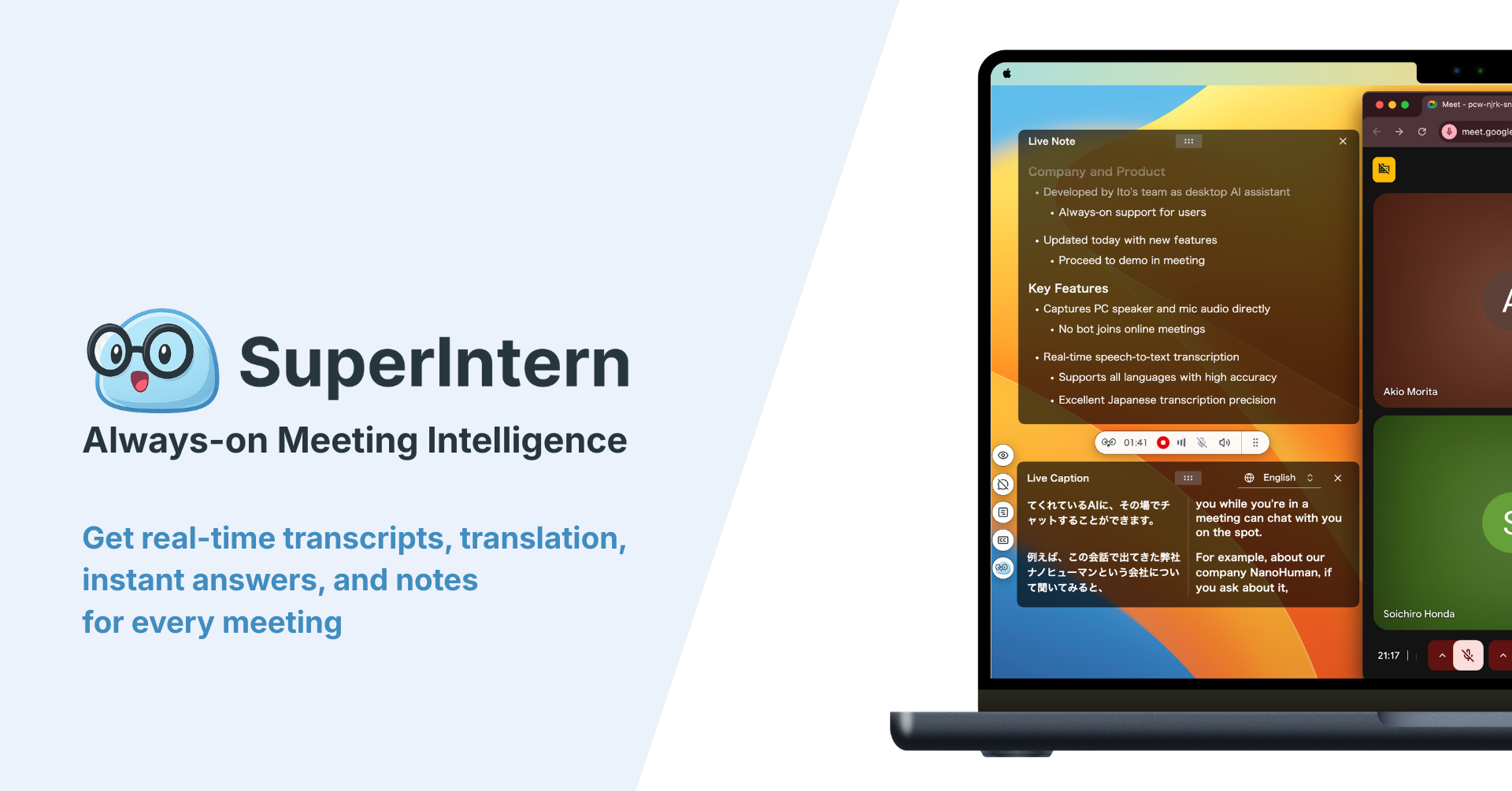
This is where a real-time AI meeting assistant comes in. SuperIntern is a bot-free desktop app (Mac and Windows) that captures the meeting directly from your device audio. No bot joins the call, which matters most at an external kickoff: your client's first impression is not an anonymous recorder sitting in the participant list. And because audio comes from the device, it works identically in Zoom, Google Meet, Microsoft Teams, Webex, and in-person meeting rooms.

For a kickoff, this turns into a concrete workflow:
- Hand AI Canvas your kickoff agenda. Before the meeting, describe your structure in plain language: "Record the project goal and success metric, capture the scope as an in/out list, the roles as a table, and every task with an owner and a due date." During the meeting, the live note fills itself in exactly that shape.
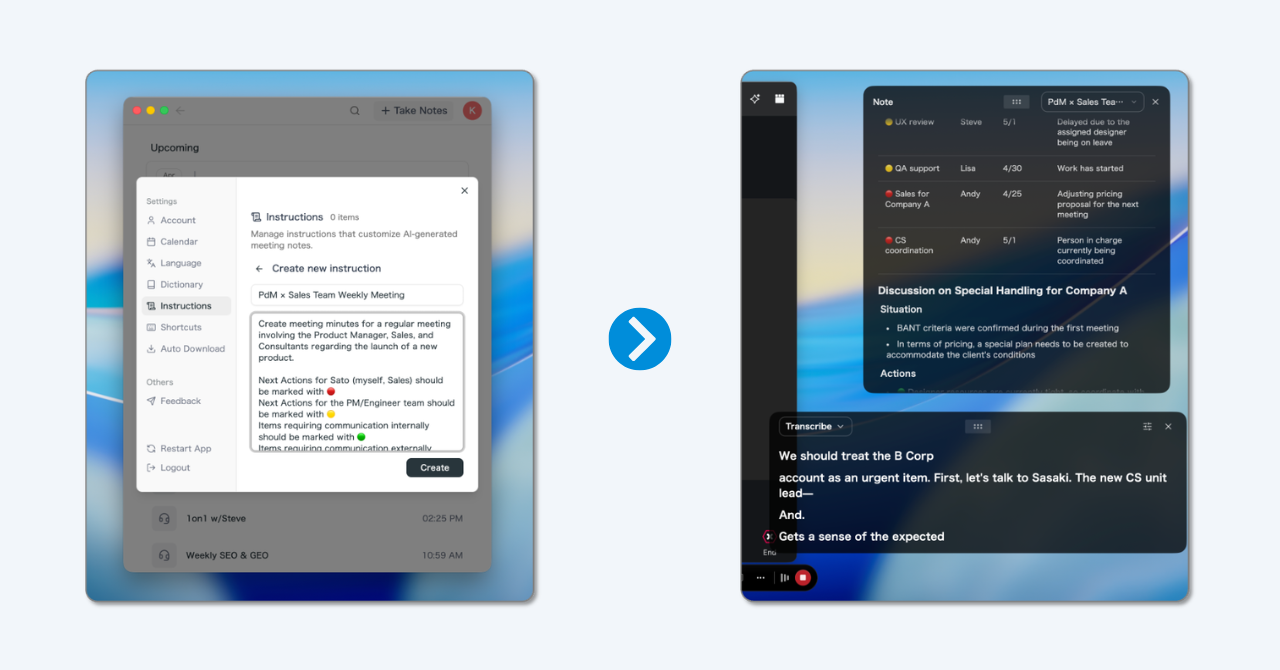
- The facilitator's dilemma disappears. Nobody has to choose between leading the conversation and keeping the record; the project lead can actually listen during the most important meeting of the project.
- The minutes are done when the meeting ends. The outcomes block in the template above is already filled in as people say goodbye. Two minutes of review, and sending minutes within 24 hours becomes routine instead of a resolution.
- Exact wording is searchable. "How exactly did the client phrase the approval deadline?" is answered by the transcript, not by gut feeling.
- International kickoffs speak one language. For distributed teams, SuperIntern translates in real time across 50+ languages, and each person gets the summary in their own language.
One honest note: SuperIntern is a desktop app for live meetings and their follow-up. It will not write your agenda or send calendar invites. You handle the preparation with the templates above; the AI handles the documentation. There is a free plan, so trying it at your next project start costs nothing.
Frequently Asked Questions
What is a kickoff meeting, in simple terms?
The official start of a project. Everyone involved builds one shared understanding of the goal, scope, roles, timeline, and how the team will work together. The name comes from football: from this moment, the ball is in play.
Is it "kickoff," "kick-off," or "kick off"?
All three exist. As a noun, American English tends toward "kickoff" and British English toward "kick-off"; "kick off" as two words is the verb form. Pick one style and use it consistently in your documents.
How long should a kickoff meeting be?
For a mid-sized project, 60 to 90 minutes; for complex work with an external partner, up to two hours. Sprint or phase kickoffs fit in 15 to 30 minutes. If you need more than two hours, planning work has probably leaked into the kickoff that should have happened beforehand.
Who should attend a kickoff meeting?
The full core team, the project lead, and the sponsor or client. At an external kickoff, add the points of contact from both sides. Pure spectators with no role in the project dilute the meeting; they get the minutes instead.
What is the difference between a kickoff and a planning meeting?
The planning meeting produces what the kickoff announces and commits to: goal, budget, rough scope. The kickoff does not renegotiate those foundations; it distributes them to the team, clarifies roles, and starts the work. If fundamental questions are still open in the kickoff, preparation was incomplete.
Does a small internal project need a kickoff?
Yes, in miniature: 30 minutes, using the five-outcomes checklist from this article, done. What matters is not the length of the meeting but that goal, scope, roles, and first steps were said out loud once and written down.
What happens after the kickoff?
Within 24 hours, the minutes with decisions and tasks. Then the shift into routine: a weekly or standup as the heartbeat, milestone reviews as checkpoints. The kickoff defines the ways of working; the routine that follows executes them.
Conclusion
A kickoff meeting is the moment a project gets its operating system: a measurable goal, a bounded scope, spoken roles, a rough timeline, and rules for working together. Those five outcomes are the standard against which every agenda item, every slide, and every minute of the session should be measured. Everything else is decoration.
And the most important document of the project start, the minutes with the exact wording, no longer needs a human stenographer. A bot-free AI assistant records decisions, roles, and tasks the moment they are spoken, in the structure of your agenda. You start the project; the assistant keeps the record. That is how the ball goes into play.
Try SuperIntern Free : no bot in your kickoff, live minutes in the structure of your agenda, decisions and tasks captured the moment they happen.