KPT Retrospective: How to Run Retros That Actually Change Things (Method, Template, Examples)
Most retrospective meetings fail in the same quiet way. The team gathers at the end of a sprint or project, shares some wins, lists some complaints, and leaves feeling vaguely productive. Two weeks later, the same problems show up again, because nothing that was said ever turned into a change.
KPT is a retrospective framework built to prevent exactly that. It structures the conversation into three buckets: Keep (what worked and should continue), Problem (what got in the way), and Try (what to change next). Popularized by Japan's agile community, where it has long been a staple retro format, it has one defining trait that makes it worth adopting in any team: the output of the meeting is not a discussion, it is a short list of concrete experiments.
This guide covers what KPT is, how to run the meeting step by step, a template you can copy today, the failure patterns that turn retros into theater, how KPT compares to other retrospective formats, and how to automate the note-taking so your retros build on each other instead of resetting every time.
⚠️ This article was independently compiled based on publicly available information and user feedback as of July 2026.
Table of Contents
- What is a KPT retrospective?
- How to run a KPT meeting: 5 steps
- A KPT template you can copy
- KPT examples from real teams
- 5 ways KPT retros go stale, and the fixes
- KPT vs. other retrospective formats
- A checklist for your first KPT retro
- Automating retro notes with AI
- FAQ
- Conclusion
What is a KPT retrospective?
KPT is a retrospective format that sorts everything the team discusses into three questions:
- Keep: What went well and is worth continuing?
- Problem: What did not go well or slowed us down?
- Try: What will we do differently in the next period?
The framework spread through agile and Scrum teams as a lightweight alternative to free-form sprint retrospectives, and it works just as well outside engineering: sales teams use it for monthly reviews, project teams for milestone postmortems, and individuals for weekly self-reviews.
The point of KPT is not the three columns themselves. It is that the format forces the conversation past reflection and into action. Keep and Problem are raw material; Try is the deliverable. A retrospective that ends without a small, owned list of Tries has not finished, no matter how good the discussion felt. Keeping that rule in mind prevents most of the failure modes covered later.
KPT vs. a generic sprint retrospective
If your team already runs sprint retrospectives, KPT is not a replacement ritual, it is a sharper agenda for the same meeting.
| Free-form retro | KPT retro | |
|---|---|---|
| Structure | Open discussion, varies by facilitator | Three fixed buckets: Keep, Problem, Try |
| Typical output | Notes, sentiments, some action items | 2-3 owned, checkable Tries |
| Risk | Vents without decisions, dominated by loud voices | Rigid if applied mechanically |
| Best for | Mature teams with strong facilitation | Any team that wants consistent, comparable retros |
The fixed structure has a compounding benefit: because every retro produces the same shape of output, you can compare retros over time and see whether the same Problems keep reappearing. That visibility is exactly what free-form retros lose.
How to run a KPT meeting: 5 steps
Plan for 30 to 60 minutes for a team of up to six people.
Step 1: Set the frame (5 min). State the period and scope under review, for example "the last two weeks, focused on the release work." Then repeat the ground rule out loud: the retro examines how the team works, never individual people. The moment a retro turns into blame, it stops producing information.
Step 2: Collect Keeps (10 min). Everyone writes their Keeps silently first, on stickies or in a shared doc, then shares one by one. Writing before speaking matters: if you open with free discussion, the loudest voice anchors the room and quieter observations never surface.
Step 3: Collect Problems (15 min). Same silent-writing process. The critical habit here is to write Problems as facts, not judgments. "Communication was bad" leads nowhere. "The spec changed twice after implementation started" points directly at a fix.
Step 4: Decide Tries (15 min). Pick the two or three highest-impact Problems and design a Try for each. Ban the phrases "be more careful" and "pay more attention." A good Try is a behavior you can verify later: "spec changes must be ticketed, and changes arriving mid-sprint roll to the next sprint" either happened or it did not.
Step 5: Assign owners and close (5 min). Give every Try an owner and a check-in point, and announce that the next retro will open by reviewing these Tries. That opening review is the engine that makes KPT compound.
A KPT template you can copy
Paste this into your shared doc or whiteboard tool and start today.
# KPT Retrospective - [Team/Project] - [Date]
Period under review: [YYYY/MM/DD - YYYY/MM/DD]
Participants: [names]

## Review of last retro's Tries
- [ ] [Previous Try] - Outcome: [worked / keep going / drop]

## Keep (what worked)
- [Things worth continuing, and why they worked]

## Problem (what got in the way)
- [Facts: when, what, and how it hurt]

## Try (what we'll change) - max 2-3
- [ ] [Concrete, verifiable Try] - Owner: [name] - Check: [next retro]

## Next retro: [date]
Three usage notes:
- The "Review of last retro's Tries" section sits at the top on purpose. The format itself guarantees that retros are a series, not isolated events.
- Cap Tries at two or three. Ten Tries means zero Tries. Small, reliable changes compound faster than ambitious lists nobody executes.
- Force "when and what" into every Problem. Once the team writes Problems as facts, the quality of Tries jumps a level.
KPT examples from real teams
An engineering team's sprint retro (two-week sprint)
- Keep: The 15-minute cap on standups stuck, and mornings got quieter for deep work. Adding a "context" field to review requests cut review back-and-forth.
- Problem: A spec change was communicated verbally on day 3, and two engineers built against the old spec. Staging collided with another team the day before release.
- Try: Spec changes are not implemented until ticketed (owner: PM, check next retro). Staging slots are reserved via calendar (owner: infra, check next retro).
A sales team's monthly retro
- Keep: Sending meeting notes the day after each call measurably improved reply rates. Moving the demo into the first 15 minutes landed well with prospects.
- Problem: Lost deals were logged as "price" when several were actually timing issues. Note quality varied so much between reps that handovers took hours.
- Try: Loss reasons become a dropdown plus one comment line (owner: sales ops, check next retro). One shared template for call notes (owner: team lead, check next retro).
Notice that in both examples, because Problems were written as facts, every Try is a change to a system, not a promise to do better.
5 ways KPT retros go stale, and the fixes
- Tries never get executed. The most common failure, and it is almost always because Tries have no owner and no check-in. The template's top section exists to fix this: every retro opens by grading the last retro's Tries.
- Problems turn into complaints about people. "Alex replies too slowly" is an attack, not a Problem. The facilitator's job is to translate: "reviews waited an average of two days." The subject is always the process, never the person.
- Keep becomes small talk. Keep is not a compliments round; it is where you identify behavior worth repeating. Adding one sentence on why something worked turns a nice moment into a reusable asset.
- The same Problem appears twice in a row. That is a signal the previous Try was too shallow, usually a "try harder" Try. Respond by banning effort-based Tries for that Problem and changing the process or tooling instead.
- Nothing is recorded, so nothing compounds. Assign a scribe and that person drops out of the discussion. Skip notes entirely and the next retro cannot review the last one's Tries, so every retro starts from zero. The AI workflow below solves this without sacrificing a participant.
KPT vs. other retrospective formats
KPT is a strong default, but not the only tool on the shelf.
| Format | Structure | Best fit |
|---|---|---|
| KPT | Keep / Problem / Try | The reliable default for recurring team retros |
| KPTA | KPT plus an explicit Action plan | Teams whose Tries stay abstract |
| YWT | Did / Learned / Next | Learning-heavy contexts: onboarding, new ventures |
| 4Ls | Liked / Learned / Lacked / Longed for | When you want emotional texture, not just process |
| Start / Stop / Continue | Start / Stop / Continue | When the team needs permission to stop doing things |
| Timeline retro | Events laid out chronologically | Long projects, incident postmortems |
A practical rotation: run KPT as the standing format for regular retros, and switch to a timeline retro for quarterly reviews or after incidents. Changing formats every meeting mostly taxes the team with relearning rules.
A checklist for your first KPT retro
When KPT adoption fails, it usually fails at the first meeting. If the team's first experience reads as "one more tedious meeting," there will be no second one. Before your first session, check these eight items:
- Is the period under review two weeks or less? (Longer periods fade from memory and turn into vibes.)
- Are there six or fewer participants? (Split larger groups by team.)
- Is a shared doc or whiteboard ready for the silent-writing phases?
- Is the opening line planned: "we examine the process, not people"?
- Does the facilitator understand the write-first, speak-second flow?
- Has the two-to-three Try limit been communicated?
- Does the template include owner and check-in fields for each Try?
- Is the next retro's date ready to go on the calendar before the first one ends?
One more early-stage tip: for the first two retros, weight Keep more heavily than Problem. Teams new to retrospectives get defensive when the meeting opens with problems. Give them the experience that success has structure too, and by the third retro the Problem discussion becomes surprisingly candid.
Also, KPT is not a team-only tool. A solo 15-minute version at the end of each week, writing your own Keep, Problem, and Try, works well. Running it personally for a week or two before introducing it to the team teaches you the facilitation instincts firsthand.
Automating retro notes with AI
The last stubborn problem in any retro practice is the record. Whiteboard photos are unsearchable. A designated scribe loses half the discussion. And without a reliable record, the "review last retro's Tries" step, the engine of the whole system, quietly dies.
This is where a real-time AI meeting assistant fits. SuperIntern is a botless desktop app (Mac and Windows) that captures meetings directly from your device audio. No bot joins the call, so it works identically whether your retro happens on Zoom, Google Meet, Microsoft Teams, Webex, or around a physical whiteboard with the app listening from a laptop.

For KPT specifically:
- Teach AI Canvas your format once. Describe it in plain language: "This is a KPT retrospective. Sort the discussion into Keep, Problem, and Try. Attach an owner to every Try, and record the review of last retro's Tries." Every retro after that fills itself in, live, in that structure.
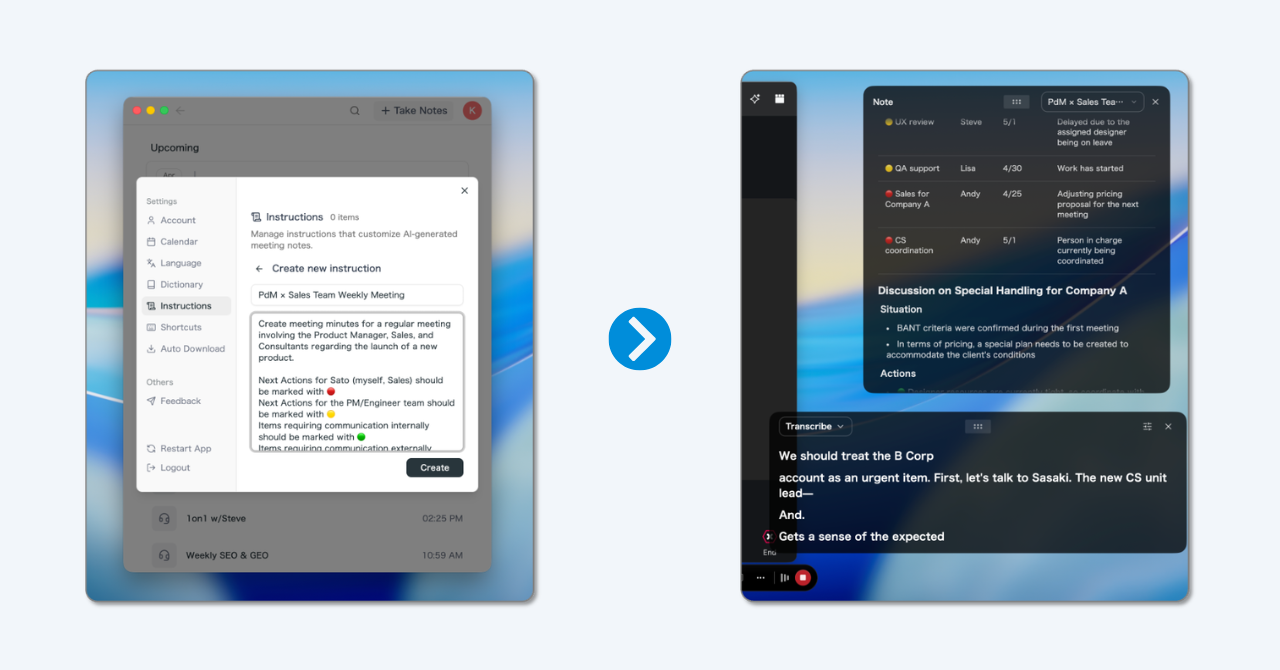
- Nobody plays scribe. The note grows during the meeting, so the post-retro cleanup of transcribing stickies into a doc simply disappears.
- Tries are captured the moment they are spoken. "Let's make ticketing mandatory next sprint" lands in the note as an owned Try in real time.
- Reviewing last retro's Tries takes seconds. Open the previous retro's note and the owned Tries are right there. You can also ask the cross-meeting AI chat: "List the Tries from our last three retros and any Problems that keep recurring."
- Multilingual teams stay in sync. Real-time translation across 50+ languages means a retro with your overseas office works, and everyone receives the summary in their own language.
One honest caveat: SuperIntern is a desktop app focused on live meetings and their notes. It is not a sticky-note whiteboard or a task manager. Many teams connect it through SuperIntern MCP to agents like Claude and push finished Tries into Linear or Jira as tickets. There is a free plan, so trying it at your next retro costs nothing.
FAQ
What does KPT stand for?
Keep, Problem, Try. Keep is what worked and should continue, Problem is what got in the way, and Try is the concrete change to attempt next.
Where does KPT come from?
KPT grew popular in Japan's agile and software community as a standard format for sprint retrospectives, and it has since spread to business teams of all kinds. It is closely related to formats like Start/Stop/Continue but leads more directly into experiments.
How often should we run a KPT retrospective?
For sprint-based teams, once per sprint (every one or two weeks). For other teams, biweekly or monthly. Cadence matters less than continuity: the next retro must open by reviewing the previous Tries. A single long retro once a quarter tends to fail because memories fade and the discussion drifts from facts to impressions.
How long should the meeting be?
For up to six people, 30 to 60 minutes. If you regularly exceed an hour, the period under review is too long, or Problem discussion is sliding into root-cause archaeology instead of Try design.
Does KPT work for remote teams?
Yes, arguably better than in person. The silent-writing phases translate naturally to shared docs, and because the meeting is already on your computer, botless AI notes can capture the discussion and the Tries without anyone taking minutes.
Is KPT the same as a sprint retrospective?
A sprint retrospective is the meeting; KPT is one format for running it. If your retros feel unstructured or fail to produce follow-through, adopting KPT inside your existing retro slot is usually the cheapest fix available.
Conclusion
KPT earns its popularity by being the smallest possible structure that still forces a retrospective to produce change. The success conditions are few: write Problems as facts, cap Tries at two or three and phrase them as verifiable behavior, give every Try an owner, and open every retro by grading the last one's Tries. Do those four things and your retros start compounding.
The record-keeping that holds it all together no longer needs a human scribe. Teach a botless AI assistant your KPT format once, and every retro leaves behind a structured, searchable note, while the team spends the meeting doing its actual job: deciding what to change.
Try SuperIntern Free : no bot in your meetings, live notes in your KPT format, and every Try carried reliably into the next retro.