MEDDPICC Explained: The 8 Elements, Discovery Questions, and a Deal Scorecard Template (2026)
Most deals that slip at the end of a quarter were never really qualified. The rep liked the buyer, the demo went well, and the forecast said "commit." Then procurement appeared, the budget owner turned out to be someone nobody had met, and the close date moved for the third time.
MEDDPICC is a qualification framework built to catch those gaps early. This guide explains what each of the eight elements means, which questions uncover them on a discovery call, and how to score a deal so your forecast reflects evidence instead of optimism. You will also find a copy-paste scorecard, a filled example from a mid-market deal, the mistakes that turn MEDDPICC into busywork, and a way to capture the answers live while the buyer is talking.
⚠️ This article was independently compiled based on publicly available information and user feedback as of November 2026.
Table of Contents
- What is MEDDPICC?
- MEDDIC, MEDDICC, and MEDDPICC: what changed
- The 8 MEDDPICC elements with discovery questions
- When MEDDPICC fits and when it is overkill
- How to score a deal: the MEDDPICC scorecard
- A filled MEDDPICC example
- Using MEDDPICC across the sales cycle
- 7 mistakes that turn MEDDPICC into busywork
- Capturing MEDDPICC live during sales calls
- FAQ
- Conclusion
What is MEDDPICC?
MEDDPICC is a B2B sales qualification framework that checks whether a deal has the eight things it needs to close: Metrics, Economic Buyer, Decision Criteria, Decision Process, Paper Process, Identify Pain, Champion, and Competition. Each letter is a question the seller must be able to answer with evidence from the buyer, not with a guess.
The framework grew out of MEDDIC, which is commonly credited to Dick Dunkel and Jack Napoli at the software company PTC in the 1990s. It spread through enterprise software sales because it gave managers a shared language for one hard question: are we actually in this deal, and do we know enough to forecast it?
| Letter | Element | The question it answers |
|---|---|---|
| M | Metrics | What measurable result does the buyer expect? |
| E | Economic Buyer | Who can say yes and release the budget? |
| D | Decision Criteria | How will they judge the options? |
| D | Decision Process | What steps and people stand between now and a decision? |
| P | Paper Process | What legal, security, and procurement steps come before a signature? |
| I | Identify Pain | What problem is costly enough to act on now? |
| C | Champion | Who inside the account is selling for you when you are not there? |
| C | Competition | What else are they considering, including doing nothing? |
MEDDPICC is not a call script or a pitch structure. It is a checklist of what you need to know. How you learn it, through good questions and good listening, is still up to you.
MEDDIC, MEDDICC, and MEDDPICC: what changed
You will see several spellings in job posts and sales playbooks. They are the same idea at different levels of detail.
| Version | Elements | What it adds | Typical use |
|---|---|---|---|
| MEDDIC | 6 | The original core: Metrics, Economic Buyer, Decision Criteria, Decision Process, Identify Pain, Champion | Simpler deals, teams new to formal qualification |
| MEDDICC | 7 | Competition as its own element | Crowded markets with frequent bake-offs |
| MEDDPICC | 8 | Paper Process, separated from the Decision Process | Enterprise deals where legal, security review, and procurement add weeks |
The "P" exists because many deals are lost after the buyer has already said yes. The champion is convinced, the economic buyer agrees, and then a security questionnaire, a data processing agreement, and a vendor onboarding form add six weeks. Tracking the paper process separately forces the seller to ask about it early.
How does MEDDPICC compare with other frameworks? BANT (Budget, Authority, Need, Timeline) is a quick first filter, useful for inbound leads and short cycles. SPICED (Situation, Pain, Impact, Critical Event, Decision) is popular for recurring-revenue and customer success motions. MEDDPICC is the most detailed of the three and fits long, multi-stakeholder deals best. Many teams use BANT to decide whether to book a discovery call and MEDDPICC once the deal is real.
The 8 MEDDPICC elements with discovery questions
For each element below you will find what "good" looks like, questions to ask, and the red flag that should lower your confidence. Ask the questions in your own words. Reading them off a list makes a discovery call feel like an audit.
Metrics
Metrics are the measurable outcomes the buyer expects, stated in their numbers. "Save time" is not a metric. "Cut onboarding from 30 days to 10 for 200 new hires a year" is.
- "How would you measure success six months after rollout?"
- "What does this problem cost you today in hours, revenue, or risk?"
- "Which number will your leadership look at to decide whether this worked?"
Red flag: the only numbers in your notes came from your own ROI calculator, not from the buyer.
Economic Buyer
The economic buyer is the person who can approve the spend and overrule a "no." This is often not your main contact, and it is not always the most senior person in the room.
- "Who signs off on an investment of this size?"
- "When you bought something similar last time, who made the final call?"
- "What does that person care about most this year?"
Red flag: you have never spoken with the economic buyer and your champion is reluctant to introduce you.
Decision Criteria
Decision criteria are the formal and informal standards the buyer will use to compare options: features, integrations, security, price, vendor stability, ease of use.
- "What would a vendor need to show for you to feel confident?"
- "Which requirements are must-haves and which are nice to have?"
- "Is there a written evaluation sheet or RFP?"
Red flag: the criteria appear to be written around a competitor's strengths, and nobody has asked you to influence them.
Decision Process
The decision process is the sequence of evaluations, meetings, and approvals that leads to a decision, with names and dates.
- "Walk me through what happens between today and a signed agreement."
- "Who else needs to be involved, and at what point?"
- "What could delay the decision?"
Red flag: the buyer says "we'll decide next month" but cannot name the meeting where it happens.
Paper Process
The paper process covers everything required to turn a yes into a signature: legal review, security and privacy assessments, procurement onboarding, and purchase orders.
- "Once you decide, what does legal and procurement need from us?"
- "Will your security team send a questionnaire? How long does review usually take?"
- "Do you sign on your paper or ours? Who redlines?"
Red flag: the close date sits two weeks after the expected decision, but security review alone typically takes four.
Identify Pain
Pain is the business problem that makes change worth the cost and effort. Strong pain is specific, felt by someone with influence, and tied to a consequence if nothing changes.
- "What happens if you don't solve this in the next six months?"
- "Who feels this problem most, and how often?"
- "Why is this a priority now rather than last year?"
Red flag: the pain is real but only felt by your contact, and leadership is not aware of it.
Champion
A champion has power or influence in the account, wants your solution to win, and actively sells it internally. A friendly contact who enjoys your calls is a coach, not a champion.
- "If you were presenting this to your leadership, what would you say?"
- "What's in it for you personally if this project succeeds?"
- "Can you help me get time with the economic buyer?"
Red flag: your "champion" cannot get you a meeting with anyone else, or will not share internal information.
Competition
Competition includes other vendors, internal tools the team wants to build, and the status quo. Doing nothing is the most common competitor in B2B sales.
- "What other options are you looking at, including keeping things as they are?"
- "What do you like about the alternatives?"
- "If you chose not to buy anything, what would happen?"
Red flag: the buyer says there is no competition. There almost always is, even if it is a spreadsheet.
When MEDDPICC fits and when it is overkill
MEDDPICC takes effort. Applying all eight elements to a $3,000 self-serve deal wastes everyone's time. Use the table below to decide how deep to go.
| Deal profile | Recommended depth | Why |
|---|---|---|
| Transactional, under a few thousand dollars, one decision maker | BANT or a short checklist | The cost of qualification exceeds the deal risk |
| Mid-market, 2-5 stakeholders, 1-3 month cycle | MEDDIC or MEDDICC | Champion and decision process matter, paper process is light |
| Enterprise, 6+ stakeholders, security review, 3-12 month cycle | Full MEDDPICC | Most losses come from unknown buyers, criteria, or paperwork |
| Expansion or renewal in an existing account | MEDDPICC focused on Metrics, Champion, and Competition | You already know the process; value proof and incumbency threats matter most |
A useful rule: the larger the deal and the more people involved, the more letters you should be able to fill in before you call it a forecast.
How to score a deal: the MEDDPICC scorecard
A scorecard turns qualification into something a manager can review in two minutes. The simplest version scores each element from 0 to 2.
| Score | Meaning |
|---|---|
| 0 | Unknown. We have not asked or the buyer has not answered. |
| 1 | Partly known. We have an answer, but it is secondhand or vague. |
| 2 | Confirmed. The buyer stated it directly, ideally in writing or with a name and date. |
With eight elements, the maximum is 16. Many teams set thresholds like these, adjusted to their own win data:
- 0-6: early stage. Keep discovering, and do not forecast it.
- 7-11: qualified pipeline. Name the two weakest letters and plan how to close them.
- 12-16: forecastable. Any remaining 0 should be an explicit, known risk.
Copy this template into your CRM notes, a shared doc, or your meeting notes:
# MEDDPICC Scorecard - [Account] / [Opportunity]
Stage: Discovery / Evaluation / Proposal / Negotiation
Last updated: [date] by [rep]

| Element           | Score (0-2) | Evidence (buyer's words, who, when) | Next action |
|-------------------|-------------|--------------------------------------|-------------|
| Metrics           |             |                                      |             |
| Economic Buyer    |             |                                      |             |
| Decision Criteria |             |                                      |             |
| Decision Process  |             |                                      |             |
| Paper Process     |             |                                      |             |
| Identify Pain     |             |                                      |             |
| Champion          |             |                                      |             |
| Competition       |             |                                      |             |

Total: __ / 16
Biggest risk:
Question to ask on the next call:
The "Evidence" column is the part that matters. A score of 2 without a quote, a name, or a date is just a feeling with a number on it.
A filled MEDDPICC example
Here is how a scorecard might look after two calls with a 400-person logistics company evaluating a customer support platform.
| Element | Score | Evidence | Next action |
|---|---|---|---|
| Metrics | 2 | Head of Support: "We need first response under 2 hours. Today it's 9." | Confirm the target with the VP |
| Economic Buyer | 1 | VP Operations signs, per our champion. Not met yet. | Ask champion for a 20-minute intro |
| Decision Criteria | 2 | Shared evaluation sheet: Salesforce integration, SSO, Japanese and English support | Send integration demo recording |
| Decision Process | 1 | "Decide by end of month," but no meeting named | Ask who attends the decision meeting |
| Paper Process | 0 | Not discussed | Ask about security review and MSA on next call |
| Identify Pain | 2 | Two enterprise customers escalated slow responses last quarter | Quantify churn risk with the champion |
| Champion | 1 | Support manager is enthusiastic but has not shared internal docs | Test: ask for the business case draft |
| Competition | 1 | "Looking at one other vendor," name not shared | Ask what they like about the alternative |
Total: 10 / 16. This is qualified pipeline, not a forecast. The two biggest gaps are the economic buyer and the paper process, so the next call should focus on those instead of another feature demo.
Using MEDDPICC across the sales cycle
You will not fill all eight letters on the first call, and you should not try. Different elements come into focus at different stages.
| Stage | Focus elements | Goal |
|---|---|---|
| Discovery | Identify Pain, Metrics, Champion | Confirm a real problem and someone who wants it solved |
| Evaluation and demo | Decision Criteria, Competition | Show how you meet the criteria, and influence them where you can |
| Business case | Metrics, Economic Buyer | Get the numbers in front of the person who approves the spend |
| Proposal and negotiation | Decision Process, Paper Process | Map every step to signature and remove surprises |
| Close and handoff | All, with Metrics carried forward | Hand customer success the metrics the buyer expects to see |
A short habit makes this work: at the end of each call, look at the scorecard and pick the one letter you will move on the next call. Write the question down before you hang up.
7 mistakes that turn MEDDPICC into busywork
- Filling fields to satisfy the CRM. If reps type "VP" into Economic Buyer to clear a required field, the scorecard becomes fiction. Managers should ask for the evidence, not the field.
- Interrogating the buyer. Eight letters do not mean eight blunt questions in a row. Weave them into a natural conversation about the buyer's problem.
- Confusing a coach with a champion. Friendly is not the same as influential. Test your champion by asking for something that costs them a little effort.
- Ignoring the paper process until the end. Security review and procurement are the most common reasons a "won" deal slips a quarter.
- Using your metrics instead of theirs. A buyer is moved by their own numbers. Your ROI deck is only useful once they agree with its inputs.
- Scoring once and never updating. A scorecard from week one is wrong by week six. Update it after every meaningful conversation.
- Relying on memory. Reps fill in MEDDPICC after the call from what they remember, which loses the buyer's exact words, the names they mentioned, and the dates they gave. That is exactly the evidence the framework depends on.
Capturing MEDDPICC live during sales calls
The last mistake is the hardest to fix by discipline alone. It is difficult to ask good questions, listen closely, and type evidence into eight fields at the same time. Most reps choose listening, then reconstruct the scorecard afterward.
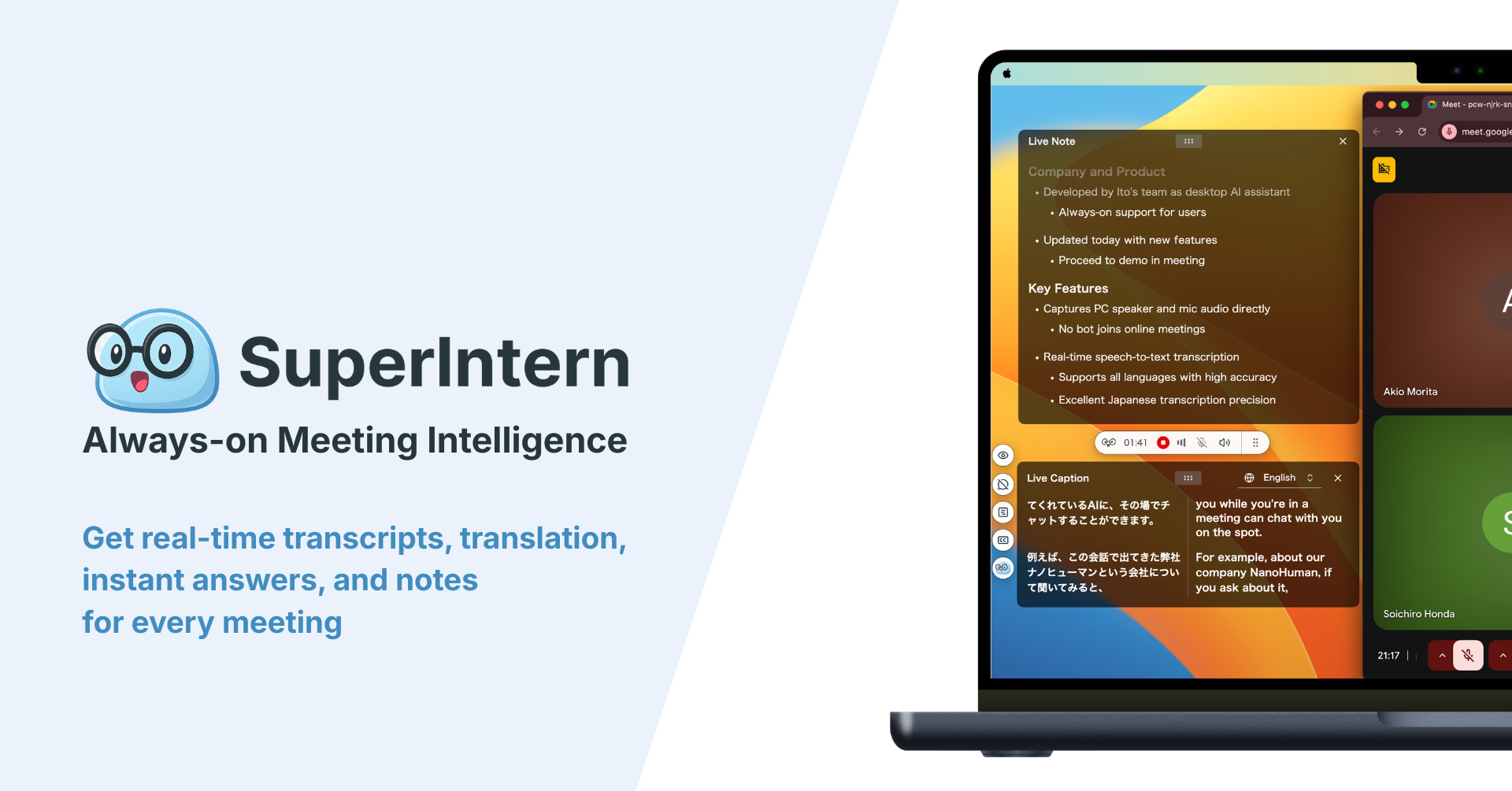
A real-time AI meeting assistant removes that trade-off. SuperIntern is a botless desktop app for Mac and Windows that captures the conversation through your computer's microphone and system audio. No bot joins the meeting, so the buyer does not see an extra participant, and it works the same in Zoom, Google Meet, Microsoft Teams, Webex, and in-person meetings.
How sales teams use it for MEDDPICC:
- A scorecard that fills itself in. AI Canvas lets you define the note format. Add an instruction like the one below, and the scorecard updates as the buyer talks.
Track this call against MEDDPICC.
For each element (Metrics, Economic Buyer, Decision Criteria, Decision Process,
Paper Process, Identify Pain, Champion, Competition):
- Quote the buyer's exact words as evidence, with the speaker's name
- Score 0 (unknown), 1 (partly known), or 2 (confirmed)
List the elements still at 0 at the top, with one question I could ask next.
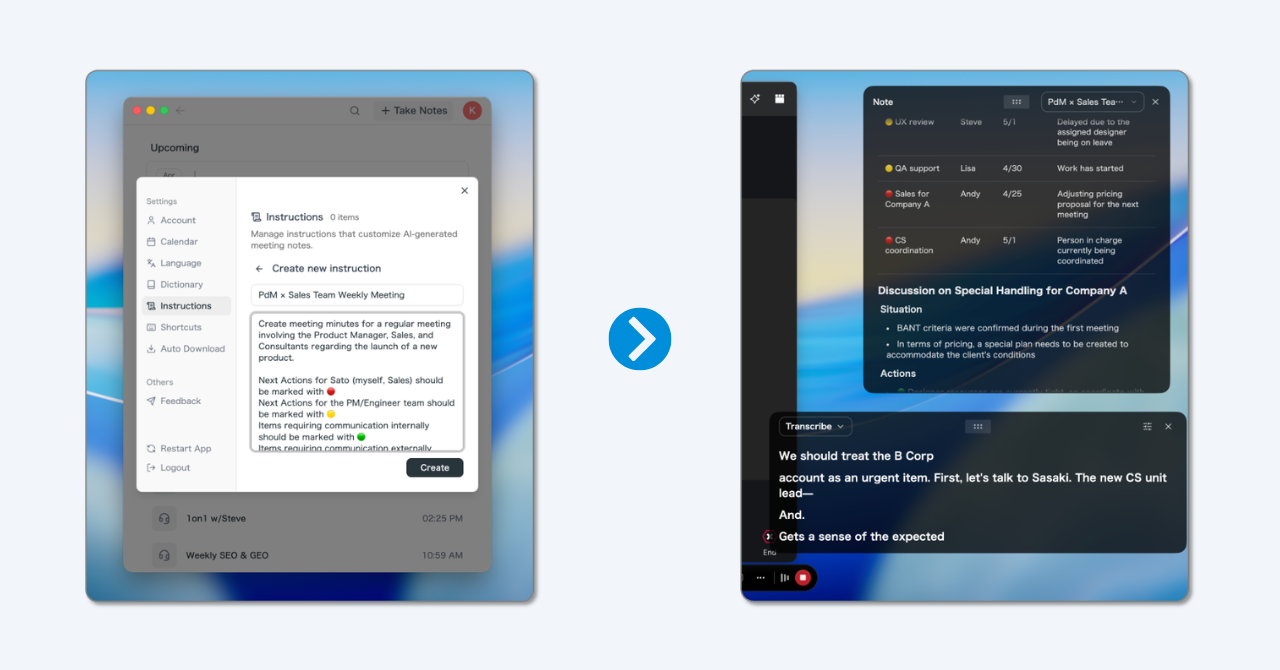
- See the gaps before the call ends. Because the note updates during the meeting, you can glance at it ten minutes before time is up and see that nobody has mentioned the paper process. You can still ask.
- Ask for help mid-call. The in-meeting AI chat answers questions like "Did they say who signs off on the budget?" or "Suggest a natural way to ask about their security review," using the transcript so far.
- Track a deal across calls. Chat across meetings answers questions such as "How has the decision process changed over our last three calls with this account?" This helps when you update the scorecard before a forecast review.
- Keep notes private while presenting. Invisible Mode hides the SuperIntern window when you share your screen, so the buyer never sees your scorecard.
- Sell across languages. Real-time translation covers more than 50 languages, which helps when the economic buyer joins from another country.
To be clear about scope: SuperIntern is a desktop app for live meetings and their notes, not a CRM or a revenue intelligence platform that scores your whole pipeline. Teams often send the finished scorecard to HubSpot or Notion through SuperIntern MCP with Claude or ChatGPT. Always get consent before recording; several US states require every party on the call to agree.
As of November 2026, the Free plan costs nothing and the Plus plan is $20 per month with 100 hours included. Live notes are available on the Free plan, so you can try a MEDDPICC template on your next discovery call.
FAQ
What does MEDDPICC stand for?
Metrics, Economic Buyer, Decision Criteria, Decision Process, Paper Process, Identify Pain, Champion, and Competition. Some teams read the "I" as "Implicate the Pain," which means helping the buyer see the consequences of not acting.
What is the difference between MEDDIC and MEDDPICC?
MEDDIC has six elements. MEDDPICC adds Paper Process (legal, security, and procurement steps) and Competition. The extra letters matter most in enterprise deals with long approval chains.
Is MEDDPICC better than BANT?
They solve different problems. BANT is a fast filter for whether a lead is worth a call. MEDDPICC is a deeper framework for managing and forecasting complex deals. Many teams use both at different stages.
How do you identify a real champion?
A champion has influence, benefits personally from your success, and takes action for you, such as sharing internal information or arranging a meeting with the economic buyer. If your contact never does any of these, treat them as a coach.
Do I need to ask all eight MEDDPICC questions on the first call?
No. Focus on pain, metrics, and a potential champion in discovery. Decision criteria, competition, and the paper process come into focus later. The scorecard shows which letters to work on next.
Can AI fill in a MEDDPICC scorecard?
AI can capture the buyer's words, organize them by element, and flag what is missing, which saves most of the manual work. The rep still needs to judge whether the evidence is strong enough and decide what to ask next.
Conclusion
MEDDPICC works when it is treated as evidence, not as a form. Four habits make the difference:
- Use the buyer's words. Every score should point to a quote, a name, or a date.
- Score honestly and often. A deal at 10 out of 16 with known gaps is more useful than a deal at 16 built on assumptions.
- Start the paper process early. Ask about security review and procurement while the buyer is still evaluating.
- Pick one letter per call. Before each conversation, decide which gap you will close.
Copy the scorecard above into your next deal and see which letters are still empty. And if you would rather listen than type during discovery, a botless AI assistant can capture the evidence for you while the buyer is talking.
Try SuperIntern Free. No bot in the meeting, and a MEDDPICC scorecard that fills itself in during the call.