Meeting Agenda: How to Write One That Works, With Templates and Examples (2026)
"Wait, what are we actually deciding today?" If that question comes up five minutes into a meeting, the meeting either has no agenda or has one that isn't doing its job. A 60-minute meeting with six people is a six-hour investment of team time. The agenda is the one-page document that decides, before anyone joins the call, whether that investment will pay off.
The word gets used loosely, though. Some teams mean a bare list of topics, some mean a detailed run of show, and plenty of calendar invites carry no agenda at all beyond a title. The difference between those versions is the difference between meetings that end early with decisions made and meetings that spawn follow-up meetings.
This guide covers what a meeting agenda actually is, how it differs from meeting minutes and other meeting documents, the seven building blocks of an agenda that works, a five-step writing process, three copy-paste templates, the mistakes that quietly break agendas, and how to connect your agenda to AI-generated meeting notes so the follow-through takes care of itself.
⚠️ This article was independently compiled based on publicly available information and user feedback as of August 2026.
Table of Contents
- What Is a Meeting Agenda?
- Agenda vs. Meeting Minutes vs. Briefing Notes
- The 7 Building Blocks of an Effective Agenda
- How to Write a Meeting Agenda in 5 Steps
- 3 Copy-Paste Meeting Agenda Templates
- A Good Agenda vs. a Bad Agenda: A Real Example
- Common Agenda Mistakes
- From Agenda to Meeting Notes, Automatically
- FAQ
- Conclusion
What Is a Meeting Agenda?
A meeting agenda is a plan, shared before the meeting, that lists what will be discussed, in what order, for how long, and with what expected outcome. It is more than a list of topics: a working agenda tells every participant why the meeting exists and what "done" looks like before anyone speaks.
The word comes from Latin: agenda is the plural of agendum, "a thing that must be done." That origin is a surprisingly good definition. An agenda is literally the list of things that must be done in the room, which is why a good one reads like a set of intended outcomes rather than a set of themes.
In business you will meet the word in two senses:
- A meeting agenda: the subject of this article. The plan for a specific meeting.
- A strategic agenda: a longer-term set of priorities, as in "the sustainability agenda" or the UN's "Agenda 21." Same root idea: a list of things to be acted on.
Agenda vs. Meeting Minutes vs. Briefing Notes
These documents show up around the same meeting and get mixed up constantly. The difference is when they are written and what they are for.
| Document | Written | Purpose | Contents |
|---|---|---|---|
| Agenda | Before the meeting | Share the meeting's design | Objective, topics, order, time boxes, owners |
| Meeting minutes | During or after | Record what happened | Decisions, key points, action items |
| Briefing note / pre-read | Before | Give context for one topic | Background, data, options for a single item |
| Summary / recap | After | Share outcomes quickly | Short digest of decisions and next steps |
The simplest way to remember it: the agenda is the plan, the minutes are the result. A healthy meeting produces both, and they should mirror each other. If your minutes never map back to the agenda, one of the two documents is decorative.
The 7 Building Blocks of an Effective Agenda
Format is flexible; substance is not. Agendas that work share these seven elements.
- Meeting name and a one-sentence objective. "What has to be decided for this meeting to be a success?" If you can't write that sentence, question whether the meeting should exist.
- Date, time, location, and duration. Include the call link. Simply stating an end time changes how people argue.
- Participants and roles. Facilitator, decision-maker, and note-taker (or the AI meeting assistant doing that job).
- The topic list. Each item gets an owner: the person who raised it and will introduce it.
- Time boxes. Rough minutes per topic. Precision matters less than the signal: 5 minutes for updates, 25 for the decision.
- Expected outcome per topic. Decision, input, or information. Three different conversations; label which one you want.
- A blank section for decisions and action items. Pre-building this into the agenda means the agenda becomes the skeleton of the minutes.
How to Write a Meeting Agenda in 5 Steps
Step 1: Write the objective as one sentence. Not "Marketing sync" but "Decide the Q4 campaign budget split." If the honest objective is only "share updates," first ask whether a document could replace the meeting.
Step 2: Collect topics from participants. Don't write the agenda alone. Open a shared doc and let attendees add items with their names attached. An item with an owner arrives pre-thought-through.
Step 3: Order by brainpower, not by tradition. Decisions first, updates last. Attention is highest in the first ten minutes; spending it on round-the-room status is the most common way meetings waste their best asset.
Step 4: Add time boxes and expected outcomes. "10 min, decision" or "15 min, input." When discussion drifts, the label gives the facilitator a graceful way back: "We're aiming for a decision today, so let's park that."
Step 5: Share it the day before, not at the start. An agenda revealed on screen at minute zero gives no one time to think. Shared a day early, it turns the meeting from a place where people start thinking into a place where people compare conclusions and decide.
3 Copy-Paste Meeting Agenda Templates
Paste these into your shared docs or notes tool. They are deliberately short: an agenda should create structure, not paperwork.
1. Weekly team meeting
# Weekly sync [team] - [date] ([start]-[end])
Objective: decisions and unblocking (status lives in the doc)

## Decisions needed (first)
- [Topic] - owner: [name] - [10 min, decision]

## Discussion
- [Topic] - owner: [name] - [15 min, input]

## Updates (5 min total, max)
- [FYI items only]

## Last week's action items
- [ ] [owner] - [task] - done?

## Outcomes (fill during the meeting)
- Decisions:
- [ ] [owner] - [task] - [due date]
2. Project kickoff
# Kickoff [project] - [date] ([60-90 min])
Objective: everyone leaves with the same goal, roles, and way of working

1. Background and goal - [sponsor] - [10 min, info]
2. Scope: in and out - [sponsor] - [15 min, decision]
3. Roles and ownership - [all] - [10 min, decision]
4. Milestones and deadlines - [PM] - [15 min, decision]
5. Ways of working (cadence, chat, notes) - [PM] - [10 min, decision]
6. Risks and open questions - [all] - [10 min, input]
7. Actions for week one - [PM] - [5 min, decision]
3. Decision meeting
# Decision meeting [topic] - [date] ([30 min])
Objective: [choose between option A and option B]
Decision-maker: [name] / Pre-read: [link] (read before the meeting)

1. Confirm the question and the criteria - [5 min]
2. Compare options (cost, impact, risk) - [10 min]
3. Questions and dissent - [10 min]
4. Decide and state the reasoning - [5 min]
A Good Agenda vs. a Bad Agenda: A Real Example
The same meeting, two agendas, two very different hours.
Before (an agenda that does nothing):
Oct 15 Marketing sync
- Campaign
- Website redesign
- AOB
There are topics, but no objective, no times, no expected outcomes. "Campaign" promises nothing, so nobody prepares, and the meeting starts with ten minutes of context reconstruction.
After (an agenda that works):
Oct 15 Marketing sync (2:00-2:45 pm)
Objective: decide the Q4 campaign budget split

1. Q4 budget split - Dana - 20 min, decision
   (pre-read: comparison sheet, please read by Tuesday)
2. Website redesign delay: how to respond - Sam - 15 min, input
3. Updates (new joiner, dates) - 5 min
4. Confirm decisions and actions - 5 min
Rewriting took five minutes. Those five minutes are the difference between a meeting that ends at 2:45 with a decision and one that ends at 3:10 with a follow-up scheduled.
Common Agenda Mistakes
- The agenda premieres at the meeting. Nobody had time to think, so the room thinks out loud, slowly. Share it the day before.
- Topics that end in a noun. "Budget" commits to nothing. "Decide budget split" contains its own success criterion. Write topics with verbs.
- No time boxes. The first topic expands to fill the hour and the last three get ninety seconds each. Time boxes are how you protect item four.
- An agenda made entirely of updates. If nothing is being decided, the meeting is a document with attendance. The agenda draft is the cheapest moment to notice that and cancel.
- Treating the agenda and the minutes as separate documents. The agenda's structure should become the minutes' skeleton. The next section shows how to automate exactly that.
From Agenda to Meeting Notes, Automatically
Even a perfect agenda leaves one job open: recording what actually happened, in the agenda's structure. Assign a note-taker and you lose half a participant. Write the notes afterward and the details fade with memory.
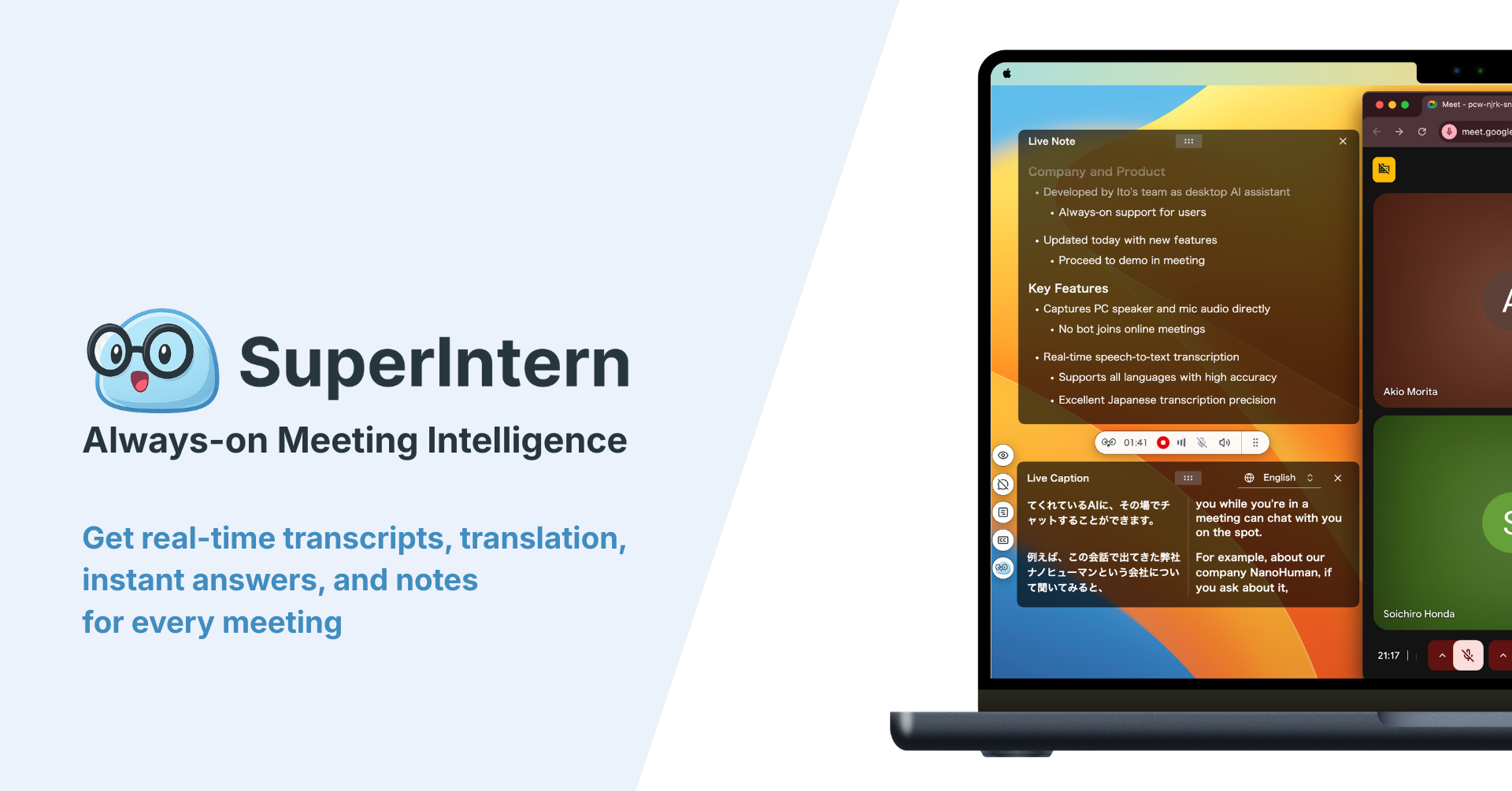
This is where a real-time AI meeting assistant fits. SuperIntern is a botless desktop app (Mac and Windows) that captures the meeting directly from your device audio. No bot joins the call, so there is nothing for external partners to admit or be distracted by, and it works identically across Zoom, Google Meet, Microsoft Teams, Webex, and in-person meetings.

Here is how the agenda pairing works in practice:
- Give AI Canvas your agenda. Before the meeting, describe your structure in plain language: "Record the decision and reasoning for item 1, collect input on item 2 as a list, and log action items with owners and due dates." During the meeting, the live note fills itself in exactly that shape.
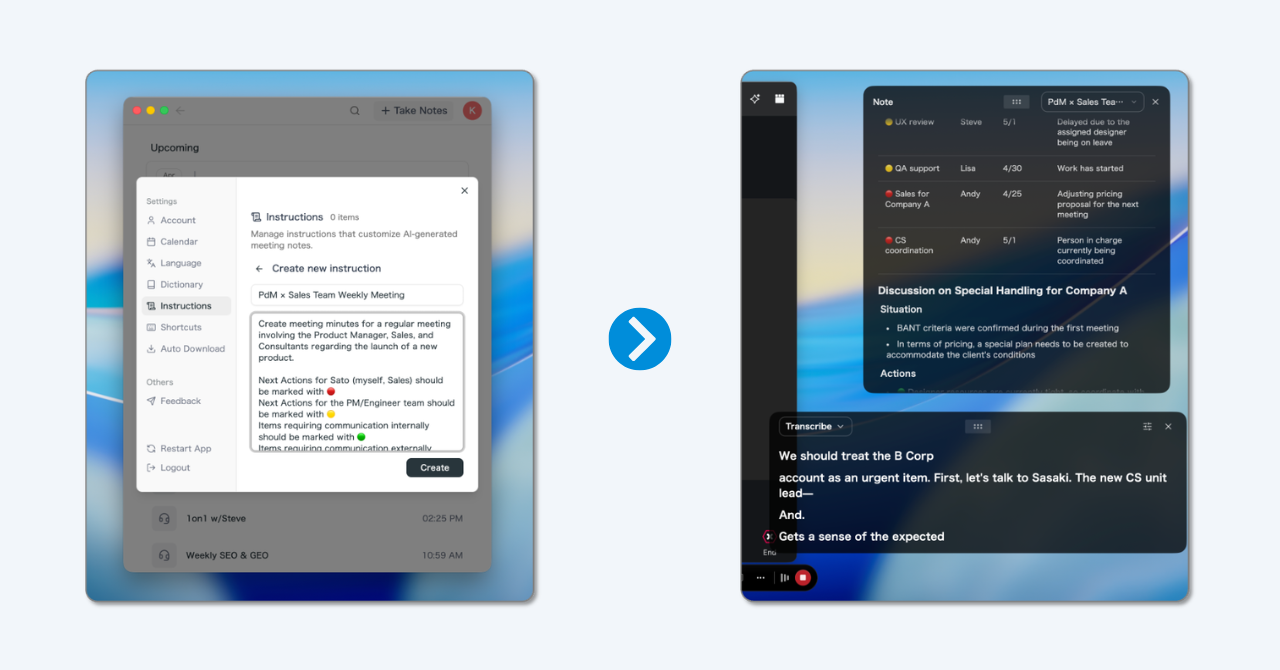
- The note-taker role disappears. Nobody trades participation for typing; the agenda no longer needs a "notes:" line at all.
- The minutes are done when the meeting ends. Your agenda's "outcomes" section is already filled in. A two-minute review and the notes ship the same day.
- "Last week's action items" fills itself. Ask the cross-meeting AI chat "what actions did we commit to in last week's sync?" and next week's agenda is pre-populated in seconds.
- Multilingual meetings can share one agenda. Real-time translation across 50+ languages means everyone follows the same items and receives the summary in their own language.
One honest caveat: SuperIntern is a desktop app focused on live meetings and what follows them. It does not send calendar invites or distribute your agenda for you. Design the meeting with the templates above; let the AI handle the record. There is a free plan, so trying it in your next meeting costs nothing.
FAQ
What is a meeting agenda, in simple terms?
It is the meeting's blueprint: a short document, shared in advance, that says why the meeting exists, which topics will be covered in what order and time, and what outcome each topic needs.
What is the difference between an agenda and meeting minutes?
The agenda is written before the meeting and describes the plan. The minutes are written during or after and record the result: decisions, key discussion points, and action items. In a well-run meeting they mirror each other.
Who should write the agenda, and when should it go out?
The organizer or facilitator owns it, but topics should be collected from participants. Share it at least a day before the meeting so people can prepare; an agenda revealed at the start of the call is mostly ceremonial.
How detailed should a meeting agenda be?
One page or less. Each topic needs an owner, a rough time box, and an expected outcome (decision, input, or information). More detail than that belongs in pre-reads, not the agenda.
Does a 15-minute meeting need an agenda?
It needs the one-sentence version: the objective and the expected outcome, written in the calendar invite. The shorter the meeting, the less time you can afford to spend discovering its purpose.
What does "agenda" mean outside of meetings?
The same root idea: a list of things to be acted on. In politics and strategy it means a set of priorities, as in the UN's "2030 Agenda." A meeting agenda is the small-scale, one-hour version of the same concept.
Conclusion
A meeting agenda is the plan that lists topics with an objective, an order, time boxes, and expected outcomes, shared before the meeting. The working formula is short: a one-sentence objective, topics written with verbs, time boxes with labeled outcomes, and distribution the day before. That is enough to turn most meetings from rooms where people start thinking into rooms where people decide.
And the agenda's twin document, the minutes, no longer needs a human author. A botless AI assistant writes the live notes in your agenda's structure, capturing decisions and action items as they are spoken. Design the meeting yourself; let the record write itself. That division of labor is what well-run meetings look like in 2026.
Try SuperIntern Free : no bot in your meetings, live notes structured exactly like your agenda, and decisions captured the moment they are made.