
How to Write Meeting Minutes: Practical Tips and Templates
Meeting minutes aren't just a record of what was said. They're a deliverable: a way to communicate decisions accurately to stakeholders and make next actions clear. Yet many people find that, when it comes time to actually write minutes, it's surprisingly difficult.
"I'm so busy taking notes during the meeting that I can't focus on the discussion itself."
"I don't know how to summarize the parts where the conversation went off track."
"Writing the minutes takes so long that it eats into my real work."
These problems can be dramatically reduced with just a few simple techniques.
In this article, we walk through the basics and best practices for writing meeting minutes with concrete examples, and then go one step further to introduce how to run meetings while sharing the minutes in real time. Whether you want to raise the quality of your minutes or improve the efficiency of the meetings themselves, this guide is for you.
⚠️ This article is based on publicly available information and user feedback gathered by our team as of February 2026.
Table of Contents
- What are meeting minutes actually for?
- Writing meeting minutes: 80% of the work happens before the meeting
- Writing meeting minutes: tips for taking notes during the meeting
- Writing meeting minutes: cleaning up after the meeting
- A meeting minutes template you can use right away
- Going further: raising meeting quality with real-time sharing
- SuperIntern: a tool that delivers real-time summarization
- Conclusion
1. What Are Meeting Minutes Actually For?
Before we get into tips for writing minutes, let's clarify why minutes are needed in the first place. Without a clear sense of purpose, it's easy to lose sight of what should go in them, and the quality of your minutes suffers.
Meeting minutes serve three main purposes.
Purpose 1: A record of decisions
Meetings typically work through multiple agenda items and arrive at some kind of conclusion for each one. Yet it's not unusual to walk away wondering, "Wait, what did we actually decide?" Minutes that clearly capture decisions ensure that everyone has the same understanding and prevent later "he said, she said" disputes.
Purpose 2: Clarifying next actions
Capturing decisions is only half the job. The other half is recording action items: who will do what by when. Without this, even the best meeting won't translate into execution.
Purpose 3: Sharing information with people who couldn't attend
Minutes let people who weren't in the meeting catch up on the discussion and the outcome. With remote work now common, it's increasingly rare for every relevant person to be on every call. Clean, readable minutes help absent colleagues get back up to speed quickly.
2. Writing Meeting Minutes: 80% of the Work Happens Before the Meeting
The biggest secret to good meeting minutes is preparation before the meeting starts. With solid prep, note-taking during the meeting and cleanup after the meeting both become dramatically easier.
Tip 1: Review the agenda in advance
Knowing the purpose and topics of the meeting ahead of time gives you a strong sense of "what we'll discuss" and "what kind of conclusion we're aiming for." If you build the agenda into your minutes template beforehand, all you need to do during the meeting is add notes under each item.
If no agenda has been shared, it's worth asking the meeting owner in advance: "Could you let me know today's goal and the topics we'll cover?" That small extra step makes a big difference in the quality of your minutes.
Tip 2: Know the attendees and their roles
Understanding who's attending, along with their positions and roles, makes it much easier to understand the context behind what's said. For meetings with first-time participants, jotting down names and affiliations beforehand will save you confusion when you organize the minutes later.
Tip 3: Have a template ready
Starting from a blank page is very different from filling in a structured template. Use the template we'll introduce below to pre-fill sections for topics, decisions, and action items before the meeting.
3. Writing Meeting Minutes: Tips for Taking Notes During the Meeting
Once the meeting starts, it's all about capturing the key points efficiently. Here are some practical tips you can apply in real time.
Tip 4: Don't try to write everything down
A common mistake is trying to transcribe every word that's said. If you chase every utterance, you'll lose track of the actual discussion.
What you really want in your minutes are the key points and conclusions. Focus on three things: what was discussed, what was decided, and who is going to do what. If you need to capture a specific nuance, jot down a keyword and flesh it out after the meeting.
Tip 5: Keep the 5W1H in mind
Using the 5W1H framework (Who / What / When / Where / Why / How) as you take notes helps prevent gaps. In meeting minutes, three of these are especially important.
- Who: the speaker and the person responsible for a task
- What: decisions and action items
- When: deadlines and the date of the next meeting
Just consistently capturing these three will give you minutes that are genuinely useful.
Tip 6: Use symbols and marks intentionally
Speed matters during a meeting. Defining your own set of symbols makes it much faster to skim and process your notes afterward.
For example, you could use:
- ★: decisions
- →: action items (add the owner's name)
- ?: items to confirm or items left open
- !: important statements or insights
A consistent symbol set lets you instantly tell decisions from open items when you assemble the final minutes.
Tip 7: Note who said what
When multiple teams or departments are in the room, recording who said what matters. It clarifies ownership and helps future readers understand the context.
You don't need to spell out full names. Initials or short nicknames are enough: things like "T→" or "S→" can keep you fast while still being identifiable.
4. Writing Meeting Minutes: Cleaning Up After the Meeting
Finalize the minutes as soon as possible after the meeting ends. Cleaning up while your memory is still fresh is the last key to producing accurate, readable minutes.
Tip 8: Share within 24 hours
The freshness of your minutes is directly tied to their value. The longer you wait, the more your memory fades and the more verification you'll need. Aim to share immediately after the meeting, and no later than 24 hours afterward.
Tip 9: Lead with the conclusion
People reading meeting minutes want to know what was decided first. Rather than walking through the discussion chronologically, structure your minutes as conclusion → background and key points → action items. This makes them far easier to read.
Tip 10: Use bullet points to stay concise
Bullets read more easily than prose. Aim for around 12 to 15 words per line, and write in short, declarative statements.
5. A Meeting Minutes Template You Can Use Right Away
Here's a template that puts the tips above into practice. Customize it for the type of meeting you're running.
[Meeting Name] XX Sync
[Date & Time] YYYY-MM-DD (Day) HH:MM - HH:MM
[Location] Meeting room / Online (Zoom, etc.)
[Attendees] Tanaka, Suzuki, Sato, Yamada
[Absent] Takahashi

# Topic 1: About XX
[Decisions]
- Move forward with XX under the YY approach

[Discussion Highlights]
- Tanaka: proposed YY from the XX angle
- Suzuki: cost concern noted; OK if ZZ

[Action Items]
- → Tanaka: draft a detailed YY plan (due: 2/20)
- → Suzuki: run a cost estimate (due: 2/21)

# Topic 2: About YY
(Same structure as above)

# Next Meeting
- Date & time: YYYY-MM-DD (Day) HH:MM -
- Planned topics: progress check on XX
The key is that each topic is organized in the order decision → key discussion points → action items. Stick to this format, and you'll produce consistently high-quality minutes for any meeting.
6. Going Further: Raising Meeting Quality with Real-Time Sharing
So far, we've covered tips for writing meeting minutes. Apply them consistently and the quality of your minutes will improve significantly.
But here's a deeper question: what if you could reduce the "write up the minutes after the meeting" step entirely? Wouldn't that be even more efficient?
The way to do that is to run the meeting while sharing the minutes in real time.
Two things that change with real-time sharing
Change 1: Misalignment gets resolved on the spot
When the minutes are visible on a shared screen during the meeting, everyone is literally on the same page. It becomes easy to confirm: "So your point is YY, right?" This prevents the "we had different understandings" problem from emerging after the fact.
Change 2: Meetings stay on topic
When the key points of the discussion are organized in real time, the flow of the meeting becomes visible to everyone. If the conversation starts drifting, a quick glance at the screen makes it obvious which topic you're supposed to be on, and self-correction happens naturally.
How this compares to the traditional approach
You can, of course, do real-time sharing with a tool like Google Docs and a designated note-taker who shares their screen. That's a perfectly valid form of real-time sharing.
The trouble is, that approach puts a heavy load on the note-taker, and it's hard for typing to keep up with the conversation. When typing speed lags behind speaking speed, important points get lost.
This is why AI-powered real-time summarization is gaining attention. AI transcribes the meeting automatically, organizes the key points, and surfaces them on screen, so real-time sharing happens without a human note-taker in the loop.
7. SuperIntern: A Tool That Delivers Real-Time Summarization
If you want to try AI-powered real-time summarization, we recommend SuperIntern.

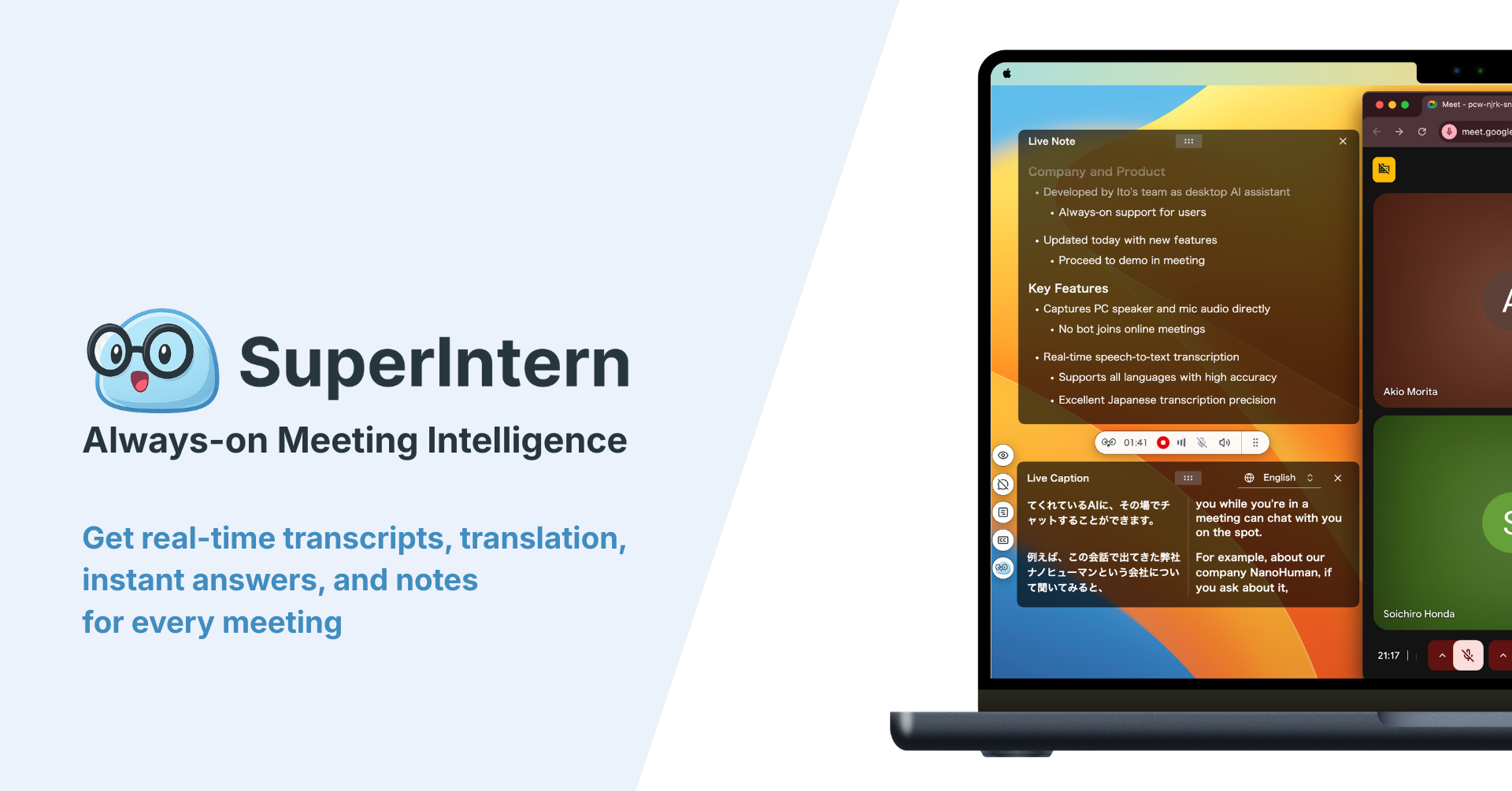
SuperIntern is an AI meeting notes tool that transcribes and summarizes the conversation in real time, organizing the key points into bullets. Because the key points are visible during the meeting, not just after, it dramatically reduces the burden of writing minutes while also raising the quality of the meeting itself.
What makes SuperIntern stand out
- Real-time summarization (Live Note): key points are auto-organized into bullets during the meeting, so you can track the discussion live and keep things on topic
- Bot-free design: audio is captured directly from your PC's microphone and speaker, so no bot joins the meeting and the other side never has to think about the tool
- High-accuracy multilingual support: optimized for English with strong performance across 50+ languages
- Automatic post-meeting minutes: a polished version of the minutes is generated automatically after the meeting ends
- AI chat: ask the AI, which already understands the meeting context, to handle follow-up work during or after the meeting
- Works with all major meeting platforms: Zoom, Google Meet, Microsoft Teams, Webex, and any other call where audio plays through your PC. In-person meetings work too.
Pricing
- Free: $0/month (no credit card required to get started)
- Plus: $22/month (100 hours included, $0.01/min beyond)
It's free, there's no credit card required, so the easiest next step is to try it in your next meeting.
8. Conclusion
This article walked through tips for writing meeting minutes and a more efficient way to run meetings.
10 tips for writing meeting minutes
Before the meeting:
- Review the agenda in advance
- Know the attendees and their roles
- Have a template ready
During the meeting:
- Don't try to write everything down (focus on key points and conclusions)
- Keep the 5W1H in mind
- Use symbols and marks intentionally
- Note who said what
After the meeting:
- Share within 24 hours
- Lead with the conclusion
- Use bullet points to stay concise
If you want to go further:
- Run meetings while sharing the minutes in real time
- Use SuperIntern, an AI real-time summarization tool, to take the note-taking burden to zero and stay focused on the discussion
Once you know a few simple techniques, writing meeting minutes becomes dramatically easier. And once you bring real-time sharing into the mix, you'll improve not just the minutes themselves but the productivity of the meeting overall.
Try the tips in this article and aim for meetings that work for you, not against you.