Objection Handling in Sales: 8 Techniques, 10 Real Examples, and a Team Playbook Template (2026)
"It's too expensive." "Just send me some information." "We already work with someone." Almost every sales conversation reaches a point where the buyer pushes back. Whether the deal keeps moving rarely depends on the product. It depends on what you do in the next thirty seconds.
This guide covers what objection handling is, how to separate genuine objections from smokescreens, and a five-step process you can apply to any objection. You will also find eight proven techniques with example phrasing, responses to the ten most common B2B sales objections, the mistakes that make objections worse, and a playbook template that helps your team learn from every call. The last section shows how AI can capture objections during the call and suggest responses in real time.
⚠️ This article was independently compiled based on publicly available information and user feedback as of October 2026.
Table of Contents
- What is objection handling?
- The 6 most common types of sales objections
- The 5-step objection handling process
- 8 objection handling techniques with example phrasing
- Objection handling examples: 10 common objections and how to respond
- Real objection or smokescreen? How to tell the difference
- 6 mistakes that make objections worse
- Template: an objection handling playbook for your sales team
- Capturing and analyzing objections with AI during the call
- FAQ
- Conclusion
What is objection handling?
Objection handling is the conversational skill of hearing a buyer's concern, understanding what is really behind it, and responding in a way that moves the conversation toward a decision. The term comes from sales, but the skill shows up anywhere you need to persuade someone: discovery calls, negotiations with procurement, pitching a project to leadership, or closing a candidate who is hesitating on an offer.
An objection is usually a good sign. Buyers who have no interest rarely argue. They politely end the call. An objection usually means, "I'm seriously considering this, but something is missing." Your job is to find out what.
It helps to separate three kinds of pushback:
| Objection | Smokescreen | Hard condition | |
|---|---|---|---|
| What it is | A genuine concern the buyer says out loud | A surface reason that hides the real concern | A fixed requirement you cannot change |
| Example | "I'm not sure we can roll this out in three months." | "Send me some materials." (really: not convinced of the value) | "We can only use vendors with SOC 2 Type II." |
| Right response | Understand, answer, confirm | Ask questions until the real reason surfaces | Check honestly whether you qualify, and walk away cleanly if not |
Reps who treat every pushback the same waste effort. They argue with smokescreens and try to persuade buyers whose hard conditions they cannot meet. Good objection handling starts with listening, not with a clever comeback.
The 6 most common types of sales objections
Objections sound different every time, but nearly all of them fall into six groups. Once you recognize the group, you know which question to ask next.
| Type | What the buyer says | What is often behind it | First question to ask |
|---|---|---|---|
| Price | "It's too expensive." | Value is not clear yet, or the budget sits with someone else | "Too expensive compared to what?" |
| Need | "We don't really need this." | The problem is not visible or not painful enough | "How do you handle this today?" |
| Timing | "Reach out next quarter." | Other priorities, no bandwidth, or a smokescreen | "What needs to happen before then?" |
| Trust | "We've never heard of you." | Fear of betting on an unknown vendor | "What would make you feel confident?" |
| Authority | "I need to run this by my boss." | They can't decide alone, or want cover | "What will your boss ask first?" |
| Status quo and competition | "We already use another tool." | Switching feels more painful than the gain | "If you could change one thing about your current setup, what would it be?" |
Notice the pattern: the first response to every objection is a question, not an answer. Only once you know what is behind the sentence can you choose the right argument.
The 5-step objection handling process
Most techniques share the same core sequence. Once it becomes habit, unexpected objections stop throwing you off.
Step 1: Let them finish and listen. Don't interrupt, even if you know the answer. Buyers often reveal the real concern in their second sentence. Note the objection in their exact words.
Step 2: Acknowledge without agreeing. "That's a fair question" shows you heard them. You are not conceding the point. You are removing the pressure for them to defend it.
Step 3: Ask and clarify the core. "What specifically feels expensive?" or "What makes you say that?" This is the most important step. It turns a vague objection into a specific problem you can actually solve.
Step 4: Respond to the clarified concern. Answer the core you just uncovered, not the original sentence. Use one of the techniques below, a customer story, or a number the buyer gave you earlier in the call.
Step 5: Confirm and agree on the next step. "Does that address your concern?" If yes, move toward a decision. If not, you have not found the real objection yet, so go back to step 3.
This sequence is often taught as the LAER model (Listen, Acknowledge, Explore, Respond). The principle is the same: understand first, answer second.
8 objection handling techniques with example phrasing
These techniques are tools for step 4. None works every time, so each one comes with a note on when to use it.
| Technique | How it works | Example phrasing | Best for |
|---|---|---|---|
| Clarifying question | Answer with a question instead of a rebuttal | "When you say expensive, is it the total cost or the monthly commitment?" | Vague, general objections |
| Yes, and | Accept part of the point and add a new angle | "Yes, setup takes time, and that's why we handle configuration in week one." | Factual objections with some truth |
| Boomerang | Turn the objection into a reason to buy | "Because your team is stretched so thin, automation pays off faster." | Time and workload objections |
| Feel, felt, found | Pair empathy with other customers' experience | "I understand how you feel. Other customers felt the same, and what they found was..." | Trust and uncertainty |
| Preempting | Raise a predictable objection before the buyer does | "You may be wondering how painful switching is. Here are three numbers." | Objections that come up in nearly every call |
| Compensation | Offset a weakness with a larger strength | "We're not the cheapest, but you'll stop paying for manual cleanup." | Price versus value |
| Social proof | Point to a comparable customer or case | "A company in your industry had the same requirement. Here's how we solved it." | Trust and risk |
| Conditional close | Make solving the objection the condition for moving forward | "If we can get you live by the end of November, are you ready to start?" | The last remaining objection |
Two notes from the field:
- Swap "but" for "and." "Yes, but" erases the first half of the sentence, so the buyer only hears the contradiction. "Yes, and" sounds like you are adding to their point.
- Combine techniques. A clarifying question almost always comes first. Depending on the answer, follow with compensation, social proof, or a boomerang, then close with a conditional close.
Objection handling examples: 10 common objections and how to respond
Treat these responses as starting points, not scripts. Adapt them to your product and your own voice, or they will sound memorized.
1. "It's too expensive." Ask: "Too expensive compared to your budget, or compared to another quote?" If it's budget, talk about term length, scope, or starting smaller. If it's a competing quote, check whether the two offers really include the same things.
2. "We don't have budget for this." "Understood. If this were a priority, whose budget would it come from?" Budget often exists, just not in your contact's department. Also ask when the next planning cycle starts.
3. "Just send me some information." A classic smokescreen. "Happy to. So I don't send you forty pages, which two things matter most to you?" Then book a time to walk through it together.
4. "We already work with a vendor." "Great, so you know the space. What's working well with them, and what would you change?" You don't need to criticize the competitor. You only need one gap they don't close.
5. "I need to talk to my boss." "Of course. What do you think they'll ask first?" Prepare the answers together, or offer to join the next conversation. This turns your contact into a champion.
6. "We don't really need this." "How does your team handle this today, and how many hours does it take each week?" When the buyer names the number, the need becomes concrete. If the honest answer is "almost none," you've saved both sides time.
7. "Reach out next quarter." "Sure. What needs to happen between now and then for this to make sense?" If it depends on a project or budget approval, write down the reason and the date. If there's no concrete reason, a different objection is usually hiding behind it.
8. "We don't have time to implement anything right now." Boomerang: "That's exactly why onboarding is designed to take as little of your team's time as possible. How many hours could you free up in the first week?"
9. "What about security and privacy?" A real objection that deserves a concrete answer. Cover where data is stored, certifications, your data processing terms, and how deletion works. Offer to answer the security team's questionnaire directly. Never dodge this one.
10. "Your competitor is cheaper." "Thanks for being upfront. Can I ask what's included in their offer?" Compare like for like. If they're cheaper for the same scope, explain plainly what your premium pays for, or adjust the scope.
Real objection or smokescreen? How to tell the difference
Smokescreens are harder to handle than objections because the real cause stays unspoken. Watch for these signals:
- The reason stays vague. "It's just not a good time" with no explanation is rarely the whole story.
- A resolved objection is instantly replaced by a new one. If price leads to timing and timing leads to the boss, the real concern is somewhere else.
- Body language doesn't match the words. Verbal agreement, but crossed arms or a glance away from the camera.
- The buyer avoids concrete next steps. Someone who wants "materials" but no follow-up call is looking for a polite exit.
The most effective tool against smokescreens is the isolating question: "Suppose we solved this. Is there anything else that would stop us from working together?" If the answer is no, it was a real objection. If the buyer hesitates and names something else, you've found the real reason.
6 mistakes that make objections worse
- Contradicting right away. "That's not true" forces the buyer to defend their position. Even if you're right, you lose the conversation.
- Discounting too early. Offering a discount at the first "too expensive" signals your price wasn't serious, and you never learn the real reason.
- Burying them in arguments. Five counterpoints feel like pressure. One fitting answer to the clarified concern lands harder.
- Taking it personally. The objection is aimed at a risk, not at you. Reps who feel stung get defensive and stop listening.
- Not confirming. Without asking "Does that address it?" you don't know whether your answer landed. The objection resurfaces in the next email.
- Not writing objections down. What the buyer raised in the call fades quickly afterward. If nobody records it, the proposal can't address it and the team can't learn from it.
Template: an objection handling playbook for your sales team
Individual reps improve with practice. Teams improve when they collect objections and share the answers that work. An objection playbook is the simplest way to do that. Copy this structure into a shared doc or spreadsheet.
# Objection Playbook - [Product / Team]
Last updated: [date]

## Objection: [buyer's exact words]
- Type: Price / Need / Timing / Trust / Authority / Status quo
- Times heard in the last 30 days:
- Deal stage: Discovery / Demo / Proposal / Negotiation
- What's usually behind it:
- Best clarifying question:
- Best response (from a real call):
- Proof: reference customer / metric / case study
- What did NOT work:
- Last updated by:

## Objection: [next objection]
...
How to keep the playbook useful:
- Use responses from real calls, not training slides. What a teammate actually said, and what actually worked, convinces reps more than any framework.
- Track frequency. Your top five objections show where your pitch, pricing, or website needs work.
- Share patterns with product and marketing. An objection that shows up in every third call is a product problem, not a sales problem.
- Review it monthly. New competitors and new pricing create new objections.
Capturing and analyzing objections with AI during the call
The weak spot of every objection playbook is the raw material. Reps write down what they remember after the call, which is rarely the buyer's exact words. And it's hard to listen closely while also typing out every objection.
A real-time AI meeting assistant fixes both. SuperIntern is a botless desktop app for Mac and Windows that captures the conversation through your computer's microphone and system audio. Because no bot joins the meeting, the buyer doesn't see an extra participant, and it works the same in Zoom, Google Meet, Microsoft Teams, Webex, and in-person meetings.
How to use SuperIntern for objection handling:
- Collect objections automatically. Add an instruction to AI Canvas such as "List every buyer objection in their exact words, tag it with one of the six types, and note how we responded." The note fills itself in while you talk.
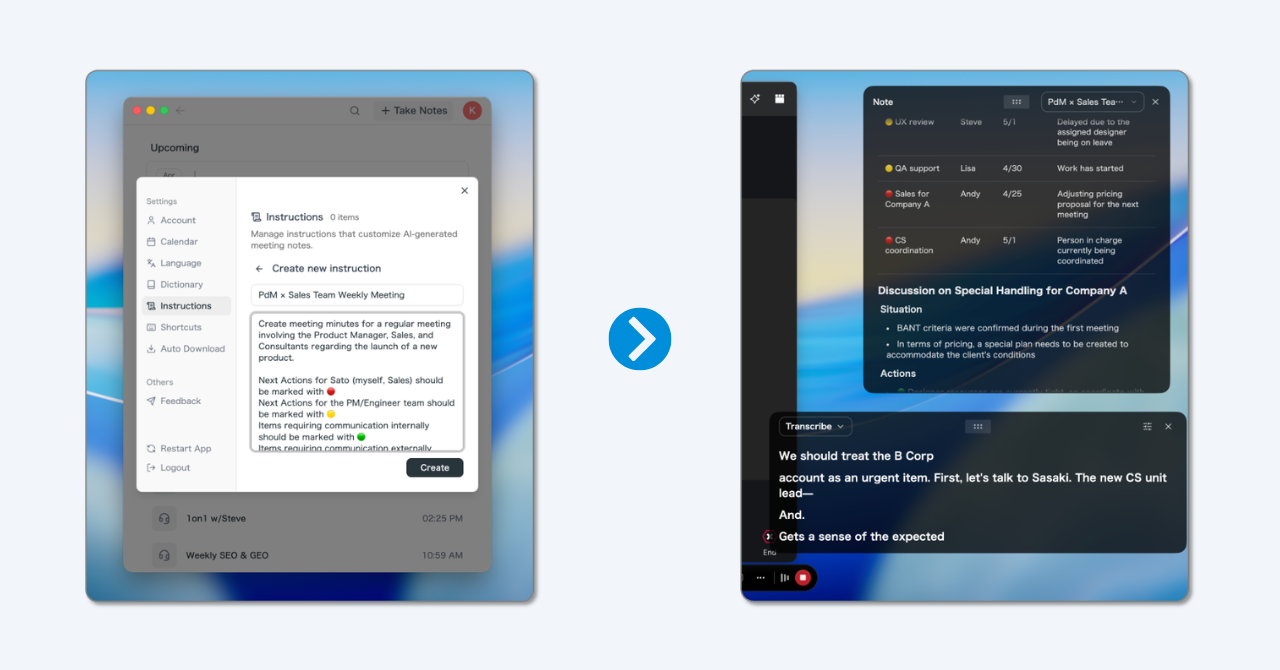
- Ask for a response mid-call. In the in-meeting AI chat, ask something like "How should I answer the security question they just raised?" The chat uses the transcript so far plus what is being said right now. Save requests you use often as skills and send them with one click.
- Analyze after the call. Chat across meetings answers questions like "Which objections came up most this month?" or "How did we respond to 'too expensive' in deals we won?" Your playbook gets built from real conversations.
- Stay discreet. Invisible Mode hides the SuperIntern window when you share your screen, so the buyer never sees your notes.
- Sell across languages. Real-time translation covers more than 50 languages, so an objection raised in Spanish or Japanese appears translated while the buyer is still talking.
To be clear about scope: SuperIntern is a desktop app for live meetings and their notes, not a CRM or a conversation-scoring coaching platform. Many teams pass the results to HubSpot or Notion through SuperIntern MCP with Claude or ChatGPT. Always get consent before recording; several US states require every party on the call to agree.
As of October 2026, the Free plan costs nothing and the Plus plan is $20 per month with 100 hours included. Live notes are available on the Free plan, so trying it on your next sales call costs nothing.
FAQ
What is the difference between an objection and a smokescreen?
An objection is a genuine concern the buyer states openly, such as price or implementation time. A smokescreen is a surface reason that hides a different, unspoken concern. You answer objections. You uncover smokescreens with questions.
What is the best objection handling technique?
No single technique fits every case. A clarifying question is almost always the right opening because it reveals the core of the objection. From there, choose compensation for price, social proof for trust, or a boomerang for time and effort.
How do I respond to "it's too expensive"?
First ask what the price is too high compared to: the budget, a competitor's quote, or the expected value. Each answer calls for a different response. Don't offer a discount until you know the reason.
Can you prevent objections?
Yes, by preempting them. Address the objections that come up in nearly every call during your pitch, before the buyer raises them. A thorough discovery at the start of the conversation also prevents many need and price objections.
How do you train a sales team on objection handling?
Collect real objections in a shared playbook, role-play the top five, and review clips from real calls together. An AI assistant that records objections word for word gives you the raw material.
Is it legal to record sales calls to analyze objections?
It depends on where you and the buyer are. Some US states require consent from only one party, while others require everyone on the call to agree, and many other countries have their own rules. The safe default is to tell the buyer at the start and get their agreement.
Conclusion
Objections don't mean a call is failing. They mean the buyer is seriously thinking. Four habits make the difference:
- Ask before you answer. Clarify the core of the objection before arguing.
- Separate objections from smokescreens. The isolating question shows whether you're working on the right issue.
- One fitting technique beats many arguments. Start with a clarifying question, then compensation, social proof, or a boomerang.
- Record objections and share them. Collected objections turn individual good calls into a better sales team.
Start with the ten examples above and the playbook template. And if you'd rather listen than type on your next call, a botless AI assistant can take the notes and suggest responses while the buyer is still talking.
Try SuperIntern Free. No bot in the meeting, objections captured word for word, and suggested responses during the call.