OKR Framework Explained: Definition, Examples, Template, and Common Failures (2026)

Most OKR rollouts do not die because of the framework. They die mid-quarter: ambitious goals get set in January, everyone feels energized for a week, and by mid-February nobody mentions them again until the quarter-end review forces the awkward question of what was actually agreed. OKR is rarely a wording problem. It is a rhythm problem.
This guide explains what the OKR framework is, how the cycle of planning, check-ins, and reviews works in practice, and walks through concrete examples from sales and product teams. It also covers the most common reasons OKRs fizzle out, how OKR differs from KPI, MBO, and SMART goals, a template you can copy today, and how AI meeting notes rescue the part of the method that fails most often: the weekly check-in.
⚠️ This article was independently compiled based on publicly available information and user feedback as of September 2026.
Table of Contents
- What is OKR?
- How the OKR cycle works
- OKR examples from real teams
- Writing key results that actually measure something
- Why OKRs fail: five common patterns
- OKR vs. KPI, MBO, and SMART
- An OKR template you can copy
- Checklist before your first OKR cycle
- Running OKR check-ins with AI meeting notes
- Frequently asked questions (FAQ)
- Conclusion
What is OKR?
OKR stands for Objectives and Key Results: a goal-setting method that pairs one qualitative, motivating goal (the Objective) with two to five measurable outcomes (the Key Results) that tell you, at the end of the cycle, whether you got there. The Objective answers "Where do we want to go?"; the Key Results answer "How will we know we've arrived?". An Objective without measurable Key Results is a wish. Key Results without an Objective are a metrics list with no direction.
The method was created by Andy Grove at Intel in the 1970s, originally under the name iMBO. It became famous when investor John Doerr brought it to Google in 1999, where it is still in use, and his 2018 book "Measure What Matters" carried it far beyond Silicon Valley. Companies of every size have since adopted OKRs with wildly different results, and the difference almost never comes down to how the goals were worded. It comes down to the discipline of the cycle.
Two traits separate OKR from classic goal-setting. First, transparency: OKRs are visible to everyone in the company, from the company level down to each team, so dependencies and conflicting priorities surface early. Second, separation from performance reviews: tie ambitious goals to bonuses and you will get cautious goals. OKR depends on the idea that hitting 70% of a genuinely ambitious target can be worth more than hitting 100% of a comfortable one.
How the OKR cycle works
OKR is less a document than an operating rhythm. A typical quarterly cycle runs on four meeting formats:
- OKR planning (start of quarter, 90 to 120 minutes). The team derives one to three Objectives from the company OKRs and writes two to five Key Results for each. The most common planning mistake is overload: five Objectives with five Key Results each means 25 numbers nobody keeps in their head. Cutting scope here is not modesty; it is focus.
- Weekly or biweekly check-ins (15 to 30 minutes). Each Key Result gets a current value, a confidence rating ("Are we still on track?"), and, when it is slipping, an agreed countermeasure. The check-in is the heart of the method, and it is exactly the meeting that busy calendars drop first.
- OKR review (end of quarter). Each Key Result is scored against its final value, usually on a 0-to-1 scale. The score matters less than the reasoning: why was the target hit or missed, and what does that imply for next quarter?
- OKR retrospective (after the review). This one is not about the goals but about the process: were the OKRs too ambitious or too safe? Did the check-ins actually happen? What do we change about the cycle itself?
Take these four formats seriously and you have understood most of the method. The wording craft that many OKR workshops obsess over is secondary.
OKR examples from real teams
Abstract definitions rarely help, so here are two concrete examples.
A B2B sales team that depends too heavily on inbound leads.
- Objective: Build a reliable outbound pipeline that doesn't rise and fall with marketing seasons.
- Key Result 1: Qualified outbound first meetings grow from 8 to 30 per month.
- Key Result 2: Reply rate on outbound sequences grows from 3% to 8%.
- Key Result 3: At least 5 outbound-sourced deals reach the proposal stage this quarter.
A product team with a leaky onboarding funnel.
- Objective: New users experience the product's core value in their first session.
- Key Result 1: Activation rate (first core action within 24 hours) grows from 34% to 55%.
- Key Result 2: Median time to first core action drops from 18 minutes to under 5.
- Key Result 3: Setup-wizard drop-off falls from 41% to under 20%.
Both examples follow the same pattern. The Objective is qualitative and directional, not a spreadsheet. Every Key Result has a baseline and a target, because without a baseline, check-in conversations turn into guesswork. And none of the Key Results is a task ("roll out an outbound tool"); each one is an outcome you can read off customer or user behavior.
Writing key results that actually measure something
The most common craft mistake is confusing outcomes with activities. An activity is done when you have done it; an outcome is achieved when something out in the world has changed.
| Weak as a key result (activity) | Stronger (outcome) |
|---|---|
| Roll out a new CRM | Average time from lead arrival to first contact drops from 2 days to 4 hours |
| Run 20 customer interviews | Three validated problem areas with willingness to pay are documented and ranked |
| Produce onboarding videos | New-user activation rate grows from 34% to 55% |
| Launch a weekly newsletter | Weekly active readers reach 2,000 with an open rate above 40% |
Activities are not forbidden; they belong one level lower, on the initiative list that feeds a Key Result. The check-in then shows whether the initiatives are working, because the Key Result moves, or it does not, and then you need new initiatives rather than new explanations.
A rule of thumb for ambition level: committed OKRs (contractual or regulatory targets, for example) should land at 100%. Aspirational OKRs are set so that roughly 70% achievement counts as a good quarter. A team that hits 100% across the board every quarter is not setting ambitious goals; it is scheduling its existing workload.
Why OKRs fail: five common patterns
- Set and forget. The OKRs are born in a planning workshop, move into a document, and resurface only at the review. Without weekly contact with the numbers, OKR stays a ritual. Fix: book the recurring check-in series the moment the OKRs are agreed.
- OKRs are KPIs with a new label. "Revenue from 2.0M to 2.2M" as an Objective is business as usual wearing a lanyard. OKRs exist to drive change, not to describe normal operations. Fix: for every Objective, ask what change in behavior or state it should cause that would not happen anyway.
- Too many goals. A team chasing seven Objectives is not prioritizing; it is cataloguing. Fix: one to three Objectives per team per quarter, and put the cut candidates on a visible "deliberately not this quarter" list.
- Check-ins lose their memory. The team does meet, but the confidence ratings, blockers, and countermeasures discussed live nowhere. Two weeks later the same discussion starts from zero, and at the review nobody remembers why a Key Result slid in February. Fix: every check-in leaves a written record of values, assessments, and decisions, and every new check-in opens with the previous one.
- OKR as a performance-review instrument. The moment achievement rates feed bonus formulas, everyone negotiates targets downward. Fix: OKR results feed learning and priority discussions; performance evaluation runs separately.
OKR vs. KPI, MBO, and SMART
These terms get lumped together, but they answer different questions and combine well.
| Framework | Core idea | Core question | Relationship to OKR |
|---|---|---|---|
| OKR | Ambitious goals with measurable results on a quarterly rhythm | What change are we driving right now? | ― |
| KPI | Standing metrics that monitor the running business | Is the operation healthy? | KPIs watch the steady state; a persistently slipping KPI is a good OKR candidate |
| MBO | Annual goal agreements between manager and employee, often tied to compensation | What does the individual owe the organization? | OKR is the successor: shorter cycle, transparent, decoupled from pay |
| SMART | Quality criteria for individual goals (specific, measurable, achievable, relevant, time-bound) | Is this goal well formed? | SMART checks the wording of individual Key Results but provides no cycle |
The short version: KPIs are the dashboard, OKRs are this quarter's route, SMART is the grammar check for individual goals, and MBO is the predecessor whose weaknesses (annual rhythm, silos, bonus coupling) OKR was built to fix.
An OKR template you can copy
Copy this template into your shared workspace and duplicate it per team and quarter.
# OKR ― [Team] ― [Quarter]
Owner: [Name]   Check-in: [weekly/biweekly, recurring calendar slot booked: yes/no]

## Objective 1: [qualitative, motivating goal in one sentence]
Contributes to company OKR: [link]
Type: [committed / aspirational]

- KR 1.1: [metric] from [baseline] to [target]   Data source: [dashboard/report]
- KR 1.2: [metric] from [baseline] to [target]   Data source: [...]
- KR 1.3: [metric] from [baseline] to [target]   Data source: [...]

## Check-in log (append per session)
[Date] ― KR 1.1: [current value], confidence: [high/medium/low]
  Blocker: [...]   Countermeasure: [who does what by when]

## Review (end of quarter)
- KR 1.1: final value [x], score [0.0–1.0], reasoning: [...]
- Learnings for the next cycle: [...]
Three usage notes. Book the check-in series when the OKRs are agreed, not later. Fill in baselines before the quarter starts, because without them every check-in is estimation. And keep the check-in log in the same document as the OKRs, so the review and retrospective do not begin with archaeology.
Checklist before your first OKR cycle
- Are there at most three Objectives per team?
- Does every Key Result have a baseline, a target, and a named data source?
- Does every Key Result describe an outcome rather than an activity?
- Is each Objective marked as committed or aspirational?
- Is the recurring check-in already on everyone's calendar?
- Is it agreed where the check-in log lives?
- Is goal achievement decoupled from bonus and salary decisions?
- Does every team member know which higher-level OKR they contribute to?
If you can tick all eight boxes, you are starting better prepared than most OKR rollouts.
Running OKR check-ins with AI meeting notes
Look back at the failure patterns and one thing stands out: OKR rarely fails at wording and almost always fails at rhythm. The critical moments are meetings, the planning session, and above all the weekly check-ins where confidence ratings, blockers, and countermeasures get discussed out loud and recorded far too rarely. The check-in happens; its record does not.

That is exactly the part an AI meeting assistant takes over. SuperIntern is a botless desktop app for Mac and Windows that records meetings straight from device audio, with no bot joining the call. That makes it work identically across Zoom, Google Meet, Microsoft Teams, and Webex, and in the meeting room where plenty of check-ins actually happen.
Applied to OKRs:
- Teach the AI Canvas your check-in format once. An instruction like "this is an OKR check-in; capture each Key Result's current value, confidence rating, blockers, and agreed countermeasures with owners" is enough, and every check-in produces a structured record in real time while the team debates instead of taking minutes.
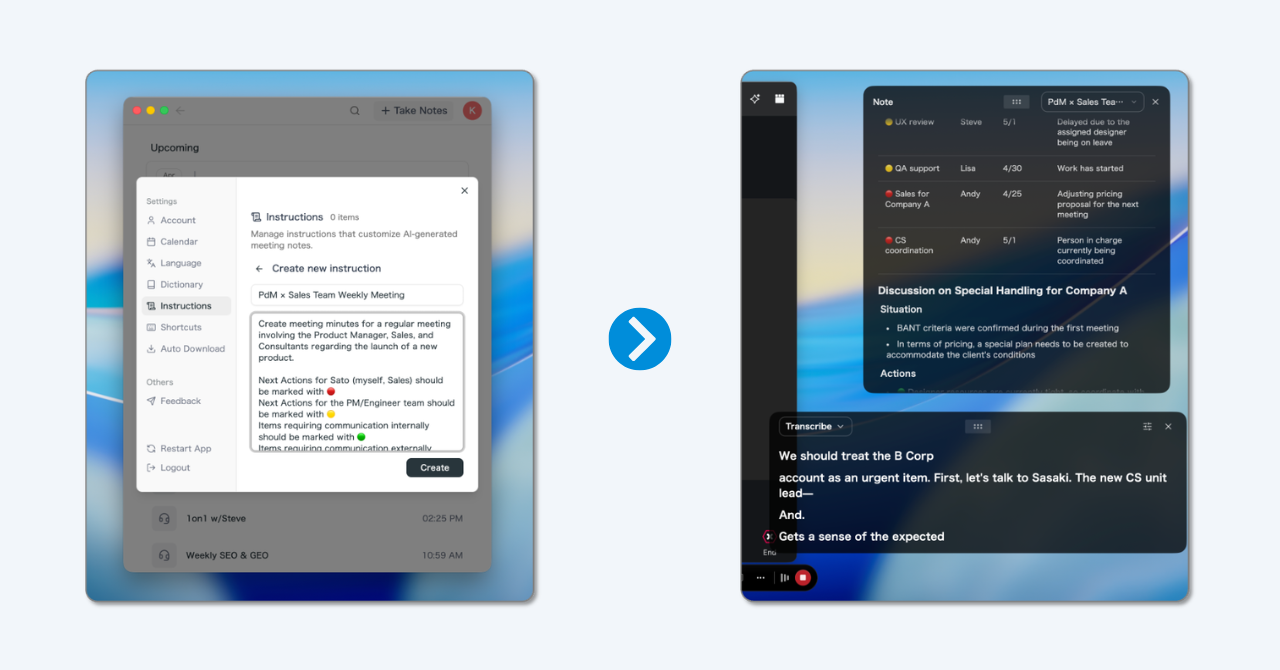
- Decisions are captured the moment they are spoken. "We're reworking the outbound sequence and revisiting the reply rate in two weeks" lands in the notes as a decision with an owner, not as something someone hopefully remembers.
- The whole quarter stays queryable. Before the review, ask the cross-meeting AI chat: "How did our confidence on KR 1.2 evolve across the last six check-ins, and which countermeasures did we agree on?"
- Distributed teams check in across languages. With real-time translation across 50+ languages, a check-in between offices needs no shared native language, and each side reads the summary in its own.
In the interest of honesty: SuperIntern is a live meeting recorder with note-taking, not an OKR tracking dashboard. Key Result numbers still come from your own analytics and CRM systems, and many teams push agreed actions into tools like Linear or Jira afterwards via SuperIntern's MCP integration with agents like Claude or ChatGPT. There is a free plan, so trying it in your next check-in costs nothing.
Frequently asked questions (FAQ)
What does OKR stand for?
Objectives and Key Results: one qualitative goal (Objective) paired with two to five measurable outcomes (Key Results). The method comes from Andy Grove at Intel and became world-famous through John Doerr at Google and his book "Measure What Matters".
What is the difference between OKR and KPI?
KPIs permanently monitor the health of the running business, like revenue, churn, or delivery time. OKRs drive a targeted change for a limited period. They complement each other: a KPI that keeps slipping is a strong candidate for next quarter's OKR.
How many OKRs should a team have?
One to three Objectives per quarter, each with two to five Key Results, is a proven range. More Objectives means less focus in practice; whatever does not fit belongs on a visible list of deliberately postponed topics.
How often should OKR check-ins happen?
Weekly or biweekly, 15 to 30 minutes. The exact interval matters less than the regularity and the written record. A quarter without check-ins is not an OKR cycle; it is two meetings with a document in between.
Do OKRs have to be achieved 100%?
Committed OKRs, yes. Aspirational ones, no: around 70% achievement counts as a good result on genuinely ambitious goals, and constant 100% scores suggest the targets are too safe. What matters is agreeing on this expectation before the quarter, not after.
Does OKR work for small teams?
The method scales down well, often better, because cross-level alignment overhead disappears. A small team sensibly starts with a single Objective and a weekly 15-minute check-in before expanding the process.
Do you need dedicated OKR software?
Not to start. A shared document with the template from this article covers the first cycles. Dedicated OKR software earns its keep when many teams link their OKRs and leadership needs an overview of dozens of goal trees.
Conclusion
OKR has survived since the Intel years because it forces two honest questions: which change actually matters to us this quarter, and how will we measure whether it is happening? Teams that struggle with the method almost never struggle with those questions. They struggle with overloaded goal catalogs, with Key Results that are task lists in disguise, and with check-ins that get skipped or evaporate without a trace.
Fix those three things and the cycle starts to run. One to three Objectives, not seven. Key Results with a baseline, a target, and a data source. And check-ins whose record writes itself, so assessments and decisions outlive the memory of the people who spoke them.
Try SuperIntern Free ― botless AI meeting notes that record OKR check-ins in real time and keep the whole quarter searchable for review and retrospective.