Performance Review Meetings: Preparation, Questions, Template, and Notes. The 2026 Guide
The performance review meeting is one of the few rituals that exists in almost every company and is underestimated in almost all of them. Once a year, manager and employee sit down, walk through a rating form, agree on three goals, and revisit the topic twelve months later. Both leave the room feeling a duty has been fulfilled, and nothing changes.
The conversation itself is not the problem. A well-run review meeting is the moment where expectations get said out loud, growth ambitions become visible, and friction becomes solvable. What is usually missing is not goodwill but structure: real preparation on both sides, questions that surface more than "all good", and a record that someone can still rely on six months later.
This guide covers exactly that: the types of review conversations, a preparation checklist for managers, example answers for employees, a five-phase meeting flow, a question catalog, a copy-paste template, and a way to produce the written record without staring at your keyboard while the other person is talking.
⚠️ This article was independently compiled based on publicly available information and user feedback as of July 2026.
Table of Contents
- What is a performance review meeting?
- The types of review conversations
- How to prepare as a manager: a checklist
- How to prepare as an employee: example answers
- The 5 phases of a good review meeting
- Performance review questions that work
- Copy-paste performance review template
- The notes: documenting without losing the conversation
- Common performance review mistakes
- FAQ
- Conclusion
What is a performance review meeting?
A performance review meeting is a planned, confidential one-on-one conversation between a manager and an employee with a clear purpose: looking back at performance, setting goals, discussing growth, exchanging feedback, or addressing a specific problem. Unlike a hallway chat, it is announced in advance, prepared, and documented.
That also separates it from the recurring 1:1. The weekly or biweekly 1:1 is an informal pulse check where the employee sets the agenda. The review meeting, whether it is an annual review or a goal-setting conversation, is more formal, less frequent, and usually follows a company framework. The two formats do not replace each other, they compound: managers who run regular 1:1s see no surprises in the annual review, and the goals agreed in the review feed the 1:1s in between.
Three traits mark a good review meeting:
- It is a dialogue, not a verdict. Both sides prepare, both sides give feedback. A meeting where only the manager evaluates is an announcement with chairs.
- It ends in agreements. Concrete goals, owners, dates. Without captured outcomes it is a pleasant conversation with no consequences.
- It is documented. The notes are the bridge to the next conversation. Without them, every annual review starts from zero.
The types of review conversations
"Performance review" is an umbrella term. In practice you will mostly meet these formats:
| Conversation type | Purpose | Typical cadence |
|---|---|---|
| Annual review | Look back, performance assessment, outlook | Yearly |
| Goal-setting conversation | Define goals, often tied to compensation | Yearly or twice a year |
| Development conversation | Career, skills, next steps | Once or twice a year |
| Feedback conversation | A specific behavior or piece of work | As needed |
| Difficult conversation | Problems, underperformance, tension | As needed |
| Return conversation | After a longer absence, such as illness or parental leave | As needed |
This guide uses the annual review as its main case, since it is the most comprehensive format. The preparation, questions, and template transfer to the other types; just drop the sections you do not need.
How to prepare as a manager: a checklist
The quality of a review meeting is decided before it starts. Walk in unprepared and you will talk about the last two weeks, not the year. This checklist covers the preparation:
- Announce the meeting early, at least one to two weeks ahead. An invitation with no lead time signals that the employee's perspective is not really wanted. Name the purpose, the duration, and the topics.
- Share guiding questions in advance. Send the agenda or the template below beforehand so both sides prepare the same points.
- Review the whole year, not the last weeks. Go through your 1:1 notes, project outcomes, and earlier feedback. Recency bias, overweighting whatever happened most recently, is the most common assessment error.
- Collect concrete examples. For every piece of feedback, positive or critical, have at least one specific situation. "You don't communicate enough" is an accusation; "on project X we only learned about the delay in the review" is a discussable fact.
- Reread the last review's notes. Which goals were agreed? What did you promise? Nothing undermines an annual review like a manager who forgot their own commitments from last time.
- Protect the setting. A quiet room or a stable video call, no double booking, phone silenced. Plan 60 to 90 minutes for an annual review.
How to prepare as an employee: example answers
As an employee, do not let the meeting simply happen to you. If you prepare, you shape the conversation instead of only reacting to it. Collect in advance: your three most important results of the year, one or two things you want to change, and the direction you want to grow in.
These are the questions to expect, with phrasings you can adapt:
- "How would you sum up your year?" Answer with results, not with "pretty good": "Three things stand out for me: project A went live, the complaint rate in my area went down, and I onboarded two new colleagues."
- "Where do you see your weaknesses?" Honest, but with a direction: "I tend to hold on to tasks too long instead of handing them off. I'm working on delegating earlier and would like to develop that deliberately."
- "Where do you want to grow?" Specific beats generic: "I want to move into a technical lead role within the next two years. As a first step, I'd like to take on the sub-project lead next quarter."
- The salary topic. If it belongs in this meeting, prepare it with facts: responsibilities taken on, results, market data if useful. And clarify beforehand whether the annual review is the intended place for it or whether it deserves a separate meeting.
Write your points down before the meeting. Under pressure, most people forget half of what they wanted to say.
The 5 phases of a good review meeting
An annual review that just walks down the HR form's rating scale feels like an exam. A five-phase flow works better:
| Phase | Content | Share of time |
|---|---|---|
| 1. Opening | Set the frame, create the atmosphere, confirm the agenda | 5% |
| 2. Looking back | Both perspectives on the year, wins and difficulties | 30% |
| 3. Feedback | Concrete feedback in both directions | 25% |
| 4. Goals and growth | Goals for the next period, development steps, support needed | 30% |
| 5. Closing | Summarize agreements, clarify notes and follow-up | 10% |
Three notes on the flow:
- Let the employee speak first in phase 2. A manager who opens with their own assessment gets agreement or defense afterwards, never an honest self-evaluation.
- Separate the look back from the goals. When assessment and goal-setting blur together, the employee negotiates the consequence of every single point of feedback.
- Summarize out loud at the end. Say every agreement once: who does what by when. What is not said out loud here will not end up in the notes either.
Performance review questions that work
Good questions are the difference between a form walkthrough and a conversation both sides take something away from. A selection by phase:
Looking back and self-assessment
- What are you most proud of this year?
- Which task drained the most energy, and why?
- What could I have done as your manager to make your year better?
Collaboration and environment
- Where do you lose time to processes or coordination?
- Who is easy to work with, and where is there friction?
- Do you feel your work is visible to the right people?
Growth and motivation
- Which tasks would you like to do more of, and which less?
- Which skill do you want to build next year?
- Where do you see yourself in two to three years, and what is missing on the way there?
Closing
- What are you taking away from this conversation?
- Is there anything you wanted to raise that we have not covered?
The same rule as in 1:1s applies: a few questions with real follow-up beat the full catalog at speed. And after an honest answer, stay quiet for a moment. The most important sentence often comes after the pause.
Copy-paste performance review template
You can paste this template straight into your document, HR tool, or note-taking app. It works for annual reviews and goal-setting conversations; for other types, delete the sections you do not need.
# Review meeting – [Name] – [Date]
Type: [Annual review / Goal-setting / Development / Feedback]
Participants: [Manager, employee, others if any]

## Looking back
- Employee's self-assessment:
- Manager's assessment:
- Key results and wins:
- Difficulties and blockers:

## Feedback
- Feedback to the employee (with examples):
- Feedback to the manager (with examples):

## Goals for the next period
- Goal 1: [measurable] – by [date]
- Goal 2: …
- Support / resources needed:

## Growth
- Development goal / career step:
- Agreed actions (training, projects, mentoring):

## Agreements
- [ ] Owner – Task – Due date
- Next review date:
The most important block is the last one. Goals and agreements with owners and dates are what make the meeting matter beyond the day itself.
The notes: documenting without losing the conversation
In a review meeting, documentation is not a side quest, it is part of the substance: agreed goals must be checkable, feedback should still be traceable months later, and nobody wants to argue next year about what was actually said this year.
At the same time, note-taking costs more here than in any other meeting. A review conversation runs on trust and attention. A manager who looks at the keyboard during the answer signals the opposite. And writing the notes from memory in the evening captures what stuck, not what was said.
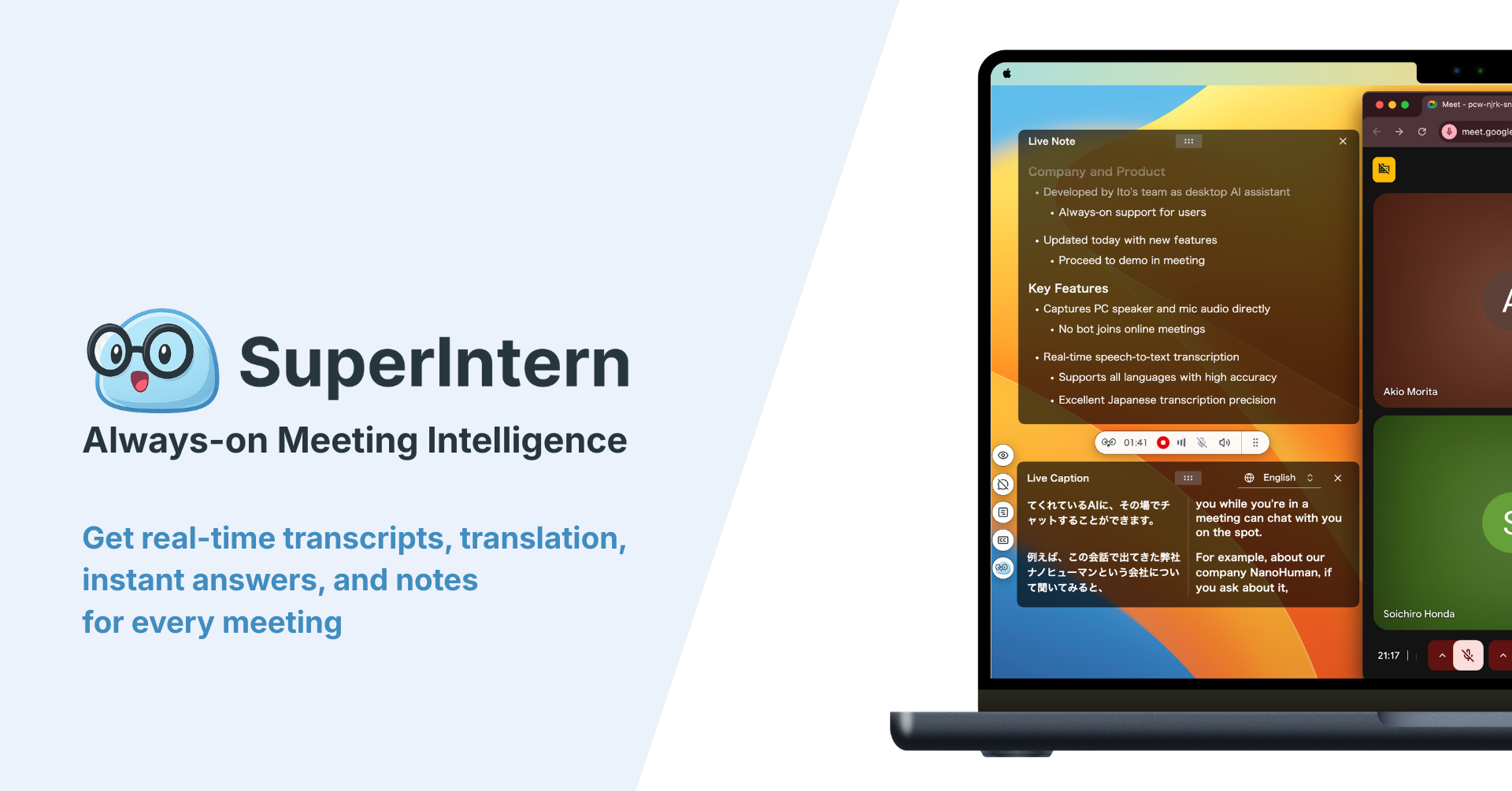
That is exactly the gap a real-time AI meeting assistant closes. SuperIntern is a bot-free desktop app that captures the conversation straight from your computer's audio. No bot joins the call, which matters in a confidential HR conversation, and it works the same whether the meeting happens on Zoom, Microsoft Teams, Google Meet, or in person across a table.

For the review meeting specifically, that means:
- You stay present. The notes build themselves live while you keep eye contact, instead of you switching between listening and typing.
- Your template fills itself in. With AI Canvas you describe the structure once, for example: "This is an annual review. Capture the self-assessment, feedback in both directions, agreed goals with dates, and development actions." Every future conversation fills exactly that form.
- Agreements are captured in the moment. "Let's sort that out later" becomes a documented item with an owner while it is being said.
- You decide where the record lives. Keep the notes of a confidential review in a private space and only you can see them; in a shared Team space they would be visible to your workspace members. Who can see the notes is up to you: they are only passed on when you actively share or export them, for example as Markdown for the HR file.
One point is non-negotiable in a conversation this sensitive: transparency. Tell the other person up front that you are using an AI tool to take the notes, and get their consent. Recording laws differ by country and, in the US, by state (one-party versus all-party consent), and regardless of the legal detail, a covert recording destroys precisely the trust the meeting is meant to build. Used openly, the tool works in your favor: both sides can see that what gets recorded is what was actually said.
To be honest about the boundaries: SuperIntern is a tool for the live conversation and its notes, not an HR suite with rating forms, scales, and review cycles. If your company needs a formal performance process with approvals, a note-taking tool complements the HR software rather than replacing it:
| Typing notes yourself | AI note tool (e.g. SuperIntern) | HR performance suite | |
|---|---|---|---|
| Conversation quality | Suffers, eyes on the keyboard | Preserved, notes run in the background | Unchanged, documentation usually after the fact |
| Completeness | Patchy, memory effects | High, built live from the conversation | Depends on manual entry |
| Formal process | No | No, but exports into your system of record | Yes: forms, scales, approvals |
| Best for | Short ad-hoc conversations | The conversation itself, on any platform | Company-wide review cycles |
Common performance review mistakes
- Rating only the recent weeks. Recency bias turns an annual review into a quarterly one. Antidote: pull notes from the whole year.
- Monologue instead of dialogue. If the manager talks more than half the time, it is a broadcast. Aim for the employee talking more.
- Criticism without examples. Generic statements trigger defense. Specific situations start a conversation.
- Mixing salary and feedback. Once money is on the table, nobody hears development feedback anymore. Separate the meetings when you can.
- Agreements without owners and dates. "We'll look into it" is not an agreement. Every item needs a name and a date.
- No notes, no follow-up. Without a record and follow-through, the best conversation is forgotten in four weeks, and next year's review starts from scratch.
FAQ
Are performance reviews required by law?
In most countries there is no general legal requirement to hold annual reviews; they are a company practice, not a statute. What is legally relevant is the documentation: in disputes about promotions, pay, or terminations, written review records often become key evidence. If your company has works-council agreements or sector rules, those may add specific requirements.
Can I refuse a performance review meeting?
Meetings about work topics are generally part of the job, so refusing outright is rarely a good idea. What you can do is ask for the purpose and agenda in advance, ask to reschedule if you genuinely cannot prepare, and, depending on your jurisdiction and company, bring a staff representative to certain formal conversations.
What if two managers attend the meeting?
Ask about the purpose first; two managers usually signal a more formal conversation, such as criticism or an organizational change. Prepare in writing, stay factual, take your own notes, and ask for the meeting record afterwards.
How long should a performance review meeting be?
For an annual review, 60 to 90 minutes is realistic. Ad-hoc feedback or problem conversations are usually fine with 30 to 45 minutes. More important than length: leave enough time at the end for the agreements phase.
How often should review meetings happen?
A common minimum is one full annual review plus a mid-year check-in. Teams that also run regular 1:1s spread feedback across the year and take the weight of the one-time verdict off the annual review.
Do I have to sign the review notes?
Signing usually confirms that the meeting took place and the content is accurately recorded. If you disagree with the wording, ask for a correction or add your own statement. Which is exactly why a record that captures what was actually said, rather than one side's memory of it, is worth having.
Conclusion
A review meeting that changes something is not a lucky accident. It takes an early invitation with clear topics, preparation on both sides, a flow that separates looking back, feedback, and goals, concrete examples instead of blanket judgments, and agreements with names and dates at the end.
The underrated building block is the record. It decides whether the conversation still has an effect in four weeks and whether next year's review builds on this one. A bot-free AI note tool takes exactly that load off you: the template fills itself live, agreements are captured as they are spoken, and you can focus on what a review meeting is at its core, an attentive conversation between two people.
Try SuperIntern Free – no bot in your confidential conversations, live notes that follow your template, and a record that is finished the moment the meeting ends.