Quarterly Business Review (QBR): Meaning, Agenda Template, and Examples (2026 Guide)

A quarterly business review is supposed to be the most strategic ninety minutes of the quarter. In practice, many QBRs are a slide deck read aloud: forty pages of charts the account team finished at midnight, a customer executive checking email by slide twelve, and a "next steps" slide that nobody opens again until the same meeting three months later.
The waste is real on both sides. Customer success teams spend days assembling decks per account each quarter. Internal QBRs pull leadership into full days of back-to-back reviews. And when the meeting produces no decisions, all of that preparation buys little more than a calendar entry.
It does not have to work that way. A QBR that is built around decisions rather than reporting is one of the highest-leverage meetings a business runs: it is where renewals are quietly won or lost, where budgets shift, and where the next quarter's priorities actually get set. This guide covers what a QBR is, how internal and customer-facing QBRs differ, how to prepare without losing a week, a copy-paste agenda template, the questions that make the conversation worth having, and the mistakes that turn QBRs into theater.
⚠️ This article was independently compiled based on publicly available information and user feedback as of September 2026.
Table of Contents
- What is a quarterly business review (QBR)?
- Internal QBR vs customer QBR
- Why so many QBRs disappoint
- How to prepare for a QBR
- The QBR agenda template
- QBR questions that drive real discussion
- Running the QBR meeting itself
- After the QBR: from review into plan
- Common QBR mistakes to avoid
- FAQ
- Conclusion
What is a quarterly business review (QBR)?
A quarterly business review (QBR) is a recurring strategic meeting, held once per quarter, where a team and its stakeholders review results against goals, surface what changed, and agree on priorities for the next quarter. The stakeholders can be internal (leadership reviewing a department or region) or external (a vendor reviewing outcomes with a customer), but the shape is the same: look back with numbers, look forward with decisions.
The key word is review, not report. A report can be read; a review requires judgment. A good QBR answers three questions that no dashboard answers on its own:
- Did we achieve what we said we would, and why or why not? Numbers plus the honest story behind them.
- What changed around us? New competitors, new stakeholders, budget shifts, product changes, market moves.
- What will we do differently next quarter? Priorities, owners, and the resources to match.
If the meeting ends and none of those three have a fresh answer, it was a status update wearing a QBR's clothes.
Internal QBR vs customer QBR
The same acronym covers two fairly different meetings, and most QBR advice fails by ignoring which one you are running.
| Internal QBR | Customer QBR (external) | |
|---|---|---|
| Who attends | Leadership plus a department, region, or function | Vendor account team plus customer stakeholders |
| Core question | Are we on track against our plan? | Is the customer getting the value they are paying for? |
| Typical owner | Head of the function, chief of staff, or founder | Customer success manager or account manager |
| Success looks like | Reallocated resources, killed or doubled projects | Renewed trust, expansion, a shared plan |
| Typical length | 60 to 120 minutes per unit reviewed | 45 to 90 minutes |
| Biggest failure mode | Slide karaoke and sandbagged targets | A one-way usage report with no customer voice |
Two practical notes:
- Customer QBRs are not for every account. Running a full QBR for every small account burns your team out and annoys customers who did not want the meeting. Reserve the live QBR for strategic accounts, and serve the long tail with a written quarterly summary they can read in five minutes.
- Internal QBRs compete with OKR reviews. If your company already runs quarterly OKR check-ins, do not stack a second ritual on top. Merge them: the QBR is simply the deepest version of the quarterly OKR conversation, with the numbers in the room.
Why so many QBRs disappoint
Most disappointing QBRs share a handful of patterns, and naming them is half the fix.
The deck is the meeting. When forty slides must be presented, discussion is what gets cut. The deck should be the pre-read; the meeting should start where the deck ends.
Reporting without judgment. Charts go up, nobody says what they mean, and the hard slide gets narrated quickly. If a metric missed, the interesting content is the diagnosis and the decision, not the chart itself.
The wrong people in the room. A customer QBR without an economic buyer becomes a feature-request session. An internal QBR without the people who can move budget becomes a rehearsal for the meeting where decisions actually happen.
No memory between quarters. Each QBR starts from a blank page because nobody can find what was decided last time. Commitments quietly evaporate, and the same discussion repeats every ninety days.
The language and distance tax. Global accounts and distributed teams often run QBRs in a language that half the room speaks as a second or third language. The people with the most context sometimes say the least, not because they have nothing to add, but because jumping into a fast discussion in another language is hard.
How to prepare for a QBR
The preparation is where QBRs are won, and also where teams lose entire days. A checklist that keeps it to hours instead:
- Send the deck or doc 48 hours ahead, and say it will not be presented. This one habit converts the meeting from broadcast into discussion. Keep the pre-read to 10 or 15 pages of substance.
- Lead with 3 to 5 metrics, not 30. Pick the numbers that map to the goals agreed last quarter, show the trend, and pre-write one sentence per metric: what moved and why.
- Pull the receipts from your own meetings. The best QBR preparation material usually already exists in your meeting record: what the customer flagged in the kickoff, what leadership committed in the last review, which risks came up in weekly syncs. If your meetings are transcribed and searchable, assembling this takes minutes; if they live in fragmented personal notes, it takes days or never happens.
- Draft the decisions, not just the data. Come in with two or three proposals ("we recommend shifting X to Y because...") so the room has something concrete to accept, amend, or reject.
- Confirm the right attendees. For customer QBRs: an economic buyer or executive sponsor on their side, and someone who can speak to product or roadmap on yours. For internal QBRs: whoever can actually approve the resource asks on the last slide.
- Ask the other side for their agenda items a week early. One question ("what would make this meeting worth your time?") routinely surfaces the topic that would otherwise appear in the final five minutes.
The QBR agenda template
Here is a 60-minute template you can copy into your meeting doc and adapt. It works for both internal and customer QBRs; the bracketed notes show where they differ.
# QBR – [Team / Account] – [Quarter]

## Alignment check (5 min)
- Goals we agreed last quarter, in one slide
- Any changes in context since then
  [customer: org changes, new stakeholders, strategy shifts]

## Results vs goals (15 min)
- 3-5 headline metrics, trend vs target
- One honest sentence per metric: what moved and why
- Wins worth naming, misses worth diagnosing

## The real discussion (20 min)
- The 1-2 topics that matter most this quarter
  [internal: the trade-off or bottleneck to resolve]
  [customer: value gaps, adoption blockers, upcoming needs]
- Proposals on the table, discussed and decided

## Next quarter's plan (15 min)
- Priorities for the next 90 days, each with an owner
- Resources or support required, approved or parked
- Success metrics for the next review

## Wrap (5 min)
- Decisions restated out loud
- Where the notes and action items will live
How to use it well:
- Protect the middle. The "real discussion" block is the meeting. If results run long, cut the results, not the discussion.
- Timebox the look-back. A useful rule of thumb is one third looking back, two thirds looking forward. The past is context; the decisions are the product.
- Restate decisions before anyone leaves. Thirty seconds of "here is what we decided and who owns what" prevents three weeks of divergent memories.
QBR questions that drive real discussion
The difference between a review and a report is usually one good question asked at the right moment. A working set:
For customer QBRs:
- "If you were renewing today, what would give you pause?"
- "What has changed in your business since we last spoke that we should know about?"
- "Where are your teams still doing manually what our product should be doing?"
- "Who is using this that we did not expect, and who is not using it that we did?"
- "What would need to be true for this to expand to [team or region]?"
For internal QBRs:
- "If we could only keep half of this quarter's projects, which half?"
- "Which metric are we watching that no longer predicts anything?"
- "What did we learn this quarter that should change next quarter's plan?"
- "Where are we resourced for the plan we had, not the plan we need?"
- "What are we not talking about because it is uncomfortable?"
Prepare answers for the questions you would least like to be asked. In customer QBRs especially, the willingness to raise the awkward topic yourself ("adoption in the finance team is behind, here is our plan") builds more trust than a quarter of green dashboards.
Running the QBR meeting itself
On the day, the host's job is to keep the room in discussion mode and to make sure the meeting produces a record worth keeping. That second job is harder than it sounds: the person facilitating a strategic conversation cannot simultaneously take faithful notes on it, and QBRs are exactly the meetings where "who committed to what" matters for the next ninety days.
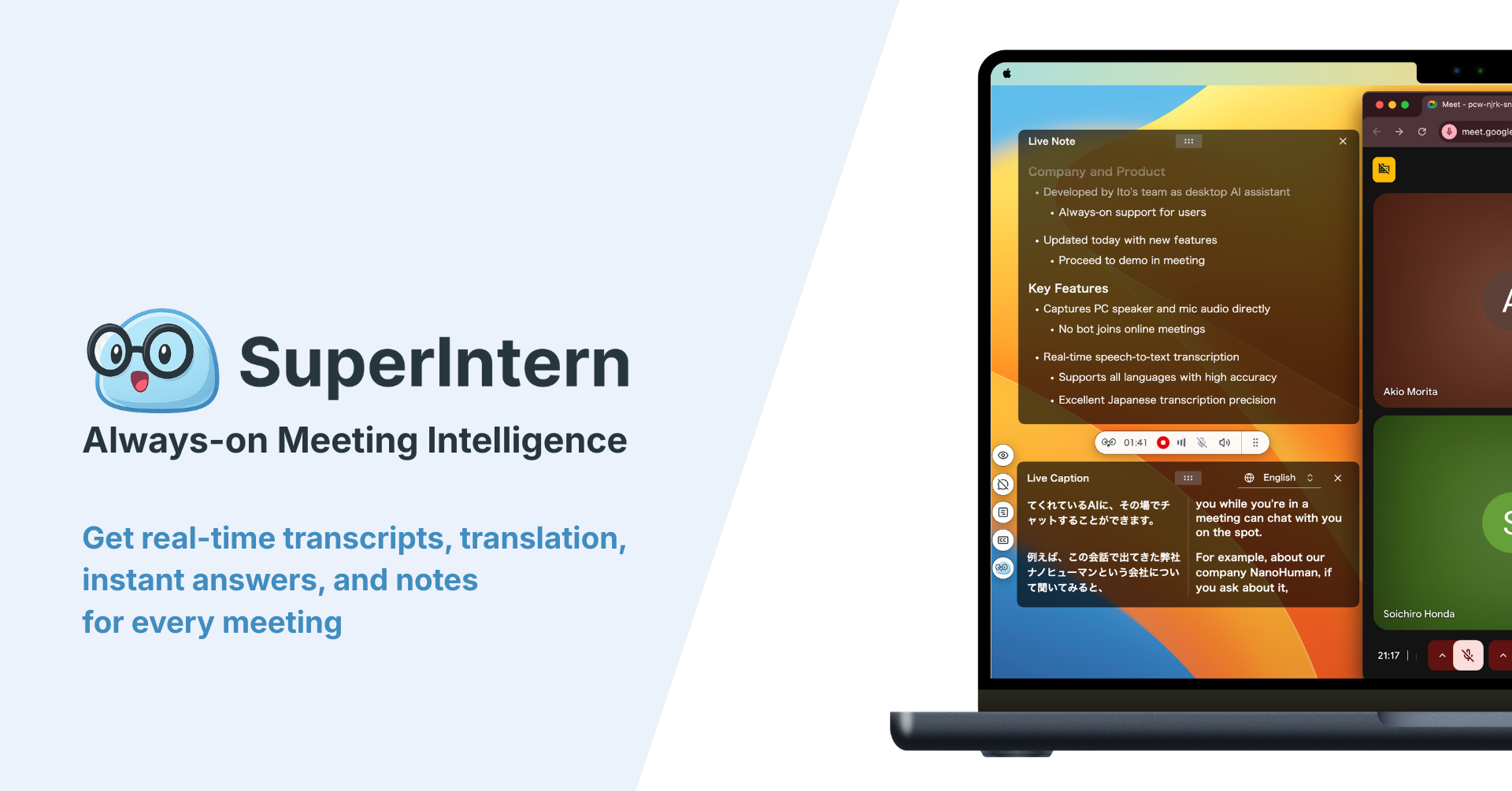
This is where an AI meeting assistant fits naturally into the QBR stack. SuperIntern is a botless desktop app that captures the meeting from your computer's audio, so no recording bot joins the call. That detail matters more in a QBR than almost anywhere else: sending a bot into a meeting with a customer executive is a tone-setter, and not the good kind. Because it captures device audio, it works identically across Zoom, Google Meet, Microsoft Teams, Webex, and in-person sessions in a conference room.

Three things change in practice:
- The notes structure themselves while you facilitate. With AI Canvas, you define the QBR format once ("capture results vs goals, risks raised, decisions with owners, and next-quarter commitments") and every review fills that same structure live, with speaker attribution.
- The language tax shrinks. For global accounts, live translated captions in 50+ languages let regional stakeholders follow the discussion in their own language and actually weigh in, instead of reconstructing the meeting from a recording afterwards.
- Last quarter stops evaporating. Preparing the next QBR starts with asking the AI chat what was decided in the previous one, across every meeting with that team or account, rather than archaeology in scattered docs. If a session was recorded elsewhere, you can upload the audio file afterwards and get the same searchable, structured notes.
One more QBR-specific detail: when you are the one sharing your screen to present, SuperIntern's Invisible Mode keeps the assistant out of the shared view, so the customer sees your deck and nothing else.
After the QBR: from review into plan
The QBR is finished when the plan ships, not when the call ends. The follow-through checklist:
- Send the recap within 24 hours. Decisions, owners, dates, and the two or three numbers that framed them. One page, in the channel the recipients actually read. For global teams, a translated recap costs minutes with AI summaries and buys real alignment.
- Turn commitments into tracked work. Every "we will" from the meeting becomes a ticket, task, or calendar entry with an owner. Anything that lives only in the deck is already lost.
- Schedule the mid-quarter pulse. A 30-minute check-in six weeks later, reviewing only the QBR's action items, is the cheapest way to make the next QBR shorter and calmer.
- Store the record where the next QBR will look. Notes, decisions, and open questions belong in a place the whole account team or department can search, because the first step of the next review is reading the last one.
Common QBR mistakes to avoid
- Presenting the pre-read. If the deck was sent ahead, walking through it live tells attendees their reading time was wasted. Open with questions on it instead.
- Running QBRs for every account by default. Match the investment to the account: live strategic QBRs for the top tier, crisp written summaries for the rest.
- Letting the vendor (or the presenting team) talk 80% of the time. In a healthy QBR, the audience speaks at least half the meeting. Track it honestly once and you may be surprised.
- Metrics without a "so what". Every chart earns its slide by ending in a sentence: keep doing, stop doing, or decide something.
- No named owners on next steps. "We will improve onboarding" is a wish. "Dana owns the new onboarding flow, drafted by May 15" is a plan.
- Skipping the QBR after a bad quarter. Cancelling the review when results are ugly is exactly backwards; the hard quarter is when the review earns its place.
- Starting each QBR from zero. If preparing the meeting requires reconstructing the last one from memory, fix the record-keeping before fixing the deck.
FAQ
What does QBR stand for?
QBR stands for quarterly business review: a strategic meeting held once per quarter to review results against goals and set priorities for the next quarter, either internally (leadership and a team) or externally (a vendor and a customer).
What is the difference between a QBR and a business review or EBR?
An executive business review (EBR) is usually a customer-facing review with executive sponsors in the room, often run once or twice a year at a higher strategic altitude. A QBR is the quarterly rhythm underneath it. Many teams run quarterly QBRs with the working group and an annual EBR with executives.
Who should attend a customer QBR?
From the customer: the day-to-day owner plus at least one person with budget or strategic authority. From the vendor: the account owner, someone who can speak to product direction, and, for strategic accounts, an executive sponsor. If no one in the room can make a decision, reschedule.
How long should a QBR be?
45 to 90 minutes for customer QBRs, 60 to 120 for internal ones. Shorter is achievable once the reporting moves into a pre-read and the meeting is reserved for discussion and decisions.
What metrics belong in a QBR?
The 3 to 5 numbers that map to the goals agreed in the previous review. For customer QBRs, that typically means outcome metrics (the results the customer bought the product for) first, and usage metrics only as supporting evidence. Thirty-metric dashboards belong in the appendix.
How do I run a QBR for a global team or account?
Send the pre-read early so non-native speakers are not decoding numbers live, use live translated captions so everyone can follow the discussion as it happens, and publish the recap in each region's language. The goal is that distance and language change nothing about who gets to participate.
Do we need a QBR every quarter?
The cadence matters more than the label. Quarterly is the default because most budgets and goals move quarterly, but a fast-moving account in its first year may need monthly reviews, while a stable internal function may combine two quarters into a deeper half-year review. Keep the rhythm; adjust the depth.
Conclusion
A quarterly business review is either the meeting where the next quarter actually gets decided, or an expensive quarterly performance of work already done. The difference is structural: a pre-read instead of a live deck, three to five metrics with honest diagnoses, a protected block for the one or two discussions that matter, decisions restated with owners, and a record that the next QBR can build on.
If your QBRs span languages, offices, or a customer on the other side of the world, the quiet upgrade is in the infrastructure: live translated captions so everyone in the room can actually join the discussion, notes that structure themselves while you facilitate, and a searchable record that makes next quarter's preparation start from evidence instead of memory. That is the job a botless meeting assistant does in the background, while your QBR finally gets to be about the decisions.
Try SuperIntern Free: no bot in your QBR, live captions in 50+ languages, and structured notes with owners and decisions ready the moment the review ends.