
Sally AI Alternative: SuperIntern vs. Sally for Bot-Free Meeting Notes
Many teams discover Sally AI when they are trying to stop writing meeting notes by hand.
That is a reasonable starting point.
Sally is a German AI meeting assistant that focuses on meeting transcription, summaries, task recognition, and follow-up workflows.
But the useful buying question is not simply "Is Sally good?"
The better question is: "Does Sally match the way our meetings actually happen, or do we need a Sally AI alternative?"
⚠️ This article was independently compiled based on publicly available information and user feedback as of June 2026.
This guide compares Sally AI and SuperIntern for teams that move between Zoom, Google Meet, Microsoft Teams, customer calls, internal syncs, and multilingual conversations.
Quick Recommendation
Choose Sally if your organization is comfortable with a meeting assistant joining calls and you want structured post-meeting task tracking.
Choose SuperIntern if visible bots create friction, if you often join meetings hosted by customers or partners, or if you want custom live notes while the conversation is still happening.
| Situation | Better fit |
|---|---|
| Internal meetings where a bot is accepted | Sally |
| External customer calls without another participant | SuperIntern |
| Post-meeting task recognition and tracking | Sally |
| Live notes in your own format during the call | SuperIntern |
| One workflow across Zoom, Meet, Teams, Webex, and in-person meetings | SuperIntern |
| Meeting analytics and conversation standards | Sally |
| Discreet use while screen sharing | SuperIntern |
| Multilingual live support and output in a target language | SuperIntern |
What Sally AI Does Well
Sally presents itself as an AI meeting assistant for transcription, meeting notes, tasks, and meeting analytics.
Its official pages describe capabilities such as:
- recording and transcription for Google Meet, Microsoft Teams, and Zoom
- AI-powered meeting summaries
- automatic recognition of action items
- task assignment and follow-up tracking
- meeting analytics such as speaker time and pauses
- multilingual transcription
- EU hosting and GDPR-oriented security messaging
- integrations with project management and CRM tools
That is useful for organizations that want a central follow-up system.
Sally is not just a transcription tool.
It is built around the work that happens after the meeting: what was discussed, what tasks were created, and where the results should go next.
Why Teams Look for a Sally AI Alternative
The reason is not always product quality.
Often it is workflow fit.
1. A Bot Can Join the Meeting
Sally describes a workflow where Sally can automatically participate in meetings and take notes.
That is convenient.
It also means the assistant can appear as a participant.
For internal meetings, that may be normal.
For customer calls, hiring interviews, investor conversations, legal discussions, or sensitive management meetings, another participant can change the tone.
Some companies block meeting bots.
Others require security, legal, or works council approval before they are used.
If your team wants to reduce that friction, a bot-free approach becomes important.
2. External Hosts Control the Meeting
In many real meetings, your team is not the host.
A customer sends a Zoom link.
A partner uses Google Meet.
An enterprise account insists on Microsoft Teams.
An interview happens in a browser room.
If the assistant must join the meeting, the workflow depends on invitations, permissions, and meeting settings.
A desktop assistant that captures local audio is more independent.
3. The Team Needs Notes During the Conversation
Many meeting assistants create the most value after the call.
That is enough when the goal is documentation.
It is weaker when the team wants to know during the meeting:
- Was that a confirmed decision?
- Is there an owner?
- Did anyone mention a deadline?
- Has the objection been answered?
- Should we clarify an open question before the call ends?
Live notes do more than document the meeting.
They improve the meeting while it is still happening.
4. The Note Structure Must Match the Role
A sales call needs different fields than a product review.
A recruiting interview needs different criteria than a customer success check-in.
A generic summary often feels too soft.
Teams need reusable structures:
| Meeting type | Useful fields |
|---|---|
| Sales discovery | pain, budget, decision maker, objection, next step |
| Customer success | risk, feedback, ticket, owner, escalation |
| Recruiting | criteria, strong answers, concerns, open questions |
| Product review | feedback, decision, risk, experiment, follow-up |
| Leadership sync | decision, dependency, blocker, accountable owner |
If that structure should be filled live, SuperIntern's AI Canvas is a better fit because teams can define the note format themselves.
Where SuperIntern Fits
SuperIntern is a bot-free desktop meeting assistant from NanoHuman Inc.
It does not join your meeting as a bot.
Instead, SuperIntern captures microphone and system audio directly from the computer.
That lets the same workflow work with Zoom, Google Meet, Microsoft Teams, Webex, Slack Huddles, Discord, browser calls, and in-person meetings.
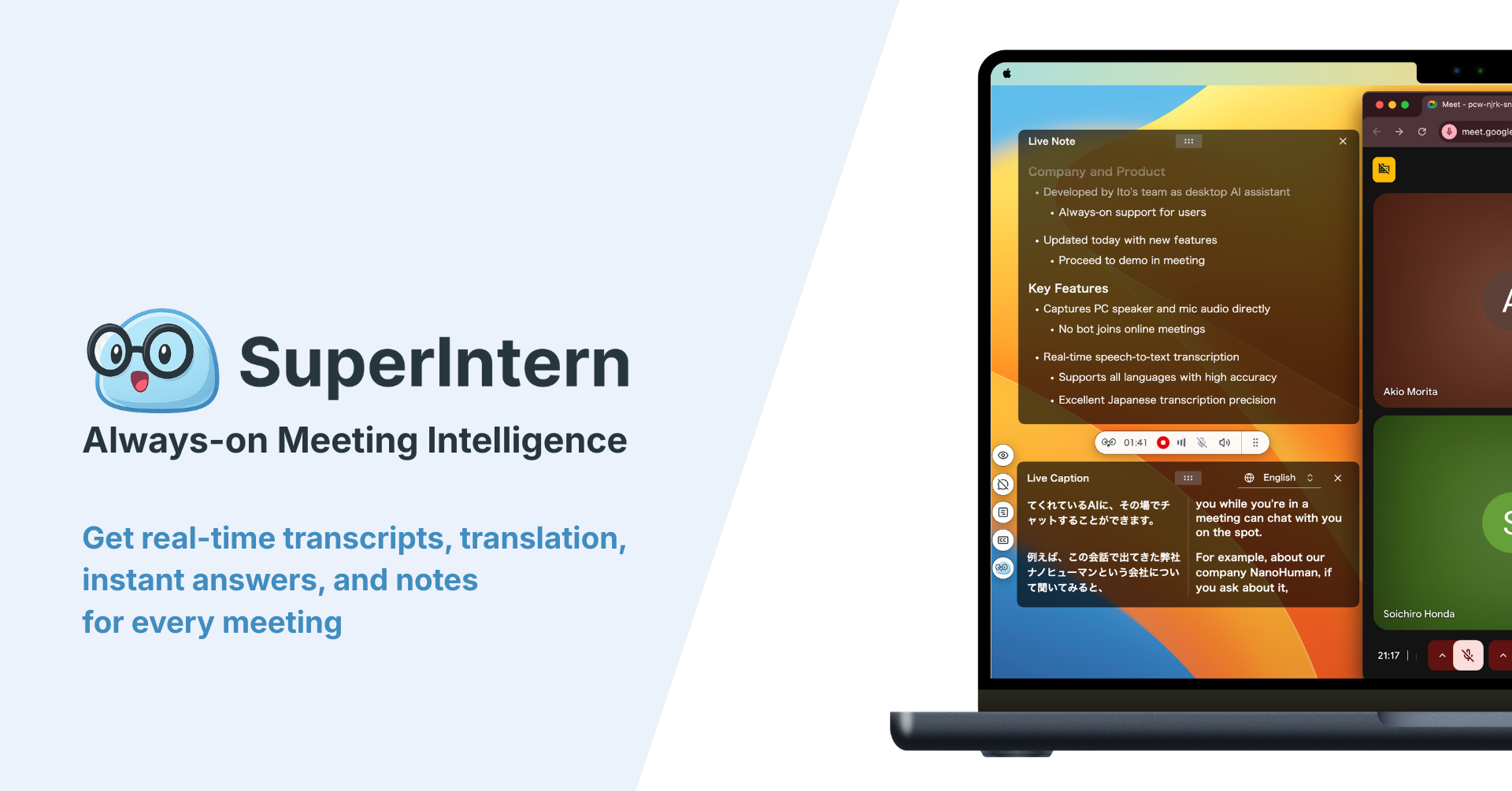
The features that matter most as a Sally AI alternative are:
- bot-free live transcription
- speaker-aware meeting notes
- AI Canvas for custom live note formats that you define yourself
- real-time translation and live captions
- custom dictionary for product names and domain terms
- Invisible Mode while screen sharing
- post-meeting AI chat based on meeting content

SuperIntern is not primarily "a bot that later sends a summary."
It is closer to a live workspace that runs alongside the meeting.
Sally AI vs. SuperIntern
| Criterion | Sally AI | SuperIntern |
|---|---|---|
| Core approach | Meeting assistant with bot workflow and follow-up automation | Bot-free desktop assistant for live meeting work |
| Meeting presence | Sally can participate in meetings | No bot joins the meeting |
| Platform dependency | Strong for Zoom, Meet, and Teams | Works wherever computer audio is available |
| Live notes | Focus on transcript, summary, and tasks | AI Canvas writes in your chosen format during the call |
| Tasks | Strong action-item detection and tracking | Tasks and follow-ups can be generated from live notes and AI chat |
| Analytics | Meeting analytics are a visible focus | Stronger focus on live support and post-meeting work |
| Privacy perception in the call | Bot may be visible | No extra meeting tile |
| Multilingual support | Multilingual transcription on official pages | 50+ languages, live translation, and target-language output |
| Setup | Invite or integrate the assistant | Start the desktop app and capture audio |
| Best fit | internal teams with accepted bots and tool sync | external calls, mixed platforms, discreet live notes |
Decision Framework
Ask these questions before choosing Sally, SuperIntern, or another AI meeting assistant.
| Question | Why it matters |
|---|---|
| Are visible meeting bots acceptable? | If not, many bot-based tools become difficult |
| Who hosts most meetings? | External hosts make bot admission less predictable |
| Do we need task tracking or live steering? | This separates post-meeting automation from in-meeting support |
| Which languages are spoken? | Spoken language and output language are separate decisions |
| Do we need works council or legal review? | Transparency and recording controls can matter in Germany and the EU |
| Where should the output go? | CRM, wiki, ticket, project board, and personal notes need different formats |
| Should notes stay hidden while screen sharing? | Sales, consulting, and interviews often need discretion |
Three Common Scenarios
Scenario 1: Internal Team With Clear Policies
The team uses Microsoft Teams or Google Meet internally.
Everyone knows meetings can be documented.
Tasks should be detected automatically and moved into project tools.
A visible assistant is accepted.
In this case, Sally can be a strong fit.
Its strength is documentation, task handling, integrations, and team follow-up.
Scenario 2: Sales and Customer Success With External Calls
An account executive talks to a customer in Zoom today, a partner in Teams tomorrow, and an investor in Google Meet next week.
The customer should not need to approve or discuss a separate notetaker.
The person leading the call needs pain points, objections, decision makers, and next steps while the conversation is still live.
Here, SuperIntern is usually the better Sally AI alternative.
The bot-free approach reduces friction.
AI Canvas can fill your custom sales structure live.
Scenario 3: Multilingual Meetings
A team speaks with customers, candidates, or partners in English, German, Japanese, or Spanish.
The final notes may need to be in another language.
In this situation, transcription alone is not enough.
Live understanding, translation, glossary control, and clean summaries matter together.
SuperIntern is strong because live transcription, real-time translation, custom dictionary, and meeting chat work from the same meeting context.
Practical Test Plan
Do not compare tools only from a demo.
Test them in real meetings.
Week 1: Simple Internal Meetings
Check:
- Is the transcript accurate enough?
- Are speakers separated correctly?
- Are action items detected cleanly?
- Does anyone actually read the output?
- Is the visible assistant accepted by the team?
Week 2: External Conversations
Check:
- Can the assistant join reliably?
- Does the customer need to approve anything?
- Does the bot create explanation overhead?
- Does a bot-free workflow feel smoother?
- Are follow-up emails faster to create?
Week 3: Critical Workflows
Check:
- sales discovery with objections
- recruiting interview with evaluation criteria
- product review with decisions
- multilingual call with output in another language
- screen sharing while sensitive notes are visible
Only then will the right fit become obvious.
Mistakes to Avoid
Looking Only at Transcription Accuracy
Accuracy matters.
But a good transcript is not the same as a useful meeting result.
The real question is whether the tool turns discussion into decisions, tasks, context, and next steps.
Underestimating Bot Visibility
A bot is not automatically bad.
It just has to fit the relationship.
Internal meetings may normalize it.
Sensitive external conversations may not.
Comparing Price Without Usage Pattern
Sally and SuperIntern have different package logic and different strengths.
Do not compare only the monthly price.
Check:
- How many users need access?
- How many meeting hours will be captured?
- Does every user actively record?
- Is task tracking or live support more valuable?
- Which features require higher plans?
Always confirm pricing and plan limits on the official pages before buying.
FAQ
Is Sally AI a good tool?
Yes. Sally can be a strong option when a meeting bot is accepted and the team wants summaries, task extraction, integrations, and meeting analytics.
Why do teams search for a Sally AI alternative?
Common reasons include visible bots, externally hosted meetings, platform switching, live note needs, multilingual workflows, and a preference for discreet desktop capture.
Is SuperIntern bot-free?
Yes. SuperIntern captures microphone and system audio through the desktop app and does not join the meeting as another participant.
Does SuperIntern work with Zoom, Google Meet, and Teams?
Yes. Because SuperIntern captures computer audio, it can be used with Zoom, Google Meet, Microsoft Teams, Webex, Slack Huddles, Discord, browser calls, and in-person meetings.
Which is better for German companies?
It depends on the meeting type. Sally can fit teams that accept bots and want post-meeting task workflows. SuperIntern often fits better when external calls, discretion, mixed platforms, and live structure matter more.
Do bot-free tools still require consent?
Yes. Bot-free does not mean hidden. Teams should explain when transcription, summaries, or AI support are used and follow internal policies.
Which Sally AI alternative should I test first?
If your main problems are visible bots and missing live notes, test SuperIntern in a real customer, recruiting, or product meeting.
Conclusion
Sally AI makes sense when your team accepts a visible assistant and wants to centralize documentation, tasks, and integrations.
SuperIntern makes sense when your team wants meetings to be more discreet, platform-independent, and structured while the conversation is still happening.
The best Sally AI alternative is not just a tool with a similar feature list.
It is the workflow that fits your meetings.
If your meetings are external, multilingual, cross-platform, or advisory, a bot-free live approach is often the stronger choice.