
Shareholder Meeting Minutes: What to Include, a Template, and Examples (2026)

Shareholder meeting minutes are the company's official record of what its owners decided. Banks ask for them in due diligence, registrars and auditors rely on them, and they are the first document a lawyer requests when a resolution is challenged. They are also, for most companies, written once or twice a year by someone who has to dig up last year's version to remember the format.
This guide covers what shareholder meeting minutes must contain, how to record quorum and votes so the resolution holds up, a template you can copy, worked examples for the most common resolutions, how to document a written consent instead of a meeting, and how to capture shareholder Q&A without a second note taker.
⚠️ This article was independently compiled based on publicly available information and user feedback as of November 2026.
This article is general information, not legal advice. Requirements depend on your jurisdiction, your articles of association or bylaws, and your share structure. Confirm specifics with your corporate counsel or company secretary.
Table of Contents
- What are shareholder meeting minutes?
- Annual general meeting vs. special meeting
- What shareholder meeting minutes must include
- Recording quorum and votes correctly
- How to write the minutes: before, during, and after
- Shareholder meeting minutes template
- Resolution examples
- Written consent instead of a meeting
- Signing, storage, and access
- Six common mistakes
- Capturing shareholder Q&A with AI
- FAQ
- Conclusion
What are shareholder meeting minutes?
Shareholder meeting minutes (called stockholder meeting minutes in the US) are the formal written record of a general meeting of a company's shareholders. They document who attended, whether the meeting was validly constituted, what resolutions were proposed, and how each one was decided.
Almost every corporate law system requires them:
- United Kingdom: The Companies Act 2006 requires companies to keep minutes of all general meetings for at least ten years (section 355). Minutes signed by the chair are evidence of the proceedings (section 356).
- United States: State corporate statutes and company bylaws require corporations to keep records of stockholder meetings. In Delaware, the bylaws or board designate an officer responsible for recording the proceedings, and those minutes become part of the corporate books that stockholders can inspect.
- Elsewhere: Most civil law countries go further and prescribe specific contents, and some require a notary for certain resolutions.
The practical point is the same everywhere. Minutes are written for readers who were not in the room: auditors, lenders, investors in your next round, regulators, and courts. They need to show that the meeting was properly called, that a quorum was present, and that each resolution passed with the required majority.
Annual general meeting vs. special meeting
The minutes follow the same structure, but the purpose and typical agenda differ.
| Annual general meeting (AGM) | Special or extraordinary meeting | |
|---|---|---|
| When it happens | Once a year, often within a set period after the financial year end | Whenever a decision needs shareholder approval between AGMs |
| Typical business | Approving or receiving financial statements, electing directors, appointing auditors, declaring dividends | Amending the articles or charter, approving a share issue, mergers, removing a director |
| Minutes title | Minutes of the Annual General Meeting | Minutes of a Special Meeting of Shareholders |
| Follow-up filings | Director changes, annual return or annual report | Often a filing with the company registry |
Startups tend to underestimate how often they will write these. Each financing round, option pool increase, or charter amendment can require shareholder approval, either at a meeting or by written consent. A single house template saves time and keeps the record consistent.
What shareholder meeting minutes must include
Exact requirements vary, but the following elements satisfy auditors, registries, and investor due diligence in most jurisdictions.
| Element | What to write |
|---|---|
| Company name and meeting type | Full legal name, "Annual General Meeting" or "Special Meeting" |
| Date, time, and place | Start and end times. For hybrid or virtual meetings, state how remote participants attended |
| Notice | That notice was given in accordance with the articles or bylaws, or that it was waived |
| Chair and secretary | Who chaired the meeting and who recorded the minutes |
| Attendance and quorum | Shares or votes present in person and by proxy, total shares entitled to vote, and a statement that a quorum was present |
| Directors and officers present | Names of board members, officers, and auditors who attended |
| Each resolution | The exact wording, a brief summary of discussion, the voting method, and the result |
| Statements required by law | Any formal statements by auditors or others that must be recorded |
| Close | The time the meeting ended |
| Signature | The chair's signature, plus any others your articles or bylaws require |
Two items cause most of the trouble later: the quorum statement and the vote result. If either is missing, nobody can confirm from the document alone that the resolution was validly passed.
Recording quorum and votes correctly
Different resolutions need different majorities. The minutes should make it obvious which threshold applied and that it was met.
| Resolution type | Typical threshold | Common examples |
|---|---|---|
| Ordinary resolution (UK) / majority vote (US) | More than 50% of votes cast, or of shares present, depending on the rules | Electing directors, appointing auditors, approving accounts, declaring dividends |
| Special resolution (UK) | At least 75% of votes cast | Amending the articles, changing the company name, disapplying pre-emption rights |
| Supermajority (US charter or bylaw provision) | As set in the charter or bylaws, e.g. two-thirds | Certain charter amendments, mergers, removal of directors |
| Class vote | Majority or supermajority of a specific share class | Changes to preferred stock rights |
Write the result in language that matches the threshold:
- "Upon a show of hands, the resolution was passed as an ordinary resolution."
- "On a poll, 4,812,000 votes were cast for and 310,000 against. The resolution was passed as a special resolution, having received more than 75% of the votes cast."
For director elections in the US, record the votes for each nominee. Where directors are elected by plurality, note that standard, because a reader cannot otherwise tell why a nominee with minority support was elected.
How to write the minutes: before, during, and after
Before the meeting. Build the skeleton from the notice and agenda. Fill in the header, the expected chair and secretary, the number of shares entitled to vote from the register of members, and a section for each resolution with its exact wording. On the day, you only need to record what happened.
During the meeting. Confirm attendance and quorum first, and record the chair's statement that the meeting is quorate. For each resolution, note who proposed and seconded it (if your rules require it), the main questions raised, the voting method, and the result. If a shareholder moves an amendment or a procedural motion, record the motion and how it was disposed of.
After the meeting. Draft the full minutes within a few days while memories are fresh. Ask the chair to review for accuracy, not for wording preferences. Have the chair sign once approved, file the minutes in the minute book, and calendar any registry filings that the resolutions trigger, such as director appointments or charter amendments.
Shareholder meeting minutes template
Copy and adapt this template. Replace bracketed text and delete anything that does not apply.
MINUTES OF THE [ANNUAL GENERAL / SPECIAL] MEETING OF SHAREHOLDERS
[COMPANY LEGAL NAME]

Date:       [Month DD, YYYY]
Time:       [10:00 a.m.] to [11:05 a.m.]
Place:      [Address], with remote attendance by video conference
Chair:      [Name, title]
Secretary:  [Name, title]

1. CALL TO ORDER AND NOTICE
   The Chair called the meeting to order at [time] and confirmed that
   notice of the meeting was given on [date] in accordance with the
   [articles of association / bylaws].

2. ATTENDANCE AND QUORUM
   Shares entitled to vote:              [number]
   Shares represented in person:         [number]
   Shares represented by proxy:          [number]
   Total shares represented:             [number] ([xx]%)
   The Chair declared that a quorum was present and the meeting was
   duly constituted.
   Directors present: [names]. Auditor present: [name, firm].

3. FINANCIAL STATEMENTS
   The Chair presented the financial statements for the year ended
   [date]. [Summary of questions and answers in 1 to 2 sentences.]
   RESOLVED, that the financial statements for the year ended [date]
   be [approved / received].
   Result: [For xx / Against xx / Abstain xx]. Passed as an ordinary
   resolution.

4. [NEXT RESOLUTION]
   [Repeat the same structure for each resolution.]

5. CLOSE
   There being no further business, the Chair declared the meeting
   closed at [time].

______________________________
[Name], Chair
Date: [Month DD, YYYY]
Resolution examples
Election of directors
4. ELECTION OF DIRECTORS
   The Chair noted that the terms of [Name] and [Name] expire at this
   meeting and that both had been nominated for re-election, together
   with [Name] as a new director.
   RESOLVED, that [Name], [Name], and [Name] be elected as directors
   to hold office until the next annual meeting.
   Result: [Name] For 5,102,000 / Withheld 40,000
           [Name] For 4,980,000 / Withheld 162,000
           [Name] For 5,050,000 / Withheld 92,000
   Each nominee was elected.
Amendment to the articles (special resolution)
5. AMENDMENT OF ARTICLES
   The Chair explained that the amendment updates the share transfer
   provisions to reflect the new investor rights agreement.
   RESOLVED, as a special resolution, that the articles of association
   be amended as set out in Appendix A.
   Result on a poll: For 4,812,000 / Against 310,000 / Withheld 20,000.
   The resolution was passed, having received more than 75% of the
   votes cast.
Recording a shareholder question
   A shareholder asked about the dividend policy for the coming year.
   The CEO replied that the board intends to prioritize growth
   investment and will review dividends against annual results.
You do not need a transcript of every exchange. One or two sentences saying who asked about what, and who answered in what sense, is the right level of detail.
Written consent instead of a meeting
Many companies, especially private companies with few shareholders, approve resolutions without holding a meeting.
- UK private companies can pass written resolutions under the Companies Act 2006. An ordinary written resolution needs a simple majority of eligible votes, and a special written resolution needs 75% of eligible votes, counted against all eligible members rather than only those who respond.
- US corporations, in Delaware and many other states, can act by written consent of stockholders holding at least the number of votes that would be needed at a meeting where everyone voted, unless the certificate of incorporation prohibits it. Companies must then promptly notify stockholders who did not consent.
A written consent is itself the record. Keep it with the minutes, and note the effective date, which is usually the date the last required signature was received. A short cover note in the minute book helps future readers:
ACTION BY WRITTEN CONSENT OF SHAREHOLDERS
[Company legal name]

The undersigned shareholders, holding [number] shares representing
[xx]% of the outstanding voting shares, consent to the following
resolution in lieu of a meeting:

RESOLVED, that [resolution text].

Effective date: [date the final required consent was received]
Notice to non-consenting shareholders sent on: [date]
Signing, storage, and access
- Signature. The chair normally signs the minutes once approved. Some articles or bylaws also require the secretary's signature. Electronic signatures are widely accepted for corporate records, but registries may have their own format rules for documents you file.
- Approval. In some companies the minutes of one meeting are approved at the next. Others approve them by the chair's signature shortly after the meeting. Use whichever your rules specify, and do it consistently.
- Storage. Keep minutes in the minute book or board portal, with the notice, proxies, and any written consents. The UK minimum is ten years. In practice, most companies keep shareholder minutes permanently.
- Access. Shareholders generally have a right to inspect minutes of general meetings. Write every sentence on the assumption that a shareholder, an acquirer's counsel, or a court will read it.
Six common mistakes
- No quorum statement. Without it, the document cannot prove the resolutions were validly passed.
- Vote language that does not match the threshold. Recording "passed by majority" for a special resolution suggests the 75% requirement was not met.
- Missing remote attendance details. If shareholders joined by video, say so and say how their votes were taken.
- Paraphrased resolutions. Write the resolution exactly as proposed. "The budget was approved" is not a resolution.
- Written consents without an effective date. The date matters for filings, share issues, and closing conditions in a financing.
- Minutes written weeks later. Delayed minutes are less accurate and are the first thing questioned in an audit or dispute. Draft within days and get the chair's signature promptly.
Capturing shareholder Q&A with AI
The hardest part of shareholder minutes is not the format. It is recording the chair's explanations and shareholder questions while also helping the meeting run, often across a room and a video call at the same time.
| Approach | Strengths | Watch out for | Best for |
|---|---|---|---|
| Secretary takes notes by hand | No extra cost | Questions get missed while the secretary handles proxies and logistics | Small meetings with little Q&A |
| Record now, transcribe later | Everything can be replayed | Transcribing takes several times the meeting length | When there is plenty of time after the meeting |
| Outsourced minute taking | Consistent quality | Cost, and confidential discussion goes to a third party | Large listed-company AGMs |
| Bot-based AI note takers | Automatic transcript | A bot appears as a participant in the video call and misses the in-room part of a hybrid meeting | Routine internal online meetings |
| Botless AI assistant (such as SuperIntern) | One method for the room and the video call. A structured draft builds during the meeting | The draft is only a draft. The secretary still reviews it and the chair still signs | Hybrid AGMs and meetings with active Q&A |
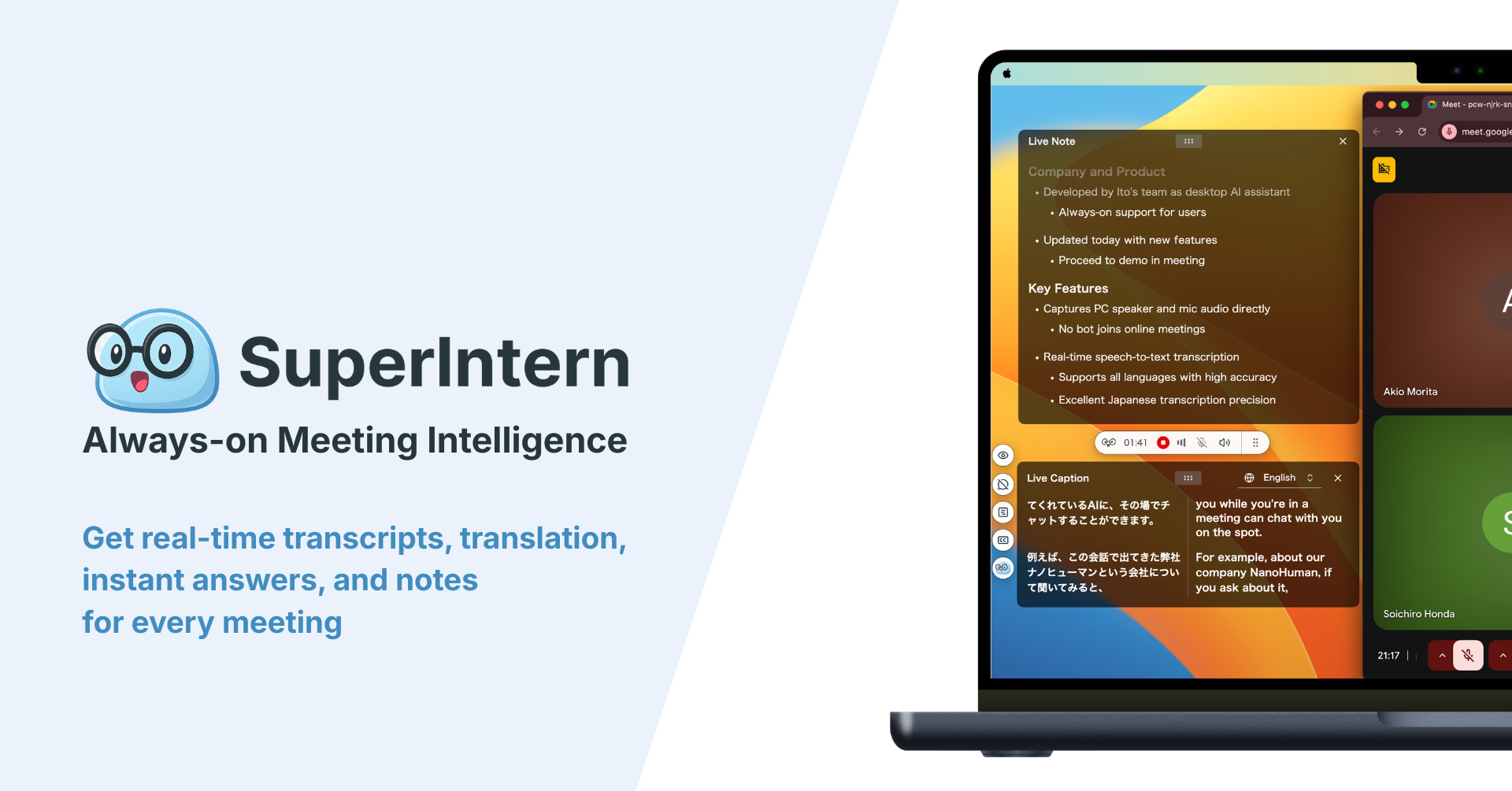
SuperIntern is a desktop app for Mac and Windows that captures audio from your computer's microphone and speakers. No bot joins the meeting, so it records in-room speakers and shareholders on Zoom, Teams, or Google Meet with the same setup.
What helps for shareholder meetings:
- AI Canvas in your minutes format. Tell it once to "record shares present and quorum, then for each resolution the presenter, a one to two sentence summary of questions, and the vote result," and the draft builds in that structure as the meeting runs.
- Speaker recognition. The chair, the directors who answer, and the shareholders who ask are kept apart, so Q&A summaries attribute questions correctly.
- Custom dictionary. Add director names, the company's legal name, and product names to reduce transcription errors.
- AI chat after the meeting. Ask "list each resolution with its vote result and every shareholder question with the answer" and check it against your notes in minutes.
- Real-time translation. When international shareholders or directors speak another language, translated captions in 50+ languages let you follow and draft in your own language.
Two honest caveats. First, AI output is a draft. The secretary still checks that every required element is there and that resolution wording is exact, and the chair's signature is what makes it the minutes. Second, recording a shareholder meeting is a governance decision. Announce it at the meeting and decide how long the recording is kept once the minutes are approved.
SuperIntern has a free plan with no credit card required, and a Plus plan at $20 per month for up to 100 hours. Try it first on a board or management meeting to judge the draft quality before you use it at an AGM.
FAQ
Who writes shareholder meeting minutes?
Usually the company secretary, general counsel, or a designated officer. In startups, it is often the CEO, COO, or an outside law firm. Whoever writes them, the chair reviews and signs.
How detailed should the minutes be?
Detailed on decisions, brief on discussion. Resolution wording, quorum, and vote results should be exact. Discussion and Q&A need only a short neutral summary per item.
Do private companies need to hold an annual general meeting?
It depends on the jurisdiction. UK private companies are not required to hold an AGM unless their articles say so. US corporations generally must hold an annual meeting under state law, although many private companies act by written consent instead.
What should the minutes say about a virtual or hybrid meeting?
State the location (if any), that shareholders could attend by remote communication, how their identity was verified, and how votes were cast. Make sure your articles or bylaws and local law allow the format you used.
How long should we keep shareholder meeting minutes?
At least as long as local law requires (ten years in the UK), but most companies keep them permanently. They are the only reliable record of how the company's ownership decisions were made.
Can we use AI to write shareholder meeting minutes?
As a drafting tool, yes. AI can capture attendance, resolution wording, vote results, and Q&A in real time. Deciding what goes into the official record and signing it remain human responsibilities.
Conclusion
Good shareholder meeting minutes come down to a few habits. Record the quorum, write each resolution exactly as proposed, state the vote result in language that matches the required majority, document written consents with an effective date, and get the chair's signature promptly. A house template takes care of the structure.
What remains is the work of capturing explanations and questions while the meeting is running. A botless AI assistant can take that over across the room and the video call, so the secretary can focus on procedure and the filings that follow.
Finish the draft of your next shareholder meeting minutes before the meeting ends. SuperIntern is free to start, with no credit card required.