Structured Interview: Definition, Types, Example Questions, and How to Run One (2026 Guide)

Two interviewers meet the same candidate on the same afternoon. One walks out sure they have found the hire; the other is sure they have not. Neither is wrong about what they saw. They asked different questions, listened for different things, and judged against a standard that only existed in their own heads. The structured interview exists to fix precisely that.
This guide covers what a structured interview is, how it compares with semi-structured and unstructured formats, when to use each, a six-step process for designing your own, how to build a rating scale that actually separates candidates, 20 example questions by competency, and a copy-ready interview guide. It closes with the part most teams underinvest in: capturing evidence without losing the conversation.
⚠️ This article was independently compiled based on publicly available information and user feedback as of October 2026.
Table of Contents
- What is a structured interview?
- Structured vs semi-structured vs unstructured interviews
- Advantages and disadvantages of structured interviews
- Types of structured interview questions
- How to conduct a structured interview in 6 steps
- Example rating scale
- 20 structured interview questions by competency
- Structured interview guide template
- Taking notes without losing the conversation
- Common mistakes
- FAQ
- Conclusion
What is a structured interview?
A structured interview is an interview in which every candidate for the same role is asked the same questions, in the same order, and their answers are evaluated against the same criteria and rating scale, all defined before the first interview takes place. The goal is that any difference between two candidates' results reflects a real difference between the candidates, not between interviewers, moods, or days of the week.
The term lives in two worlds. In social and market research, a structured interview is a data-collection method built on a fixed questionnaire, close to a survey read aloud. In HR, which is the focus here, it is a selection method. Both share one idea: standardize so you can compare.
"We have a list of questions" does not make an interview structured. Four elements usually need to be in place:
- Job-derived questions. They come from an analysis of what the role actually requires, not from an interviewer's favorite repertoire.
- One script for everyone. Same questions, same order, same permitted follow-ups.
- Criteria written in advance. For each question, someone has already described what separates a weak answer from a strong one.
- Independent scoring. Each interviewer scores alone, from notes, before discussing the candidate with anyone.
Structured vs semi-structured vs unstructured interviews
None of the three formats is good or bad in the abstract. They serve different purposes. Here are the differences that matter when choosing:
| Structured | Semi-structured | Unstructured | |
|---|---|---|---|
| Questions | Fixed, identical for all | A fixed core plus open questions | Open, emerge from the conversation |
| Order | Fixed | Flexible | None |
| Follow-ups | Limited and planned | Open, based on answers | Fully open |
| Evaluation | Scale defined in advance | Mixed: scale for the core, impression for the rest | Interviewer's overall impression |
| Comparability across candidates | High | Medium | Low |
| Preparation required | High | Medium | Low |
| Candidate experience | Can feel rigid if run poorly | Natural and orderly | Natural but unpredictable |
| Typical use | Roles with many candidates and multiple interviewers | Most hiring loops; qualitative research interviews | Exploratory chats, informal first contacts |
In practice, many companies land on a semi-structured interview with a structured core: five or six fixed, scored questions every candidate answers, plus open time to get to know the person and handle their questions. That is a sensible starting point if your team has never interviewed from a script. What you should avoid is using an unstructured conversation as the deciding interview. It lets the most interviewer bias through and gives you the least to justify a decision later.
Advantages and disadvantages of structured interviews
Industrial-organizational psychology has been comparing selection methods for decades. The field's landmark meta-analyses, from Schmidt and Hunter's classic 1998 review to Sackett and colleagues' 2022 re-analysis, place structured interviews among the strongest predictors of job performance and clearly ahead of free-form interviews. That is the underlying reason for their popularity, but not the only one.
Advantages
- Real comparability. When everyone answers the same thing, you can put answers side by side. Without that, you are comparing different conversations.
- Less bias. A fixed script narrows the room for rapport, first impressions, or "reminds me of myself" to decide the hire.
- Defensible decisions. Scores and notes per criterion document why someone was chosen. That helps with legal challenges and with your own leadership.
- Perceived fairness. Candidates tend to value a process where everyone faces the same test.
- Easier interviewer onboarding. A new panelist can contribute from their first interview if they have a guide and a scale.
Disadvantages
- Preparation cost. Good questions and scales take hours to write and need revisiting when the role changes.
- Risk of rigidity. Read like an interrogation, the interview turns cold, and strong candidates notice.
- Less room for the unexpected. An interesting thread outside the script can go unexplored if nobody reserves time for it.
- It demands evidence discipline. Scoring against criteria requires an accurate record of what was said. Without one, the scale gets filled in from memory and much of the benefit evaporates.
The first three are design problems: add an open segment, plan your follow-ups, keep a conversational tone. The fourth is operational, and we cover it in detail below.
Types of structured interview questions
Almost every question in a structured hiring interview belongs to one of four families:
| Type | What it measures | Typical form | Example |
|---|---|---|---|
| Behavioral | Past behavior as a predictor of future behavior | "Tell me about a time when…" | "Tell me about a time you had to deliver a project in half the planned time." |
| Situational | Judgment in a hypothetical job scenario | "What would you do if…?" | "A key client asks for a change that breaks the quarter's plan. What do you do?" |
| Technical or knowledge | Command of tools, methods, or regulations | Direct question or short exercise | "How would you calculate cost per hire for a recruiting process?" |
| Motivational | Fit with the role and its real conditions | "What draws you to…?" | "This role involves 30% travel. How does that fit your current situation?" |
For behavioral questions, the STAR method (Situation, Task, Action, Result) is the standard tool for both asking and evaluating. If a candidate jumps from the situation straight to the result, the interviewer knows what is missing: "What did you do, specifically?" That follow-up should be written into the guide, not improvised.
How to conduct a structured interview in 6 steps
1. Analyze the job. Talk to the people who do the role today, their manager, and the people who depend on their work. Ask what separates someone excellent in the role from someone adequate. Write down concrete situations, not adjectives.
2. Pick 4 to 6 competencies. Turn that analysis into a short list, for example problem solving, client communication, prioritization, and collaboration. More than six competencies in a one-hour interview usually means none gets measured well.
3. Write 1 or 2 questions per competency. Mix behavioral and situational questions. For each, write down one or two permitted follow-ups ("What would you do differently today?", "What was the measurable result?").
4. Anchor the scale. For each question, describe what a 1, a 3, and a 5 answer sound like. Those descriptions turn a score into something more than a feeling. There is a worked example in the next section.
5. Prepare the interviewers. Share the guide in advance, decide who asks what if there is a panel, and agree on the rules: stay on script for the core, take factual notes, and do not discuss the candidate until you have scored.
6. Record, score independently, then debrief. Each interviewer scores from their notes before the decision meeting. In the debrief, compare scores by competency, discuss big gaps with the notes in front of you, then decide. This keeps the most senior voice in the room from pulling everyone else along.
Example rating scale
A behaviorally anchored rating scale (BARS) describes what you observe at each level. Here is an example for the competency "problem solving" and the question "Tell me about a complex problem you solved in your last role":
| Score | What you observe in the answer |
|---|---|
| 1. Insufficient | Describes the problem vaguely, does not identify a cause, and the outcome depends on others. Cannot explain their own contribution. |
| 2. Limited | Identifies the problem and applies a known fix, but does not weigh alternatives or measure the result. |
| 3. Adequate | Explains the cause, describes their action clearly, and gives a concrete result. The reasoning is sound, if linear. |
| 4. Strong | Compares several options, justifies the choice with data, involves the right people, and measures the result. |
| 5. Exceptional | All of the above plus explicit learning: what changed in the process so the problem does not recur, and how they shared it with the team. |
Two tips for building one. Write the anchors with observable verbs ("compares", "measures", "explains") rather than adjectives ("brilliant", "proactive"). And test the scale on a couple of real answers before using it in a live loop: if two interviewers score the same answer two points apart, the anchors need sharpening.
20 structured interview questions by competency
Use these as a starting bank. Pick one or two per competency for the role and write their anchors before using them.
Problem solving
- Tell me about a complex problem you solved in your last role. How did you find the cause?
- Describe a time the first solution you tried did not work. What did you do next?
- Imagine a key metric drops 20% week over week with no obvious cause. How would you investigate?
Communication
- Tell me about a time you had to explain something technical to someone without that background. How did you check they understood?
- Describe a difficult conversation with a colleague or client. How did you prepare for it?
- If you had to tell a client about a major delay tomorrow, how would you do it?
Collaboration
- Tell me about a project where your team disagreed on how to move forward. What role did you play?
- Describe a time you helped a colleague even though it was not your responsibility.
- What would you do if a teammate was not delivering their part and it put a shared deadline at risk?
Prioritization and organization
- Describe a week when you had more work than you could finish. How did you decide what to drop?
- Walk me through how you organize a project from assignment to delivery.
- If two managers gave you conflicting urgent tasks for the same day, what would you do?
Customer focus
- Tell me about a time a customer was unhappy. What did you do, and what was the outcome?
- Describe an improvement you proposed based on customer feedback.
- A customer asks for something that goes against company policy. How do you handle the conversation?
Learning and adaptability
- Tell me about something you had to learn quickly to do your job. How did you approach it?
- Tell me about a significant professional mistake. What did you change because of it?
- Describe a change at your company you initially disagreed with. How did you handle it?
Leadership (for roles with direct reports)
- Tell me about a time you had to give negative feedback to someone on your team. How did you do it, and what happened next?
- Describe an unpopular decision you made. How did you explain it?
A legal note worth repeating: questions about age, marital status, family plans, religion, health, national origin, or other protected characteristics have no place in any guide. In the US, federal law enforced by the EEOC, plus state and local rules, restricts what can be asked and recorded in hiring. A fixed script has an extra benefit here: if a question is not written down, nobody asks it by accident.
Structured interview guide template
Paste this template into your notes tool or ATS and adapt it to the role. It is designed for a 50 to 60 minute interview covering four competencies.
# Structured interview – [Role] – [Candidate] – [Date]
Interviewer(s): [Name, role]
Format: [In person / video call: platform]
Consent for notes or recording: [Yes / No, how it was communicated]

## 1. Opening (5 min)
- Introduce yourself and the format
- "Every candidate answers the same questions"

## 2. Competency A: [name] (10 min)
Question: [exact wording]
Permitted follow-ups: [1-2]
Notes (facts and quotes):
Score (1-5): [ ]  Anchor that justifies it:

## 3. Competency B: [name] (10 min)
Question:
Permitted follow-ups:
Notes:
Score (1-5): [ ]  Anchor:

## 4. Competency C: [name] (10 min)
Question:
Permitted follow-ups:
Notes:
Score (1-5): [ ]  Anchor:

## 5. Competency D: [name] (10 min)
Question:
Permitted follow-ups:
Notes:
Score (1-5): [ ]  Anchor:

## 6. Open segment and candidate questions (10 min)
- Off-script topics worth verifying:
- Candidate's questions:

## 7. Close
- Next steps and timeline communicated:

## Individual evaluation (before the debrief)
- Total score: [ /20]
- Strongest evidence for:
- Strongest evidence against:
- Recommendation: [Advance / Do not advance / Open questions: which]
The last block matters most and is the one people skip. Filling it in before talking to the rest of the panel is what makes the debrief a comparison of independent judgments rather than echoes of the first opinion voiced.
Taking notes without losing the conversation
This is the real bottleneck of structured interviewing. The interviewer has to follow the guide, listen closely, ask the right follow-up at the right moment, read the candidate, and capture facts precisely enough to score against a scale. Type while the candidate talks and you lose eye contact and follow-ups. Do not type and you score from memory, which favors whatever was said last and whatever matched your first impression.
This is where an AI meeting assistant fits. SuperIntern is a desktop app that transcribes the interview in real time from your computer's audio, with speaker identification, and no bot ever joins the call. It works the same on Zoom, Google Meet, Microsoft Teams, or in an in-person interview.
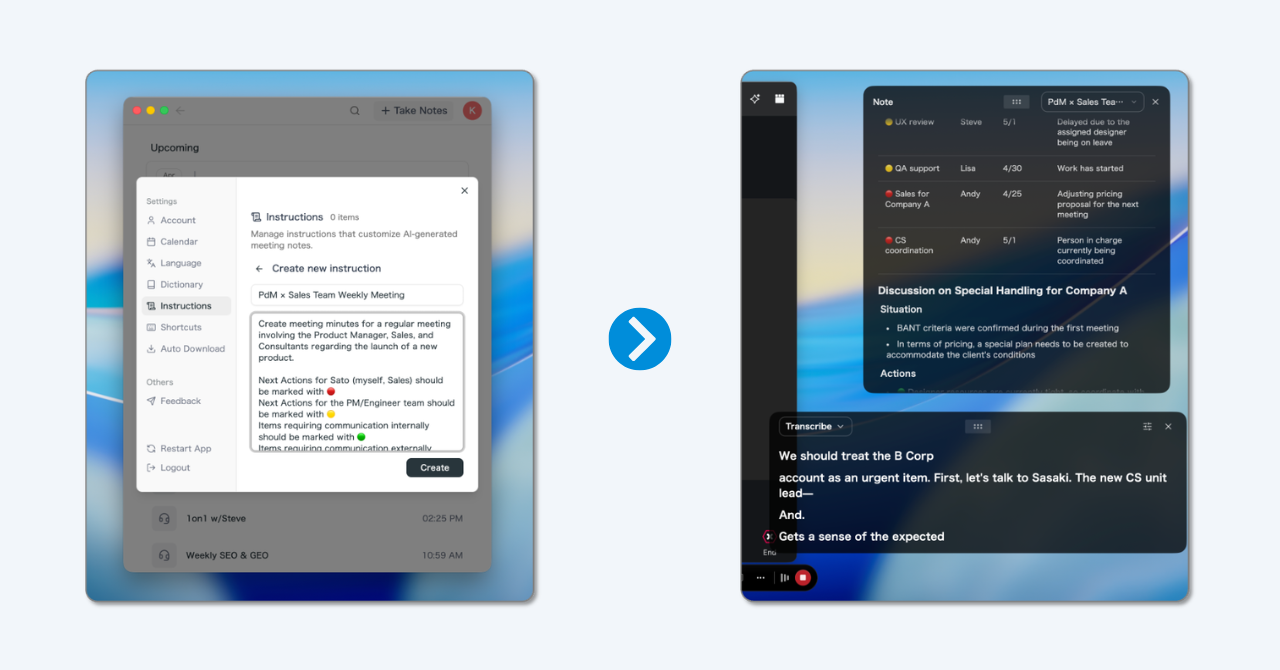
For structured interviews specifically:
- Your guide becomes the shape of your notes. With AI Canvas you define the template blocks once (competencies, questions, evidence), and every interview produces notes in that same shape as it happens. Two candidates end up documented in the same structure, which is exactly what a structured interview needs.
- You score from facts, not recollection. Afterward you have a transcript showing who said what. You can go back to the exact answer before choosing an anchor.
- Post-meeting AI chat helps you review evidence. Questions like "What measurable result did they mention in the problem-solving question?" get answered from the transcript, not from the panel's memory.
- Interviews across languages. If you interview candidates in other countries, real-time translation and summaries in your language keep language from becoming an accidental filter.
Two non-negotiables. First, tell the candidate and get their consent before transcribing or recording. One sentence does it: "I use an AI note-taker so I can listen to you instead of typing; only the hiring team sees the transcript. Is that okay?" Recording consent rules vary by state and country, so check yours. Second, the AI documents, but the scoring is human. The interviewer picks the anchor and owns the evaluation; the transcript is the evidence, not the judge.
To put each tool in its place:
| Handwritten notes | AI note-taker (e.g. SuperIntern) | ATS or recruiting platform | |
|---|---|---|---|
| Faithful record of what was said | Partial | Full transcript with speakers | Depends on integrations |
| Interviewer attention | Split | On the candidate | Not applicable |
| Same note structure for every candidate | Depends on discipline | Yes, via an AI Canvas template | Scorecard forms |
| Works on any platform and in person | Yes | Yes, no bot | Varies |
| Pipeline, offers, and candidate communication | No | No | Yes |
SuperIntern covers the conversation and its notes. It does not replace an ATS or manage applications and offers; in a mature process, both pieces coexist.
Common mistakes
- Calling an interview structured because it has prepared questions. Without an anchored scale and independent scoring, it is still a free-form chat with a cheat sheet.
- Too many competencies. Eight competencies in an hour produce eight shallow evaluations. Four measured well beat eight measured badly.
- Improvised follow-ups that differ per candidate. A great follow-up for one candidate and none for another breaks comparability. Plan follow-ups in the guide.
- Scoring after the debrief. If the panel talks before scoring, scores converge toward the dominant opinion.
- Notes full of adjectives instead of facts. "Very proactive" cannot be compared with anything. "Proposed and ran the vendor switch unprompted; cut cost 12%" can.
- Interrogation tone. Reading questions without looking up makes for a worse experience and worse answers. Structure is not coldness: explain the format, say why everyone gets the same questions, and have a conversation.
- Never revising the guide. If a question does not separate anyone (everyone scores a 3), replace it in the next loop.
FAQ
What is a structured interview in simple terms?
It is an interview where every candidate answers the same questions, in the same order, and is evaluated on the same predefined scale. The aim is to compare candidates fairly and reduce the weight of the interviewer's personal impression.
What is the difference between a structured and a semi-structured interview?
In a structured interview, the questions, order, and follow-ups are fixed and everything is scored. A semi-structured interview has a common core of questions, but the interviewer can change the order, probe freely, and add questions as the conversation develops. Semi-structured gains naturalness and loses some comparability.
How many questions should a structured interview have?
For a 45 to 60 minute interview, 6 to 10 main questions is usually right: one or two for each of 4 to 6 competencies, with room for follow-ups and the candidate's own questions.
What is the STAR method, and how is it used in structured interviews?
STAR stands for Situation, Task, Action, Result. It is used to frame behavioral questions and to judge whether a candidate's answer is complete. If the specific action or the result is missing, the interviewer uses a planned follow-up to get it.
Are structured interviews used in research too?
Yes. In social, market, and academic research, a structured interview is a data-collection technique with a fixed questionnaire applied identically to every respondent. The logic is the same as in hiring: standardize so you can compare and analyze.
Can you record or transcribe a job interview?
Yes, as long as you inform the candidate, get their consent, and handle the data under applicable privacy and recording laws. In the US, some states require all-party consent for recording. Tell the candidate who will access the transcript and how long it will be kept.
Can AI score candidates for me?
Handing over the decision is not advisable. AI is very useful for transcribing, structuring notes, and finding evidence, but scoring against the scale and the final decision should stay with people who can justify them.
Conclusion
A structured interview is not a cold form. It is a way of taking every candidate seriously: same questions, same criteria, same chance. The mechanics fit on one page: analyze the role, pick a few competencies, write behavioral and situational questions, anchor the scale in observable behavior, and score independently before you debrief.
Where most loops break down is the record. A well-designed scale only works with faithful evidence of what each candidate said. Solve that part with a consistent template that fills in during the interview and transparent consent, and the rest of the method starts delivering what it promises.
Try SuperIntern Free: no bots in your interviews, live notes that follow your competency guide, and a speaker-labeled transcript ready for evidence-based scoring.