Conflict Management at Work: Types, Escalation Stages, Methods, and the Conflict Conversation (2026 Guide)
Conflict at work is not a malfunction; it is the default state of any group of people with different goals, roles, and personalities. What gets expensive is not the conflict itself but how it is handled. A dispute over responsibilities that smolders for months burns productivity, morale, and eventually people, while the same issue, addressed early and with structure, would have been resolved in a single conversation.
That is what conflict management is about. This guide explains what the term means, which types of conflict show up at work, how conflicts escalate according to Friedrich Glasl's model, what the five conflict styles are and when each one makes sense, which methods have proven themselves, how to lead a conflict conversation in five steps, how to prevent conflicts structurally, and which part of the work AI can take off your hands.
⚠️ This article was independently compiled based on publicly available information and user feedback as of September 2026.
Table of Contents
- What Is Conflict Management?
- Types of Workplace Conflict
- Glasl's 9 Stages of Conflict Escalation
- The 5 Conflict Styles (Thomas-Kilmann Model)
- Conflict Management Methods at a Glance
- How to Lead a Conflict Conversation: 5 Steps
- Template: Preparing and Documenting the Conflict Conversation
- Real-World Examples
- Preventing Conflict Before It Starts
- Common Mistakes
- How AI Supports Conflict Management
- Frequently Asked Questions
- Conclusion
What Is Conflict Management?
Conflict management is the set of practices used to recognize conflicts early, work through them in a structured way, and resolve them before they escalate and permanently damage collaboration. It operates on three levels: recognizing conflict (diagnosis), working through conflict (intervention, such as a conflict conversation or mediation), and preventing conflict (structural prevention through clear roles, processes, and communication routines).
It is just as important to be clear about what conflict management is not. The goal is not to suppress every disagreement. Productive argument about the better solution is a feature of any healthy decision culture, not a bug. Conflict management starts where a disagreement about the matter threatens to become a clash between people: when positions harden, communication breaks down, and the parties put more energy into the conflict than into the work.
For managers, conflict management is core business, because unresolved conflict shows up reliably in the numbers: more sick days, more turnover, slower decisions, and meetings where the real issue is no longer said out loud. The good news is that the tools are learnable, and in most cases far simpler than the first uncomfortable moment of the conversation suggests.
Types of Workplace Conflict
The first step of any conflict work is diagnosis: what is this fight actually about? Four conflict types cover most situations at work.
| Conflict type | What it is about | Typical example |
|---|---|---|
| Task conflict | Different judgments on a factual question: approach, priority, method | Two engineers argue about the right architecture for a new feature |
| Relationship conflict | Personal tension, damaged trust, antipathy | Two colleagues only exchange the bare minimum, regardless of the topic |
| Role and resource conflict | Unclear responsibilities, or competition over scarce resources: budget, staffing, recognition | Two teams claim the same project, or a task belongs to nobody |
| Values conflict | Different convictions about what is right and important | Thoroughness versus speed, caution versus experimentation |
The distinction is more than theory, because each type calls for a different treatment. A task conflict can be settled with data and criteria. A role conflict needs a structural decision from leadership. A relationship conflict needs a moderated conversation, and a values conflict often cannot be resolved at all, only negotiated into a form both sides can work with.
The trickiest cases are disguised conflicts: what is fought as a factual dispute over a detail is often a relationship or recognition conflict underneath. A reliable signal is stubbornness that does not match the stakes. When the heat of the argument is out of proportion to the size of the topic, it is worth looking beneath the surface.
Glasl's 9 Stages of Conflict Escalation
The best-known model of conflict dynamics comes from the conflict researcher Friedrich Glasl. It describes how conflicts escalate through nine stages, grouped into three phases. The central idea: conflicts do not escalate randomly. They follow a downward dynamic, and the further they progress, the less able the parties are to stop them on their own.
| Phase | Stages | What it looks like |
|---|---|---|
| Win-win (stages 1 to 3) | Hardening, debate and polemics, actions instead of words | Positions harden, people try to win arguments instead of understanding, then start acting unilaterally. A solution without losers is still possible |
| Win-lose (stages 4 to 6) | Coalitions, loss of face, threat strategies | Allies are recruited, the other side is publicly devalued, threats replace arguments. The goal is now to win |
| Lose-lose (stages 7 to 9) | Limited destructive blows, fragmentation, together into the abyss | Harming the other side is accepted even at one's own expense. Without massive outside intervention, the conflict ends destructively |
Two practical rules follow. First: the earlier you intervene, the cheaper the resolution. At stages 1 to 3, a structured conversation between the parties is usually enough. From the second phase on, you typically need a neutral third party, such as the manager or an internal facilitator, and from the third phase on, professional external help.
Second: watch the transitions. The move from stage 3 to stage 4 is the most critical moment in the model, because from there the conflict stops being about the issue and becomes a fight about people. If you notice, as a manager, that someone is recruiting allies ("can you confirm he always does this?"), waiting is no longer an option.
The 5 Conflict Styles (Thomas-Kilmann Model)
People react to conflict differently. The widely used model by Kenneth Thomas and Ralph Kilmann maps behavior along two axes: how strongly do I pursue my own interests (assertiveness), and how strongly do I consider the other side's interests (cooperativeness)? That yields five styles, and none of them is right or wrong in itself.
| Style | In short | Useful when... | Risky when... |
|---|---|---|---|
| Avoiding | Neither my interests nor yours, for now | The issue is minor, or a pause will calm things down | Important issues are left to smolder indefinitely |
| Accommodating | Your interests before mine | The relationship matters more than the issue, or you were wrong | It becomes a habit and frustration accumulates |
| Competing | My interests before yours | A fast decision is needed, or a principle must be defended | It becomes the default style and destroys trust |
| Compromising | Both sides give something up | Time is short and both sides can live with the result | The lazy middle ground leaves both problems unsolved |
| Collaborating | Both sets of interests in full | The issue is important enough for real problem-solving | The effort is out of proportion for small matters |
The practical value of the model lies less in labeling others than in self-diagnosis. Most people have a favorite style they apply regardless of the situation: one person always competes, another always avoids. Conflict competence means choosing the style to fit the situation instead of following your reflex.
Conflict Management Methods at a Glance
For working through conflicts in a structured way, a handful of methods have become established. They can be combined depending on the escalation level and the conflict type.
- The structured conflict conversation. The standard tool for early stages: the parties resolve the conflict directly with each other, ideally following a fixed sequence such as the 5-step guide in the next section. The precondition is that both sides are still willing to talk.
- Facilitation by the manager. When the direct conversation fails, or the power gap between the parties is too large, a third person moderates: with authority, but without taking sides. The manager structures the conversation, enforces fairness, and records agreements, but decides only if no agreement can be reached.
- Mediation. A formalized process with an impartial third party who does not decide anything but leads the parties to their own solution. Useful from the middle escalation stages onward, or when the manager is themselves a party to the conflict.
- The Harvard method (principled negotiation). A negotiation approach with four principles: separate the people from the problem, negotiate over interests rather than positions, develop options for mutual gain, and rely on objective criteria. Especially useful for task and resource conflicts.
- Nonviolent Communication (NVC). Marshall Rosenberg's four-step conversation format: describe the observation, name the feeling, express the need, formulate the request. Its value lies in the strict separation of observation from evaluation, which takes accusation out of the conversation.
- Team workshops and supervision. When entire teams or departments are in conflict rather than two individuals, you need group formats: facilitated workshops on roles and interfaces, regular retrospectives, or external supervision.
How to Lead a Conflict Conversation: 5 Steps
The conflict conversation is the single most important tool in conflict management, and it rarely fails for lack of goodwill. It fails for lack of structure. This sequence works for a direct conversation between two people as well as for one moderated by a manager.
Step 1: Prepare and invite. Get clear for yourself: what exactly happened (facts, not interpretations)? What is my share in it? What would a good outcome look like? Then invite personally and without blame: "I can tell something is off between us, and the way we work together matters too much to me to let it slide. Do you have 45 minutes tomorrow?" Important: a neutral place, enough time, no audience.
Step 2: Set the frame. At the start, both parties (or the facilitator) name what the conversation is about and what it is not: "This is about how we handle handovers between our teams. It is not about who was at fault in the past." Add the ground rules: let each other finish, speak for yourself, be specific.
Step 3: Hear both perspectives. Each side describes its view without being interrupted, ideally in I-statements: "I learned about the deadline at short notice three times, and then I am the one breaking promises to my team." The other side summarizes what it heard before responding. This technique from active listening is the moment where most conflict conversations turn, for the better: someone who feels genuinely understood for the first time no longer needs volume to defend their position.
Step 4: Clarify interests and collect options. Behind every position sits an interest. "I want to be cc'd on every email" is a position; the interest behind it is usually "I do not want to be blindsided by another change." At the level of interests, far more solutions are available than at the level of positions. Collect several options before evaluating any of them.
Step 5: Agree and plan the follow-up. The conversation ends with a concrete agreement: who will do what differently from now on, how will we know it is working, and when will we talk about it again? "We talked it through" is not an agreement. "Requirement changes go through the ticket system from now on, and we check in four weeks in our 1:1 whether it is holding" is one. Put the agreement in writing, otherwise the next conflict starts with the question of what was actually agreed.
Template: Preparing and Documenting the Conflict Conversation
You can copy this template straight into your notes tool. The first part structures your preparation along the diagnosis from the previous sections; the second part structures the outcome record of the conversation.
# Conflict conversation – Preparation
Participants: [names] | When: [date, place]

## My preparation
- What concretely happened (facts, not interpretations): [...]
- My share in the situation: [...]
- My interest (what I actually need): [...]
- Suspected conflict type: [task / relationship / roles & resources / values]
- Estimated escalation stage (Glasl 1 to 9): [...]
- A good outcome from my point of view: [...]

# Conflict conversation – Outcome record
## Points discussed
- [...]

## Agreements
- [Who] does [what] differently starting [date]
- Success criterion: [how will we know it is working?]

## Follow-up
- Next check-in: [date]
- Open points: [...]
Two notes on usage. Fill in the preparation part for yourself only; it does not belong in the conversation. And share the outcome record with everyone involved on the same day, so the agreement is confirmed while memory is fresh.
Real-World Examples
Example 1: The responsibility conflict. Two team leads keep clashing because customer requests land sometimes in one team, sometimes in the other, and each side accuses the other of cherry-picking. Diagnosis: role and resource conflict, escalation stage 2 to 3. Approach: their shared manager moderates a conversation in which both sides first describe their view. At the level of interests, it turns out both care about predictable workload, not about individual customers. Result: a written routing rule plus a monthly review. The conflict was never personal; it was a hole in the structure.
Example 2: The smoldering relationship conflict. A senior developer and a new colleague barely speak since he sharply criticized her code in front of the whole team. Work now flows through detours, and others have to mediate. Diagnosis: relationship conflict with injured recognition, stage 3 to 4. Approach: the manager first holds one-on-one conversations, then a moderated conversation between the two. In that conversation, observation is separated from evaluation: the problem was not the technical critique but its place and tone. Result: an apology for the form, an agreement to do code reviews in a small circle, and a follow-up a month later.
Example 3: The values conflict in a project. Product management wants to show a prototype to the customer quickly; engineering considers the quality indefensible. Each side accuses the other of endangering the project. Diagnosis: values conflict (speed versus thoroughness) on the task level, stage 2. Approach: no debate about core values, but a conversation about objective criteria in the spirit of the Harvard method: what exactly has to work at the customer demo, and what may stay provisional? Result: an explicit list of which parts may be demo quality, and a fixed date for the cleanup. The values gap remains, but it has found a working form.
Preventing Conflict Before It Starts
The cheapest conflict is the one that never escalates. Prevention does not mean enforcing harmony; it means structurally draining the most common sources of conflict.
- Make roles and responsibilities explicit. A large share of team conflicts are structural problems in disguise. When two people claim the same decision, or a task belongs to nobody, the fight is pre-programmed. Clear ownership, even in a simple responsibility matrix, removes the breeding ground.
- Voice expectations early. Most disappointments grow out of expectations that were never spoken. Regular 1:1s and honest, timely feedback ensure that irritations surface while they are still small.
- Document decisions and agreements. A surprising number of conflicts begin with two different memories of the same meeting: what was promised, what was the deadline, who owned which task? A written record of important meetings is unglamorous, but it removes the foundation from this entire class of conflict.
- Maintain a healthy meeting culture. Meetings where people are interrupted, where the same voices dominate, and where criticism gets personal produce conflict on a conveyor belt. Firm ground rules and a facilitator who enforces them are effective communication in practice, and therefore conflict prevention.
- Normalize disagreement. Teams that are allowed to argue openly escalate less often. A manager who admits their own misjudgments and visibly rewards substantive pushback lowers the threshold for raising problems early.
Common Mistakes
- Sitting it out and hoping for self-healing. Conflicts rarely disappear on their own; left alone, they climb down Glasl's stages. Addressing things early is almost always cheaper than addressing them late.
- Mediating the issue when the relationship is injured. Prescribing a factual compromise for a relationship conflict treats the wrong problem. Diagnosis first, then method.
- Deciding immediately as the manager. A ruling from above ends the argument but not the conflict, and both sides learn only that conflicts are things you carry to the boss. Moderate first; decide only when no agreement can be reached.
- Asking blame questions instead of future questions. "Who started it?" leads to defense; "how do we handle this from now on?" leads to solutions. The past gets clarified only as far as understanding requires.
- Taking sides before hearing both parties. Whoever judges after the first account becomes a party to the conflict and loses the ability to mediate.
- Not recording agreements and not following up. Without a written agreement and a follow-up date, the best conflict conversation is only a pause. The conflict returns, now with the added accusation that the deal was broken.
How AI Supports Conflict Management
The core of conflict management, which is listening, understanding interests, and rebuilding trust, cannot and should not be automated. But there is one part of the work that automates beautifully: documenting what was actually said and agreed. It also happens to be the place where many conflicts start in the first place.
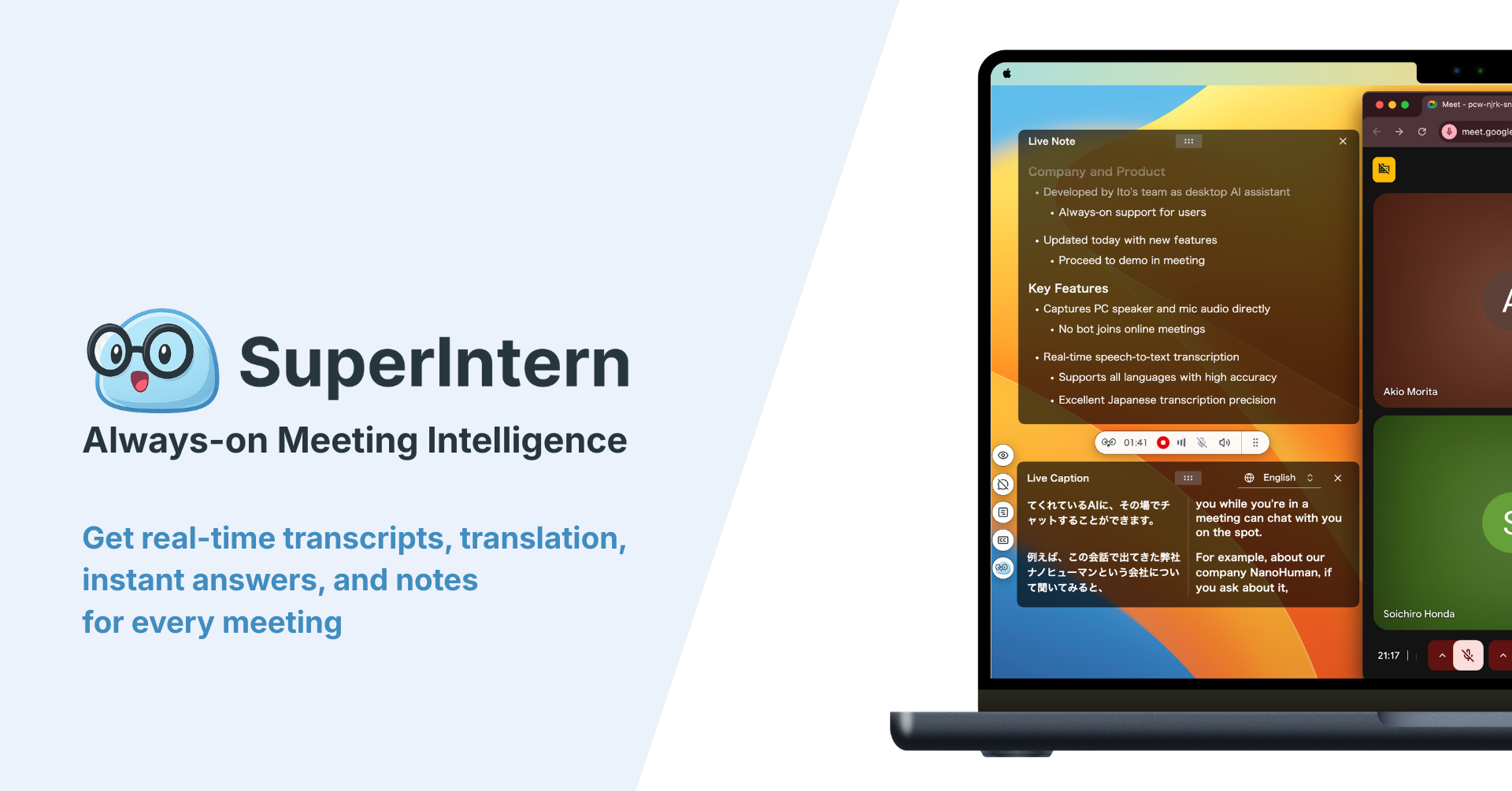
SuperIntern is a botless desktop app for Mac and Windows that captures audio directly from the device. No bot joins the call, so it works platform-independently across Zoom, Google Meet, Microsoft Teams, Webex, and in-person meetings.

Four building blocks matter for conflict management.
- One shared memory instead of two recollections. Transcription with speaker attribution documents who said what. The dispute "we never agreed to that," which weeks later grows out of two honest but different memories, dissolves with one look at the record, before it turns personal.
- Agreements that write themselves down. The AI Canvas builds a structured live note during the conversation, following your instruction, for example: "Capture the points discussed, the agreements made, and the next steps with owners." The most important part of the conflict conversation, the written agreement from step 5, is produced as a byproduct and can be shared immediately.
- Moderating without doubling as note-taker. Whoever moderates a difficult conversation needs full attention for the undertones. When the record keeps itself, the facilitator can stay in the conversation instead of switching between listening and writing.
- Defusing language barriers as a conflict source. In international teams, tension often grows from plain misunderstandings in a second language. Live captions and real-time translation across 50+ languages ensure everyone follows the same conversation, and the summary arrives in each person's working language.
Two honest caveats. First, no tool replaces the conversation itself: AI records agreements, it does not make them. Second, sensitive conversations demand extra care: recording requires the participants' consent, and in a conflict situation especially, whether and how the conversation is documented should be agreed openly. Used transparently, the record often has a de-escalating effect, because it replaces individual interpretation authority with a shared factual basis. A free plan is available, so the workflow can be tested in your next recurring meeting.
Frequently Asked Questions
What is conflict management, in short?
The set of practices for recognizing conflicts early, working through them in a structured way, and resolving them before they escalate: from diagnosing the conflict type through the conflict conversation and mediation to prevention via clear roles and documented agreements.
What are the 5 steps of a conflict conversation?
Prepare and invite, set the frame, hear both perspectives, clarify interests and collect options, agree and plan the follow-up. The last step and its written form are decisive: without a recorded agreement and a follow-up date, the conversation has no lasting effect.
What are the 4 types of conflict?
In a work context, the usual distinction is task conflicts (disputes about approaches), relationship conflicts (personal tension), role and resource conflicts (responsibilities and scarce resources), and values conflicts (different convictions). The diagnosis determines the method, because each type calls for different treatment.
What are Glasl's 9 stages of escalation?
A model by Friedrich Glasl that describes conflict escalation in three phases: win-win (hardening, debate, actions instead of words), win-lose (coalitions, loss of face, threat strategies), and lose-lose (limited destructive blows, fragmentation, together into the abyss). The higher the stage, the more outside help is needed.
When should a manager step into a conflict?
As soon as a conflict visibly impairs collaboration or the parties can no longer resolve it on their own, and at the latest when coalitions form and third parties get pulled in (Glasl stage 4). Stepping in means moderating first, not ruling: a decision from above is the last resort, not the first move.
What is the difference between mediation and facilitation?
Facilitation structures a conversation and can be done by the manager, even though they are part of the hierarchy. Mediation is a formalized process with an impartial, usually specially trained third party, suited to more escalated conflicts or cases where the manager is themselves a party.
Can AI help with conflict management?
With the documentation side, yes: meeting records with speaker attribution create a shared factual basis, live notes capture agreements, and real-time translation defuses misunderstandings in international teams. The conversation itself, the listening, and the trust-building remain human work.
Conclusion
Conflict management is not a dark art; it is a craft with clear tools: diagnose the conflict type, estimate the escalation stage, choose the fitting style and method, and lead the conflict conversation through the five steps until a written agreement stands. Add structural prevention, with clear roles, expectations voiced early, and documented agreements, and many conflicts get resolved before they deserve the name.
The most tedious side job of conflict work, keeping a complete record of what was said and agreed, is one you can now hand off. That keeps your attention where no tool can reach: on listening, on understanding, and on the question of how two positions become a team again.
Try SuperIntern Free : Botless live meeting notes with speaker attribution, so agreements never depend on memory again.