Steering Committee: Meaning, Roles, Who Sits on It, Agenda Template, and Minutes (2026 Guide)

The steering committee is the room project managers prepare for most carefully, and the room that is most often used badly. In one company it is a slide show where nobody decides anything. In another, three executives spend 40 minutes debating the color of a button. Both waste the most expensive hour a project has.
This guide explains what a steering committee is and what it exists to do, which responsibilities belong to it and which do not, who should sit on it, how it differs from the project manager, the PMO, and an advisory board, how to run a meeting in 60 minutes, and how to prepare decisions so they actually get made. You will also find templates for a decision paper and for the minutes, the mistakes that turn steering committees into status theater, and a way to capture every decision verbatim without anyone taking notes.
⚠️ This article was independently compiled based on publicly available information and user feedback as of October 2026.
Table of Contents
- What is a steering committee?
- Steering committee responsibilities
- Who sits on a steering committee?
- Steering committee vs. project manager, PMO, and advisory board
- How a steering committee meeting runs: the 60-minute agenda
- The decision paper: how decisions actually get made
- Project manager checklist: before, during, and after the meeting
- Steering committee minutes template
- Common steering committee mistakes
- Capturing decisions without taking notes
- Frequently asked questions
- Conclusion
What is a steering committee?
A steering committee is the top decision-making body of a project. It represents the sponsor, sets the goals, budget, and boundaries, makes the decisions that exceed the project manager's authority, and is accountable to the organization for the project's success. The project manager runs the project day to day. The steering committee steers it at the points where the direction is actually set.
You will hear the same body called a steering group, steering board, project board, governance board, or simply the SteerCo in large companies. In PRINCE2 it is the Project Board. In German-speaking companies it is the Lenkungsausschuss, in French ones the comité de pilotage. Whatever the label, the role is a fixed part of project governance rather than a fashionable extra.
The idea is simple: a project needs someone above the project. The project manager cannot decide alone whether the budget grows by 30 percent, whether a department has to give up part of its requirements, or whether the project should continue at all. Those calls need people who control the resources involved and who will live with the consequences in their own line organizations. Those people are the steering committee.
A steering committee is therefore not an extended project team, not a status meeting, and not a discussion forum. It is a body that meets at defined points to decide, on the basis of information prepared in advance.
Steering committee responsibilities
The responsibilities fall into six areas. The right-hand column matters as much as the middle one: most steering committee problems come from the committee doing things that are not its job.
| Responsibility | What it means in practice | What explicitly does not belong here |
|---|---|---|
| Set the mandate and goals | Approve the project charter, confirm success criteria and non-goals | Writing the detailed project plan |
| Provide resources | Release budget, people, and time, resolve conflicts of interest between departments | Assigning individual tasks to team members |
| Make decisions | Decide on changes, escalations, and options that exceed the project manager's authority | Making decisions the project manager can make alone |
| Steer progress | Approve milestones and stage transitions, assess deviations from plan, budget, and quality | Chasing every weekly task in the status report |
| Own major risks | Assess the big risks, decide on responses, represent them to the organization | Working every item in the risk register |
| Represent the project | Build acceptance in the organization, enforce decisions in their own departments | Replacing project communication |
PRINCE2 captures the role in a phrase that is useful well beyond the method: management by exception. The committee defines tolerances for time, cost, scope, quality, benefits, and risk. As long as the project stays within those tolerances, the project manager works independently. The committee only steps in when a tolerance is forecast to be exceeded. That keeps the body free for the decisions that genuinely need its level.
The most common failure in practice is a slow drift downward: the committee starts discussing operational questions because they are more tangible than strategic ones. The damage is twofold. The meeting gets long, and the project manager loses room to act because suddenly even small things need sign-off.
Who sits on a steering committee?
The right membership follows one question: who controls the resources and bears the consequences? Anyone without decision-making authority does not belong at the table as a voting member. They belong on the guest list or the distribution list for the minutes.
| Role | Who it usually is | Job in the committee |
|---|---|---|
| Sponsor (chair) | Executive, division head, business owner | Carries overall accountability, has the final word when members disagree, chairs the meeting |
| Business or user representatives | Heads of the departments that will use the result | Make sure the result meets the need, provide subject-matter staff |
| Supplier representatives | Head of IT, internal engineering, external vendor | Stand for feasibility, quality, and delivery resources |
| Project manager | The project manager | Reports, prepares decisions, usually does not vote |
| PMO or project assistant | Project management office | Organizes the meeting, the papers, and the minutes |
| Guests as needed | Finance, legal, data protection, works council, customer | Advise on specific agenda items |
The first three rows match the three perspectives PRINCE2 requires on a Project Board: Executive, Senior User, and Senior Supplier. The split is so durable because it mirrors the three interests that pull against each other in every project. The business wants benefits, the users want their requirements met, and the delivery side wants realistic conditions. If one perspective is missing from the room, it is missing from the decisions too.
On size: three to seven voting members is the rule of thumb. Fewer and perspectives are missing. More and every decision becomes a negotiation. If more people have a stake in the project, that is a case for an advisory board or a distribution list, not for more chairs at the table.
On the project manager: they are the most important person in almost every meeting, and deliberately not a voting member. They prepare the decisions, lay out options, and make a recommendation. The people who will live with the consequences decide. That separation protects both sides. The project manager does not have to defend decisions beyond their authority, and the committee cannot hide behind the project manager.
Steering committee vs. project manager, PMO, and advisory board
These terms get mixed up constantly. The distinction decides which question goes to which body.
| Body or role | Level | Decides on | Meets |
|---|---|---|---|
| Steering committee | Strategic | Mandate, budget, stage approvals, escalations, cancellation | At milestones, usually monthly to quarterly |
| Project manager | Operational | Everything within agreed tolerances: planning, tasks, leading the team | Daily to weekly with the team |
| PMO (Project Management Office) | Supporting | Methods, standards, reporting, templates | Continuously |
| Advisory board or sounding board | Advisory | Nothing binding, gives recommendations and feedback | As needed |
| Portfolio board | Enterprise-wide | Prioritization across projects, resources across projects | Quarterly |
Two distinctions deserve extra attention.
Steering committee and steering group: in many organizations these are synonyms. In some, the steering group is a smaller, more operational body that handles alignment between full committee meetings. If both terms exist in your organization, state explicitly in the project charter which body makes which decisions.
Steering committee and advisory board: the board advises, the committee decides. People who give valuable advice but do not control resources belong on the advisory board. Mix both functions in one body and you get long discussions and unclear resolutions.
How a steering committee meeting runs: the 60-minute agenda
A good steering committee meeting is short because the work happened beforehand. The papers go out at least three working days in advance, with the expectation that members read them. The meeting itself is for deciding, not for informing.
| Time | Agenda item | Goal | Who |
|---|---|---|---|
| 0 to 5 min | Open, confirm quorum, confirm agenda | Everyone knows what is being decided today | Chair |
| 5 to 10 min | Open resolutions from the last meeting | Was what we decided actually done? | Project manager |
| 10 to 20 min | Project status on one page | RAG status for time, cost, scope, quality, risk, discuss deviations only | Project manager |
| 20 to 45 min | Decision items | For each decision paper: options, recommendation, resolution | All |
| 45 to 52 min | Risks and escalations | Assess major risks, decide on responses | All |
| 52 to 58 min | Outlook to the next stage or milestone | What has to happen before the next meeting? | Project manager |
| 58 to 60 min | Read back the resolutions | Everyone hears the same decisions, owners, and dates | Chair or minute taker |
Three principles make the difference:
- Status is one page, not a presentation. A committee that watches 30 minutes of status slides has 30 minutes less to decide. Members who have read the papers only need the deviations and their causes.
- Decisions sit in the middle, not at the end. Put the decision items in the last ten minutes and they get made under time pressure or not at all. The most focused part of the meeting belongs to the decisions.
- Every resolution is read back out loud. Wording, owner, date. Two minutes that prevent the most common dispute after steering committees: different memories of the same decision.
On cadence: many projects meet monthly, short projects every two weeks, long programs quarterly plus extra sessions at stage gates. More important than a fixed rhythm is that decisions never have to wait for the next meeting. Urgent cases need a route to a written resolution by email or a short ad hoc session.
The decision paper: how decisions actually get made
The difference between a steering committee that decides and one that defers almost always lies in the preparation. A decision paper forces the project manager to ask the question in a form that can be answered. This template fits on one page, and that is deliberate.
DECISION PAPER No. [running number]
Project: [name]        Meeting date: [date]        Submitted by: [project manager]

1. Decision required (one sentence)
   The steering committee is asked to decide whether [specific question].

2. Background (max. 5 lines)
   What happened, and why does this exceed the project manager's authority?

3. Options
   | Option | Cost | Time | Risk | Impact on goals |
   |--------|------|------|------|-----------------|
   | A: [..] | [..] | [..] | [..] | [..]            |
   | B: [..] | [..] | [..] | [..] | [..]            |
   | C: Change nothing | [..] | [..] | [..] | [..]  |

4. Project manager's recommendation
   Option [X], because [two-sentence rationale].

5. Consequences of not deciding
   If no decision is made today, the following happens before the next meeting: [..]

6. Resolution required (wording to vote on)
   "The steering committee resolves to [..]. Owner: [name]. Implemented by: [date]."
Three notes on using it:
- The "change nothing" option is always included. It shows what deferral costs and turns an either-or question into a trade-off.
- The recommendation is mandatory. A committee without a recommendation from the project manager has to do the analysis in the meeting, and that is exactly when 25 minutes become an hour. Members may decide differently, but they should not start from zero.
- The resolution text is pre-written. What is pre-written can be voted on and pasted into the minutes. What is formulated in the room ends up in the minutes as "was discussed."
Project manager checklist: before, during, and after the meeting
For the project manager, every steering committee meeting is a small project of its own. This checklist covers the points where meetings fail in practice.
One week before
- Decision needs collected: which questions exceed my authority and have to go on the agenda?
- Decision papers written, each with options, recommendation, and resolution text
- Critical decisions pre-discussed with the key members. No surprises in the meeting, and that applies to good news as much as bad.
- Status report condensed to one page, only deviations commented
Three working days before
- Agenda with timings, status report, and decision papers sent out
- Quorum checked: are the people present without whom nothing can be decided? If not, a deputy with decision-making authority arranged
- Minute taking settled: who writes, or which AI meeting assistant takes it over?
During the meeting
- Open every decision item with the question: "I am asking for a resolution on ..."
- Bring digressions back: "That is a question for the project team, I will take it with me."
- Repeat every resolution in its wording and have it confirmed before moving to the next item
Within 24 hours after
- Decision minutes sent, with resolutions verbatim, owners, and dates
- Resolutions transferred into the project plan and task management
- Team told what was decided and what changes as a result
Steering committee minutes template
Steering committee minutes are decision minutes, not discussion minutes. Nobody will later need to read who made which argument. What gets read is what was decided, by whom, and by when. For the difference between the types, see our guide to action, discussion, and verbatim minutes.
STEERING COMMITTEE MINUTES
Project: [name]     Meeting No.: [no.]     Date: [date]     Duration: [from to]
Present (voting): [names, roles]
Present (advisory/guests): [names]
Apologies: [names, represented by]
Minutes: [name or tool]

1. Quorum confirmed: [yes/no]

2. Implementation of resolutions from meeting No. [no.]
   | Resolution | Owner | Status |
   |------------|-------|--------|

3. Project status
   Time: [green/amber/red]  Cost: [..]  Scope: [..]  Quality: [..]  Risk: [..]
   Material deviations: [1 to 3 sentences]

4. Resolutions
   R-[no.]: "The steering committee resolves to [wording]."
            Vote: [unanimous / majority / dissent from ..]
            Owner: [name]   Implemented by: [date]
   R-[no.]: ...

5. Deferred decisions
   | Topic | Reason for deferral | Missing information | Due by |
   |-------|---------------------|---------------------|--------|

6. Risks and agreed responses
   | Risk | Assessment | Response | Owner |
   |------|------------|----------|-------|

7. Next meeting: [date], planned decision items: [..]
The "deferred decisions" section is deliberately detailed. A deferral without a note of which information is missing and when it will be available is not a deferral. It is a postponement with no end. The table turns it into a task with a date.
Common steering committee mistakes
- The body is too big. Twelve people do not decide, they negotiate. Anyone who does not control budget or resources gets the minutes and a seat on the advisory board.
- The meeting is a status presentation. If 45 of the 60 minutes go to slides, the committee has missed its actual purpose. Status belongs in the pre-read, the meeting belongs to decisions.
- Decisions without a paper. A question that lands on the table without options and a recommendation gets deferred or decided on gut feeling. Both are expensive.
- Operational topics on the agenda. As soon as the committee debates the wording of a requirements document or the choice of a single tool, the project manager loses room to act and the committee loses its time.
- Surprises in the meeting. A red budget the sponsor hears about for the first time in the room triggers a crisis of trust, not a decision. Critical news is discussed one to one beforehand.
- Nobody with authority in the room. If the decisive person is absent and their deputy has to "take it back first," the meeting was wasted. Deputies need decision-making authority.
- Resolutions without wording. "The budget topic was discussed and there is agreement to adjust" is not a resolution. A resolution has one sentence, one owner, and one date.
- No follow-up. Resolutions whose implementation is not checked at the next meeting become recommendations. The second agenda item above is the cheapest insurance against that.
Capturing decisions without taking notes
Everything in this guide converges on one place: the minutes. Resolutions verbatim, vote result, owners, dates, deferred items with reasons. In practice, exactly these minutes are the hardest thing to get, because the person best placed to write them is the project manager, and the project manager is presenting, fielding questions, and defending a recommendation at that very moment. Anyone who takes notes at the same time does both halfway. And the PMO colleague who takes the notes often does not know the subject matter well enough to word a resolution precisely.
SuperIntern is a botless AI meeting assistant for Mac and Windows. It captures audio directly on your device, so no bot joins the meeting, which makes a noticeable difference in a room with executives, customers, or external vendors. It works the same in Microsoft Teams, Zoom, Google Meet, and Webex, and in the boardroom when the committee meets in person.

For steering committees, it helps in concrete ways:
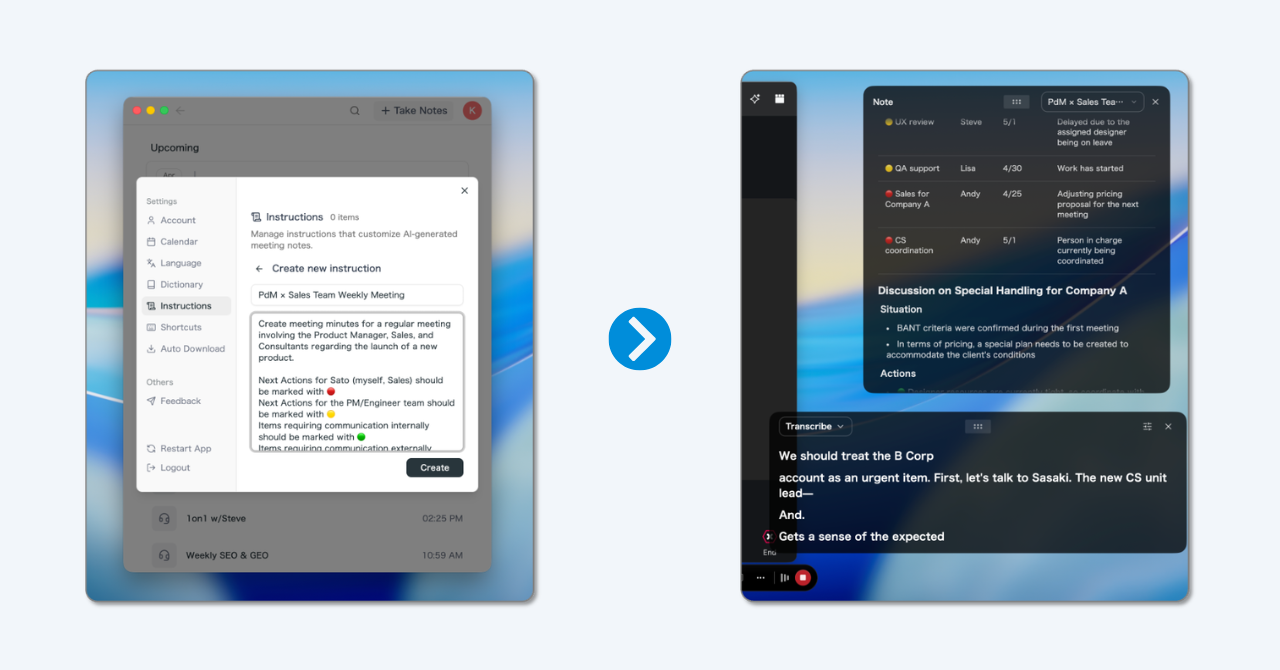
- AI Canvas writes the decision minutes live, in your structure. Tell it once, in plain language: "This is a steering committee meeting. Capture every resolution verbatim with the vote result, owner, and date, list deferred decisions with the reason, and record agreed risk responses." The minutes then take exactly that shape during the meeting, and the read-back in the last two minutes is already on screen.
- Invisible Mode hides the notes while you share your slides. The project manager presents the status and the decision papers over screen share. The live notes stay invisible to the other participants.
- Speaker identification ties every resolution to the people who made it. Because the transcript knows who said "Then we go with option B," you can trace later who carried a decision. Participants can be pulled straight from the calendar event.
- Chat across all your meetings. Ask "What has the steering committee decided about the budget in the last three meetings, and what conditions were attached?" and get an answer grounded in what was actually said. For preparing the next decision paper, that is often half the work.
- Send resolutions to your tools. Through SuperIntern's MCP connection, AI agents such as Claude or ChatGPT can read the minutes and create agreed actions as tasks in tools like Jira, Linear, or Asana.
It also offers real-time subtitles and translation in 50+ languages, which helps in international steering committees where headquarters speaks English and the business unit speaks something else. The summary comes out in the language you choose. SuperIntern does not replace the decision paper or the preparation; those remain the project manager's job. What it does is make sure every resolution is recorded the way it was made. There is a free plan, so you can try the workflow at your next meeting at no cost.
Frequently asked questions
What is a steering committee in a project?
A steering committee is the top decision-making body of a project. It represents the sponsor, sets the goals, budget, and boundaries, makes decisions that exceed the project manager's authority, and is accountable for the project's success. In PRINCE2 it is called the Project Board, and in large companies often the SteerCo.
What are the responsibilities of a steering committee?
It approves the project charter, provides budget and resources, decides on changes and escalations, approves stage transitions and milestones, owns the major risks, and represents the project in the organization. Operational planning, task assignment, and team leadership are not its responsibilities. Those belong to the project manager.
Who should be on a steering committee?
Typically the sponsor as chair, representatives of the business departments that will use the result, and representatives of the delivery side, such as the head of IT or an external vendor. The project manager attends, reports, and prepares decisions but usually does not vote. Three to seven voting members is a good guideline.
What is the difference between a steering committee and a project manager?
The project manager runs the project operationally within agreed tolerances for time, cost, and scope. The steering committee steers strategically: it sets those tolerances, decides when they are exceeded, and approves stages. The project manager recommends, the steering committee decides.
How often does a steering committee meet?
Monthly meetings are common, every two weeks for short projects and quarterly for long programs, each supplemented by extra sessions at stage gates or escalations. For urgent decisions between meetings, a written resolution procedure by email should be agreed in advance.
What should steering committee minutes include?
Attendees and quorum, the status of resolutions from the last meeting, the project status with material deviations, every resolution verbatim with vote result, owner, and date, deferred decisions with reasons, and agreed risk responses. They are decision minutes, not a record of the discussion.
What is the difference between a steering committee and a steering group?
In most organizations, nothing. Steering group, steering board, project board, and SteerCo are all names for the same body. In some organizations the steering group is a smaller, more operational body that works below the full steering committee between its meetings. If both exist where you work, the project charter should say which one decides what.
Conclusion
A steering committee earns its place when it does what it exists for: deciding. That takes the right membership of sponsor, business, and delivery, a clear line between the committee and the operational project manager, a short agenda with the decisions in the middle, and decision papers that already contain options, a recommendation, and the resolution text.
Then make sure every resolution is recorded the way it was made: verbatim, with an owner and a date, and checked at the next meeting. Nobody has to write those minutes by hand anymore. A botless AI assistant fills your minutes template during the meeting, and the project manager can focus on what counts in that room: bringing well-prepared decisions to a close.
Try SuperIntern Free : Botless live minutes that capture every steering committee resolution verbatim while you present and decide.