
How to Write Notes From Memory After a Meeting: Template, Example, and Legal Weight (2026)

A record written from memory is what you have when nobody took notes during a conversation: after a performance review, a call with your landlord, or a heated exchange on a project team. Done well, it lets you reconstruct what happened weeks or months later. Done badly, it is a collection of impressions that carries little weight when it matters.
This guide explains what notes from memory are (often called contemporaneous notes, a memo to file, or, in German-speaking workplaces, a Gedächtnisprotokoll), when they are worth writing, and how much they hold up. You get a step-by-step method, a copy-ready template, a worked example, a credibility checklist, and a way to capture important conversations live so you do not have to rely on memory at all.
⚠️ This article was independently compiled based on publicly available information and user feedback as of October 2026. It is not legal advice; for a specific dispute, talk to an employment lawyer or your HR or union representative.
Table of Contents
- What are notes from memory?
- When notes from memory are worth writing
- Notes from memory vs. call notes vs. meeting minutes
- How much notes from memory hold up
- How to write notes from memory in 6 steps
- Copy-ready template
- Example: notes after a difficult HR meeting
- Common mistakes
- Credibility checklist before you file it
- Better than memory: capture important conversations live
- Frequently Asked Questions (FAQ)
- Conclusion
What are notes from memory?
Notes from memory are a written summary of a conversation or event that you create after it ends, based on what you remember. That is the key difference from meeting minutes, which are taken while the meeting happens.
The purpose is almost always the same: making something traceable later. Who said what, what was announced, what was agreed or refused? Memory fades fast and details blur, so timing is everything. Notes written the same day are far more useful, and far more credible, than notes written a week later. That is why lawyers and HR teams talk about contemporaneous notes: records made at or close to the time of the event.
You will also see the term used in universities, where students write down oral exam questions from memory so later cohorts can prepare. This article focuses on the workplace, but the same principles apply.
When notes from memory are worth writing
Not every conversation needs a record. Notes from memory pay off when a conversation could have consequences later and no other document exists.
| Situation | Why a written record helps | What to pay attention to |
|---|---|---|
| Performance review or disciplinary meeting | Announcements, criticism, and commitments can be shown later | Exact key statements, who was present, how you responded |
| Termination or severance conversation | Offers, deadlines, and pressure are documented | Do not sign anything you do not understand; write it up the same day |
| Conflict, bullying, or harassment | Single incidents only show a pattern as a series | One entry per incident, with date, place, and witnesses |
| Call with a landlord, agency, or insurer | Verbal promises otherwise disappear | Name of the person, extension, reference or claim number |
| Client conversation without notes | Agreements on price, scope, and dates stay tangible | Confirm them by email afterward |
| Accident or workplace incident | Sequence and people involved are captured before memories fade | Separate facts from assumptions, add a sketch or photos |
| Medical or advisory appointment | Diagnoses, recommendations, and next steps stay available | Ask about terms you did not understand, mark uncertainties |
A simple rule of thumb: if you leave a conversation thinking "I should remember this," that is already your cue to write it down.
Notes from memory vs. call notes vs. meeting minutes
These documents overlap, but they are not the same. The biggest difference is when they are created.
| Document | Created | Typical use | Weight as a record |
|---|---|---|---|
| Notes from memory | After the conversation, from recollection | Conflicts, HR issues, calls nobody documented | Medium, rises with timeliness and detail |
| Conversation notes | During or right after the conversation | Client, vendor, and advisory calls | Medium to high |
| Meeting minutes | During the meeting, often by a designated person | Team meetings, committees, boards | High, especially once approved |
In short: if you can take notes during the conversation, do that. Notes from memory are the second-best option for situations where note-taking was impossible, inappropriate, or simply forgotten.
How much notes from memory hold up
Notes from memory are not a contract and not proof on their own. In most legal systems they are treated as your own account of events. They show what you wrote and when, not that every word is true. A court, arbitrator, or HR investigator weighs them alongside everything else: witness statements, emails, chat logs, and calendar entries.
In practice, good notes still carry real weight, for three reasons:
- They support your testimony. Months later, notes help you recall details precisely. In US courts, for example, a witness can use notes to refresh their memory, and under certain conditions a record made while events were fresh can itself be read into evidence. A detailed, consistent account is more credible than a vague recollection.
- They show timing. Notes dated and emailed to yourself, your lawyer, or your HR representative on the day of the conversation are hard to dismiss as something invented later.
- They reveal patterns. In bullying or repeated misconduct cases, a series of dated entries builds a picture that a single complaint cannot.
Credibility rises when another person who was present reads and signs your notes. It drops when the notes are written long after the event, contain judgments instead of statements, or were edited later.
Why not just record it? Recording laws vary widely. In the US, federal law and most states allow a participant to record with their own consent, but a number of states, including California, require every party to agree. In much of Europe, secret recordings are restricted or even criminal; in Germany, recording a private conversation without consent is an offense. Even where it is legal, a secret recording can damage trust and break company policy. That is exactly why written notes from memory remain so common.
How to write notes from memory in 6 steps
1. Start immediately. Write as soon as possible, ideally within the first hour. If you cannot, jot down bullet points on your phone and write them up that evening.
2. Capture the basics. Date, start and end time, place or channel (in person, phone, video call), and everyone present with their role. Without these details, the notes cannot be tied to a specific event.
3. Write in chronological order. Record the conversation in the order it happened. This helps you remember and makes the notes easier for others to follow.
4. Quote the key statements. For decisive sentences, use the exact words: "If nothing changes by the end of November, we will have to part ways" is very different from "Concerns were raised." Mark what is a direct quote and what is paraphrased.
5. Separate facts from impressions. Describe observable behavior ("Mr. K raised his voice and left the room") rather than judgments ("Mr. K was aggressive"). Your impressions can go in, but in a separate, clearly labeled section.
6. Finish and timestamp. Sign and date the notes. Email them to yourself or store them somewhere with a reliable timestamp so the creation time can be shown. Do not edit the original later; add corrections as a dated addendum.
Copy-ready template
This template covers most workplace situations. Copy it into your notes app or a document and fill it in right after the conversation.
NOTES FROM MEMORY

Written on: [date, time]
Conversation on: [date], [start]–[end]
Place/channel: [room, phone, Teams, Zoom ...]
Present: [name, role] / [name, role]
Purpose/topic:

Sequence of the conversation (chronological):
1.
2.
3.

Key statements (exact words):
- [Person]: "..."
- [Person]: "..."

Agreements, announcements, deadlines:
-

What I said / how I responded:
-

My impressions (kept separate from facts):
-

Witnesses / related documents:
-

Signed: ____________
Reviewed by (optional): ____________
A note on storage: do not keep notes about HR matters only on a company laptop. If your employment ends, you may lose access. At the same time, respect data protection rules and your employer's confidentiality policies.
Example: notes after a difficult HR meeting
Here is the template filled in. The example is fictional.
NOTES FROM MEMORY

Written on: Oct 14, 2026, 5:40 pm
Conversation on: Oct 14, 2026, 3:00–3:35 pm
Place/channel: Meeting room 2.14
Present: Sarah Lane (team lead), Mark Brandt (HR), me (Jordan Webb)
Purpose/topic: Feedback on the "Portal Relaunch" delivery

Sequence of the conversation (chronological):
1. Sarah opens with criticism of the late go-live (2 weeks).
2. I explain that requirements were expanded on Sep 2.
3. Mark asks about my workload; I mention 3 parallel projects.
4. Sarah says she will adjust my goals for the quarter.

Key statements (exact words):
- Sarah: "From now on, I want a status report every Friday."
- Mark: "This is not a formal warning, it is a feedback conversation."

Agreements, announcements, deadlines:
- Weekly status report starting Oct 17.
- Follow-up meeting on goals by the end of October.

What I said / how I responded:
- I asked for a written list of the expanded requirements.

My impressions:
- Sarah did not dispute the Sep 2 scope expansion.

Witnesses / related documents:
- Email from Sep 2 with the additional requirements.

Signed: J. Webb
Notice three details: the notes were written two hours after the meeting, the decisive sentences are quoted word for word, and they point to a document (the email) that supports the writer's position.
Common mistakes
- Writing too late. After a few days, you are no longer reconstructing the conversation but your interpretation of it. The creation date makes that visible to others too.
- Summaries without quotes. "There was criticism" proves nothing. The decisive sentences belong in the notes word for word.
- Judgments and guesses. Phrases like "she obviously wanted me gone" weaken the document. Describe what was said and done.
- Papering over gaps. If you do not remember something exactly, say so ("exact wording not recalled"). Honest uncertainty makes the rest more credible.
- Editing the original. Add a dated addendum instead. A document with an unclear edit history is easy to challenge.
- Leaving out your own words. What you said, refused, or promised matters as much as what the other side said.
- No timestamp. Without an email to yourself or similar proof, it is hard to show when the notes were written.
Credibility checklist before you file it
Run your notes through this list before you save them. The more boxes you tick, the stronger they are.
| Criterion | Done? |
|---|---|
| Written within 24 hours of the conversation | ☐ |
| Date, time, place, and everyone present listed | ☐ |
| Conversation recorded in chronological order | ☐ |
| Key statements quoted and marked as quotes | ☐ |
| Facts and impressions kept separate | ☐ |
| Gaps in memory stated openly | ☐ |
| Your own statements and responses included | ☐ |
| References to emails, chats, or witnesses | ☐ |
| Signed and stored with a reliable timestamp | ☐ |
| Original unchanged, corrections added as an addendum | ☐ |
Better than memory: capture important conversations live
The core problem with notes from memory never goes away: they are only as good as your recall. In some situations, like an unannounced confrontation or a tense HR meeting, that is unavoidable. But for planned conversations such as client calls, project meetings, vendor check-ins, or scheduled feedback sessions, there is a better option: with everyone's consent, document the conversation live.
SuperIntern is a botless AI meeting assistant for Mac and Windows. It captures audio directly from your computer's microphone and system sound, so no bot joins the call. It works the same in Zoom, Google Meet, Microsoft Teams, and Webex as it does in a conversation around a table.
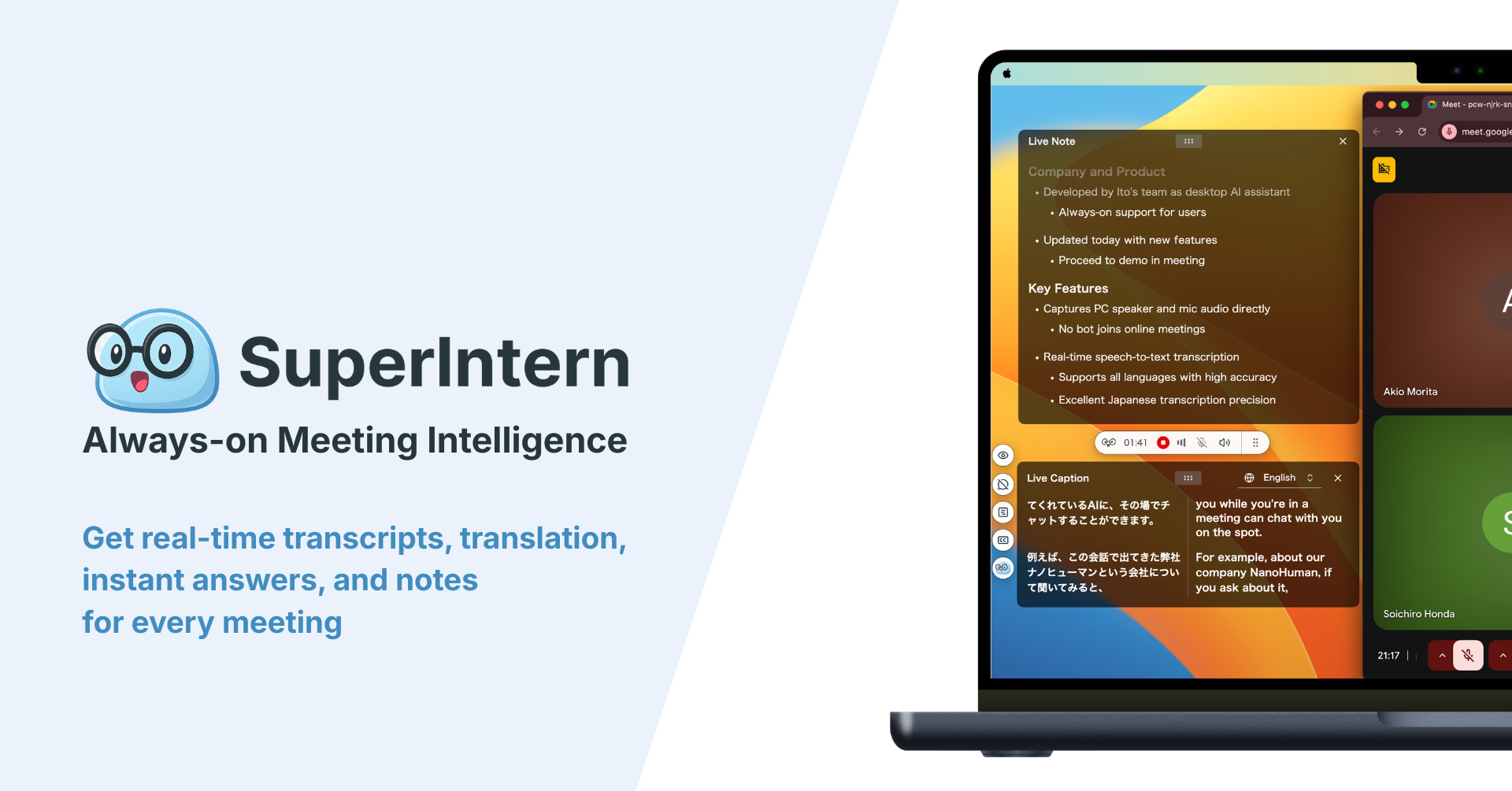
What that means for documentation:
- The record is built during the conversation. With AI Canvas, you define your format once, for example the fields from the template above. The AI fills in the sequence, key statements, and agreements in real time, instead of you reconstructing everything that evening.
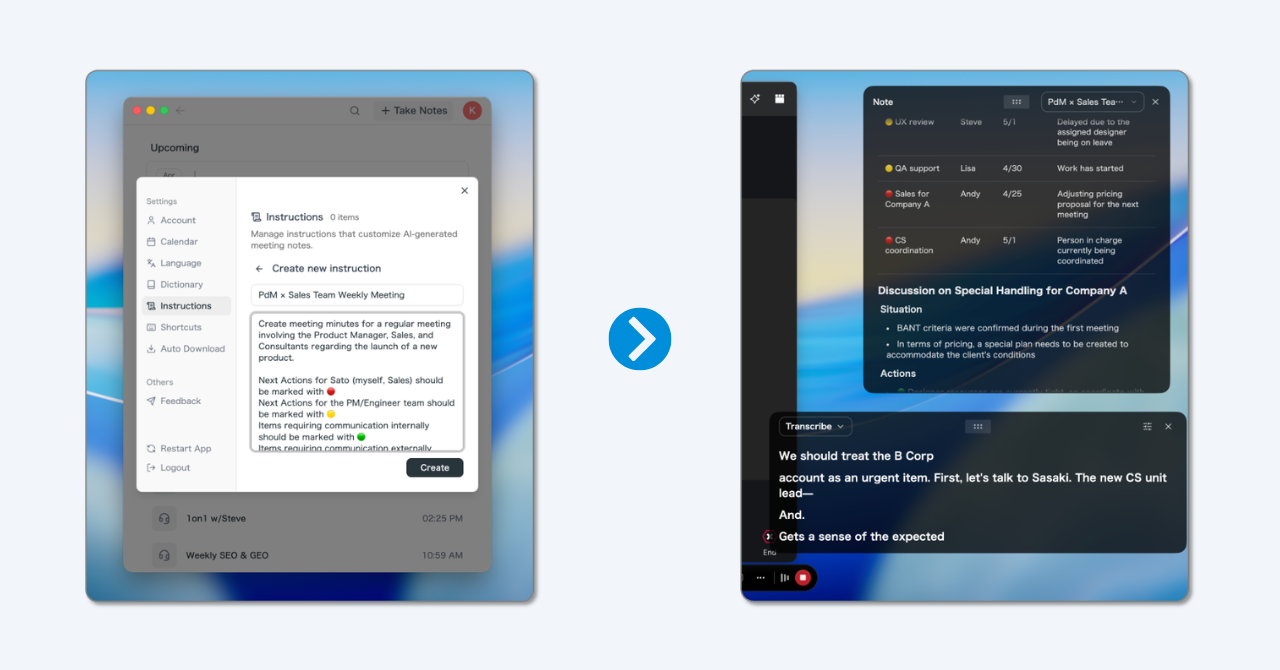
- Exact quotes instead of rough recall. Real-time transcription with speaker recognition shows who said which sentence. The parts that are hardest to get right from memory are available word for word.
- Ask instead of searching. After the meeting, ask the AI chat something like "What deadline was given for the status report?" and get an answer grounded in the conversation.
- Names and terms spelled correctly. A custom dictionary keeps project names, acronyms, and people's names accurate.
- Multilingual conversations. For calls in other languages, SuperIntern translates in real time across 50+ languages, and you can get the summary in your own language.
To be fair about the limits: SuperIntern does not replace notes from memory where there is no consent to transcribe. Tell participants up front and keep a record of their agreement; your local recording laws and privacy rules, such as GDPR in the EU, set the standard. The app is also built for conversations at your computer. For planned meetings, though, it removes exactly the reconstruction work this article is about. There is a free plan, so you can try it in your next meeting.
Frequently Asked Questions (FAQ)
What are notes from memory?
Notes from memory are a written summary of a conversation or event, created after it ends, based on recollection. They capture who was present, what happened in what order, key statements, and agreements so the event can be reconstructed later.
Are notes from memory admissible as evidence?
Often, yes, but rules differ by country and forum. They usually do not prove on their own that the content is true; they are weighed together with other evidence. Writing them promptly, in detail, without judgments, and having a witness countersign all increase their weight.
Do notes from memory need to be signed?
There is no general requirement. A signature and date show who wrote the notes and when. A countersignature from another person who was present makes them stronger still.
How soon should I write notes from memory?
As soon as possible, ideally within the first hour and no later than the same day. The longer the gap, the fewer details are reliable and the easier the notes are to challenge.
Can I secretly record the conversation instead?
It depends on where you are. Some places allow a participant to record with only their own consent; others require everyone's consent, and some treat secret recording as a criminal offense. Even where it is legal, it can break company policy. A recording or AI transcription is safest with everyone's agreement.
Can I share my notes with a lawyer or HR?
You can generally share your own notes with people advising you. Be careful with trade secrets and other people's personal data, and if in doubt, check what you are allowed to pass on.
What is the difference between notes from memory and a memo to file?
A memo to file is a formal internal note documenting a decision or event for the record, often written by a manager or HR. Notes from memory can be the raw material for one. The method in this article, prompt, chronological, and quoted, works for both.
Conclusion
Notes from memory are the most important tool when nobody could take notes during a conversation. They become credible when you write them immediately, record the basics completely, quote decisive sentences, separate facts from impressions, and secure the time they were written.
For planned conversations, it is worth going one step further: with everyone's consent, a botless AI assistant documents the meeting live, attributes statements to speakers, and saves you the evening reconstruction. Notes from memory then become the exception for the cases where you truly need them.
Capture your next important conversation live instead of reconstructing it from memory later. SuperIntern is free to start, no credit card required.