
Turn Meeting Action Items into Linear Issues Automatically with SuperIntern MCP

Think about what happens after you say "I'll file an issue for that" in a meeting.
You open the notes, copy action items one by one, create a new issue in Linear, clean up the title, set the assignee and priority, and rewrite the context so anyone can understand it. Two or three minutes per item, four or five items per sync, and that's fifteen minutes gone after every meeting. Worse, when you're rushed, you file duplicates or forget to file at all. Your meeting content lives in SuperIntern, your tasks live in Linear, and a human has always been the glue in between.
This guide shows how to connect SuperIntern's MCP and Linear's MCP to Claude, so that turning meeting decisions into Linear issues, duplicate check included takes exactly one prompt.
⚠️ This article was independently compiled based on publicly available information and user feedback as of July 2026.
Table of contents
- What we're building: before / after
- How it works: three roles
- Setup
- Demo 1: File all action items right after a meeting
- Demo 2: Push sprint planning decisions into your cycle
- Demo 3: A weekly sweep for tasks that only exist out loud
- Tips and caveats
- Going further: the same pattern, other tools
- FAQ
What we're building: before / after
Before: After each meeting, you file issues in Linear by hand while reading the notes. Duplicate checking runs on memory. In a busy week, filing slips entirely, and the next meeting starts with "whatever happened to that?"
After: You ask Claude once ("file the action items from today's sync in Linear") and it's done. Claude extracts the tasks from the meeting summary, checks them against existing issues, and files only the new ones, with owners and priorities set.
The reason this works so smoothly is that SuperIntern is a botless desktop meeting assistant: no bot joins your call, and transcripts and AI summaries accumulate automatically in the background. There is nothing to operate during the meeting. The meeting data is simply there; all that's left to automate is getting it into your task tracker, and that's the part you hand to AI.

How it works: three roles
The integration is a combination of three players.
| Role | Player | What it does |
|---|---|---|
| Provide meeting data | SuperIntern MCP | Serves transcripts, live transcripts, AI summaries, and meeting notes, strictly read-only |
| Judge and write | Claude (the AI client) | Reads the data, extracts action items, checks duplicates, drafts issue descriptions |
| Take action | Linear (MCP) | Creates and updates issues, adds comments, searches existing issues |
MCP (Model Context Protocol) is an open standard for safely connecting AI assistants to external tools. SuperIntern's MCP exposes your meeting data to AI clients read-only, while Linear's official MCP server handles searching, creating, and updating issues. In other words, it is Claude that files issues in Linear, not SuperIntern. Your SuperIntern data can never be modified by the AI, and it can only see meetings you yourself can access in SuperIntern. The only writes happen on the Linear side, so you can experiment without any risk of an AI breaking your meeting notes.
Setup
There are only two connections to make. Neither requires an API key, just a login screen.
1. Connect SuperIntern MCP to Claude
In Claude, open Settings → Connectors, choose "Add custom connector", and register the connection URL:
https://mcp.app.super-intern.com/mcp
A SuperIntern login screen opens; sign in and grant access. SuperIntern-side requirements (Plus plan or higher for personal workspaces, admin enablement on Enterprise) and setup steps for other clients like Claude Code and Cursor are covered in our MCP setup guide.
2. Connect Linear MCP to Claude
Linear ships an official MCP server too. Add Linear from Claude's connector directory, or register it as a custom connector with the connection URL, then approve the OAuth flow for your Linear workspace.
https://mcp.linear.app/mcp
Per-client instructions for Claude Code, Cursor, Codex, and other MCP clients are in Linear's official docs.
To check both connections, try:
List my 3 most recent SuperIntern meetings and 3 Linear issues assigned to me
If both come back, you're ready.
Demo 1: File all action items right after a meeting
The most frequent use is bulk filing right after a sync or kickoff. The key is inserting a duplicate check against existing issues between extraction and filing. That step is where handing this to AI really pays off.
Get the AI summary of today's "Product Sync" and extract the action items.
For each one, check whether it duplicates an existing issue in the Product team
in Linear, and file only the new ones as issues.
Start each title with a verb, include the decision context and the source
meeting name in the description, and set assignees and priorities based
on the summary.
Claude reads the summary, searches Linear, and comes back with something like this:
Created 4 issues in the Product team.
- "Start design work on onboarding flow B": Sara / High
- "Draft the audit-log export API spec": Ken / Medium
- "Compile competitor research on the pricing change": Mia / Medium
- "Fix the SSO settings error message copy": unassigned / Low
Note: "Improve mobile notifications" duplicated existing issue PRO-198, so instead of filing it I added the discussion from the meeting as a comment on PRO-198.
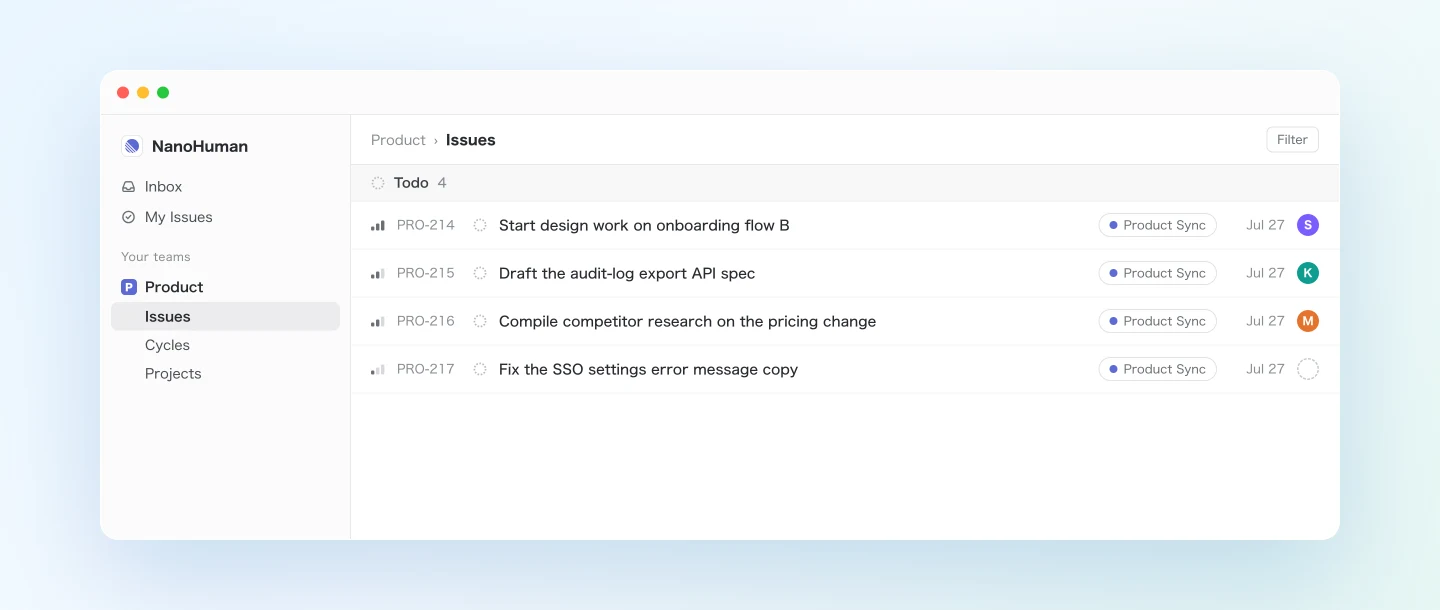
Each issue description records why the task exists, with the source meeting attached. When someone asks about the background later, the issue traces straight back to the meeting. Because SuperIntern's AI summaries keep action items structured, extraction stays reliably accurate.
Demo 2: Push sprint planning decisions into your cycle
A planning meeting produces two kinds of output: the scope you agreed on, and the reasons things got deferred. Both belong in Linear, and both are tedious to transcribe by hand.
Get the transcript of yesterday's "Sprint Planning".
Turn the items we agreed to take on this cycle into Linear issues and assign
them to the current cycle. If an issue already exists, don't create a new one,
just assign it to the cycle. For items we deferred, add the reason for the
deferral as a comment on the matching existing issue.
Notice this prompt asks for the transcript, not the summary. In planning, the texture of the "why are we deferring this" discussion matters, so pointing the AI at the raw conversation makes the recorded reasons concrete. Conditions stated out loud, like "once the dependency on X clears," land verbatim as issue comments.
Demo 3: A weekly sweep for tasks that only exist out loud
Bug reports and improvement ideas get mentioned in meetings, never get filed, and quietly vanish. Once a week, sweep them all up. Referencing multiple meetings at once is something only MCP makes easy.
Get all of this week's meetings in the "Product Team" project and list every
bug or improvement request that was mentioned out loud.
For anything matching an existing Linear issue, add the meeting context as
a comment. For anything not filed anywhere, show me a draft list of new
issues first, before creating them.
This prompt deliberately asks Claude to show drafts instead of filing immediately. A weekly sweep casts a wide net and can pick up hallway-style chatter, so a two-step flow, where you scan the list and reply "file these two," is the safe pattern. Run it every Friday and "I mentioned it in the meeting" stops being where tasks go to die.
Tips and caveats
Start with draft review. For your first few runs, add "show me the list before filing" so you learn Claude's extraction habits and granularity. Once the output feels right, save the whole prompt as a snippet and it becomes paste-and-go.
Name the team and project explicitly. "In the Product team," "in the current cycle": being explicit is the reliable way to prevent filing into the wrong place, and it matters more the more complex your Linear workspace is.
Bake your issue conventions into the prompt. "Start titles with a verb," "split anything larger than one person-week": encode your team's issue rules in the prompt and the output becomes indistinguishable from hand-written issues.
Always include the duplicate check. One line, "search existing issues first," eliminates most double filing. Claude tends to search more patiently than humans do.
Improve accuracy on the SuperIntern side. The more accurately names and feature terms are transcribed, the better the assignee matching gets. Register frequent member and feature names in SuperIntern's custom dictionary.
Writes only happen in Linear. Your SuperIntern data is never modified through MCP. If you don't like a filed issue, you edit or delete it in Linear, which keeps the cost of mistakes low.
Going further: the same pattern, other tools
The pattern extends well beyond Linear: SuperIntern MCP provides the data, Claude judges, and another tool receives the action.
- Slack: share the list of freshly filed issues straight into a team channel. We covered the Slack side in detail in the previous article in this series
- Other trackers: Jira and GitHub Issues work with the same flow via their MCP servers or connectors, and the "file from meeting notes" prompt carries over almost unchanged
- All the way to code: connect Claude Code to both SuperIntern MCP and Linear MCP, and "file the issues we agreed on in that meeting, then start implementing" becomes a single thread
We'll keep exploring these combinations in this series, one tool at a time, with real prompts.
FAQ
Can I use SuperIntern MCP on the free plan?
No. Personal workspaces require the Plus plan or higher. Team plan workspaces can use it as is, and on Enterprise it works once an admin turns on "MCP access" in workspace settings.
Does SuperIntern create the issues in Linear?
No. Claude creates and updates issues using Linear's MCP. SuperIntern MCP only provides meeting data read-only; SuperIntern itself never writes to external tools.
Can the AI modify my meeting notes or transcripts?
No. Every SuperIntern MCP tool is read-only; no create, edit, or delete operations exist. Writes happen only on the Linear side.
What if it floods Linear with wrong issues?
Use the draft-review pattern from the tips section and you approve the list before anything is created. And if an unwanted issue does get filed, you just edit or delete it in Linear; the source data in SuperIntern is untouched.
Does this work with Jira or GitHub Issues?
The structure is identical. As long as the target tool has an MCP server or a connector for your AI client, the extract-and-file flow works the same way. Check your client's integration list.
Does this work with AI clients other than Claude?
Both SuperIntern MCP and Linear MCP support MCP clients such as Claude Code, Codex, and Cursor. Any client that can connect to both will run the prompts in this article almost verbatim.
SuperIntern already handles the "capture" half of your meetings automatically. Now automate the "turn it into work" half.