Communication Styles: The 4 Types, How to Spot Yours, and How to Work With Each (2026 Guide)

Two people can deliver the same message and get opposite results. One says "the deadline is at risk" and the room starts solving; the other says the same words and the room goes defensive. The difference usually isn't the message. It's the style it travels in.
Communication styles are one of those frameworks that sound like training-day filler until you watch them explain a real conflict: the colleague who agrees to everything and delivers nothing, the manager whose feedback everyone fears, the "fine, whatever works" that wasn't fine at all. In this guide you'll see what the four classic styles look like at work, with signs and example phrases for each, how to identify your own default under pressure, how to adapt when you're working with each style, what changes in meetings and remote channels, and how the DISC model and other frameworks relate to the big four.
⚠️ This article was independently compiled based on publicly available information and user feedback as of September 2026.
Table of Contents
- What are communication styles?
- The 4 communication styles at a glance
- Passive communication: signs, causes, and cost
- Aggressive communication: signs, causes, and cost
- Passive-aggressive communication: signs, causes, and cost
- Assertive communication: the style worth training
- How to identify your own communication style
- How to work with each style
- Communication styles in meetings and remote work
- Beyond the big four: DISC and other frameworks
- How AI shows you your real communication style
- Frequently asked questions
- Conclusion
What are communication styles?
A communication style is the characteristic way a person expresses needs, opinions, and disagreement: how directly they speak, how much they protect the relationship versus the message, and what they do when their interests collide with someone else's. The most widely used model distinguishes four styles: passive, aggressive, passive-aggressive, and assertive. It comes out of the assertiveness training tradition in behavioral psychology, and half a century later it remains the default framework in communication skills programs for a simple reason: four categories are few enough to remember in a live conversation and sharp enough to explain most workplace friction.
Three clarifications before the details, because they prevent the most common misuse of the model:
- Styles are behaviors, not personality types. Nobody is "a passive person" the way they're an introvert. People show a style in a context: plenty of us are assertive with peers, passive with the boss, and short-tempered with the vendor at 6 pm. Because styles are learned behavior, they can be trained.
- Everyone uses all four. The useful question is not "which style am I" but "which style do I fall back on under pressure, with whom, and what is it costing me".
- The point is adaptation, not labeling. Diagnosing a colleague's style is only useful if it changes how you approach them. Used as a label ("classic aggressive, ignore him"), the framework becomes one more source of conflict.
The 4 communication styles at a glance
| Style | Implicit motto | What it sounds like | What it looks like | Cost to the team |
|---|---|---|---|---|
| Passive | "You matter, I don't" | "It's fine, whatever works for everyone..." | Quiet in meetings, agrees quickly, apologizes often | Problems surface late, workload imbalances, silent resentment |
| Aggressive | "I matter, you don't" | "This is wrong. Who approved this?" | Interrupts, raises voice, wins the room and loses the truth | People stop reporting problems, decisions go unchallenged |
| Passive-aggressive | "I'll agree now and resist later" | "Sure, great plan." (then the delay, then the sarcasm) | Says yes and does no, ironic compliments, backchannel complaints | Confusion, distrust, conflicts that never resolve |
| Assertive | "We both matter" | "I see a risk with X. I propose Y. What am I missing?" | States position calmly, listens, negotiates openly | Momentary discomfort, then faster and better decisions |
If you only remember one thing from the table, make it this: the styles differ in two dimensions, how directly the message is expressed and how much respect it carries for the other side. Aggressive is direct without respect. Passive is respectful without directness. Passive-aggressive is neither. Assertive is both, which is why it's the only style that gets the message across without charging interest on the relationship.
Passive communication: signs, causes, and cost
The passive style avoids friction by shrinking the sender. Opinions arrive wrapped in disclaimers, requests become hints, and disagreement stays home.
Signs to recognize it:
- Sentences that retreat before they land: "this is probably a dumb question, but...", "just my two cents".
- Fast agreement that doesn't match the face saying it.
- Requests phrased as apologies: "sorry to bother you, whenever you have a second, no rush at all".
- A workload that quietly grows, because "no" isn't in the vocabulary.
Where it comes from. Rarely laziness or lack of ideas. The usual roots are fear of conflict, a hierarchy that punished disagreement in the past, or a work culture that rewarded "being easy to work with" until it became a cage. Passive communicators are often the most conscientious people in the room, which is exactly why they burn out.
What it costs. The passive style postpones instead of resolving. The concern not raised in planning becomes the incident of week six. The overload never mentioned becomes the resignation that "came out of nowhere". Teams with a passive majority feel harmonious right up until they don't.
If this is your default: you don't need to become confrontational; you need a smaller unit of courage. One clearly stated opinion per meeting, one honest "I can't take this on this week", one question asked without the apology wrapper. The techniques in our assertive communication guide are the training program for exactly this.
Aggressive communication: signs, causes, and cost
The aggressive style gets the message through by putting the relationship under the wheels. It's direct, often effective in the short term, and expensive everywhere else.
Signs to recognize it:
- "You" openers loaded with judgment: "you always", "you clearly didn't think about".
- Interrupting as a habit, volume as an argument.
- Criticism aimed at people rather than problems: "that's incompetent" instead of "that's late".
- Winning as the goal of every exchange, including the ones with nothing at stake.
Where it comes from. Sometimes plain stress: aggressive is the style many people default to when the deadline is tomorrow. Sometimes it's learned success, because raising your voice worked once and became a tool. And sometimes it's the local culture: teams inherit the style of whoever leads them.
What it costs. The aggressive communicator is usually the last to know anything is wrong. People filter what they report, pad estimates to avoid explosions, and route around them entirely. The short-term wins are real, which is what makes the style sticky; the long-term price is a team that manages you instead of informing you.
If this is your default: the highest-leverage fix is mechanical, not spiritual. Replace "you" openers with facts ("the report arrived Thursday" instead of "you're always late"), and ask one genuine question before stating your position. Direct is a strength; the training is keeping the direct and dropping the demolition.
Passive-aggressive communication: signs, causes, and cost
The passive-aggressive style disagrees without saying so. On the surface everything is fine; the resistance shows up in delays, sarcasm, and selective forgetting.
Signs to recognize it:
- Yes in the meeting, no in the behavior: the agreed task quietly deprioritized.
- Sarcasm doing the work of feedback: "great plan, what could possibly go wrong".
- Complaints that travel to everyone except the person who could act on them.
- The silent treatment, the delayed reply, the "fine." with a period you can hear.
Where it comes from. Usually a passive communicator with unexpressed anger, or an environment where open disagreement feels unsafe but compliance can't be faked completely. Passive-aggressive behavior is often less a character flaw than a symptom: it tells you where honest "no" is not allowed.
What it costs. Of the four styles this one is hardest on trust, because it makes words unreliable. Colleagues learn that "sure" might mean anything, so they start double-checking, escalating, and documenting. The team's communication overhead grows to compensate for messages that can't be taken at face value.
If this is your default: the exit is the same door the anger came in through. The sarcastic comment and the missed deadline are disagreements that never got spoken; practice saying the small version out loud instead ("I don't think this plan survives contact with the client, can I explain why?"). If open disagreement genuinely isn't safe on your team, that's worth naming as the real problem, and our conflict management guide covers how to raise it before it escalates.
Assertive communication: the style worth training
The assertive style says what it means, hears the answer, and protects both the message and the relationship. It's the only style of the four that scales: teams where disagreement is normal make better decisions than teams where it's dangerous or invisible.
What it sounds like in practice:
- Facts before judgments: "the last two deliveries arrived unreviewed" instead of "you're careless".
- First-person positions: "I see a risk", "I need the draft by Thursday", "I disagree with the timeline".
- Concrete requests with a what and a when, and real questions after them: "what am I missing?".
- No said plainly, with the actual reason, and an alternative when one honestly exists.
Assertiveness has its own complete playbook, from I-messages and the DESC method to saying no to your boss, in our assertive communication guide. Two points matter for this article's purpose.
First, assertive is the target style, but not a universal tone. Directness is calibrated to context and culture: the same boundary can be set with more preamble in a hierarchical setting and stay perfectly assertive. What defines the style is clarity plus respect, not bluntness.
Second, assertiveness is the learnable one. You don't fix a passive default by "being more confident"; you fix it with mechanics that can be prepared in advance: a fact, its effect, a request. That's also why the style survives pressure better than good intentions do.
How to identify your own communication style
Self-diagnosis by memory fails for a predictable reason: we remember what we meant, not what we said. Better inputs, in increasing order of honesty:
A quick self-assessment. For each question, answer with what you actually did last time, not what you'd advise someone else to do:
- A task lands on your full plate. Do you accept and overload (passive), snap (aggressive), accept then let it slip (passive-aggressive), or renegotiate priorities out loud (assertive)?
- You disagree with a plan in a meeting. Silence? Frontal attack? Hallway commentary afterwards? Or a stated objection with a proposal?
- A colleague's work creates rework for you, repeatedly. Do you absorb it, blow up, hint at it sarcastically, or name the pattern and ask for a change?
- Someone interrupts you mid-sentence, again. Do you stop talking, talk over them, mutter, or say "let me finish this thought"?
- Your honest status is "we're going to miss the date". What does your status report say?
Four or five answers in the same column is your default under pressure. Most people land in two columns: one style for peers, another for power.
Ask the people who receive you. One question to a trusted colleague beats an hour of introspection: "when I'm stressed, what am I like to deal with?". Brace for the answer.
Read yourself in transcripts. If your meetings are transcribed, you have something rare: a record of what you actually said. Count your apology-openers, check whether your disagreement was voiced in the room or only exists in your memory of the meeting, and see who you interrupted. We cover the tooling for this in the AI section below.
How to work with each style
Diagnosing others is only useful if it changes your approach. The playbook, style by style:
| Colleague's style | How to recognize it | What works | What makes it worse |
|---|---|---|---|
| Passive | Quick agreement, quiet meetings, "whatever works" | Ask direct, specific questions ("what's your concern with the timeline?"), leave real pauses, ask for objections privately if needed | Filling every silence, treating the first "fine" as the final answer |
| Aggressive | Interruptions, judgments, volume | Stay factual and calm, don't match the escalation, name behavior when needed ("I want to finish my point") | Escalating back, or capitulating (it teaches the style that it works) |
| Passive-aggressive | Yes-then-no, sarcasm, backchannel complaints | Make agreements explicit and written, ask the disagreement out loud ("you seem unconvinced, what's the concern?"), close loops in the room | Playing along with the surface agreement, sarcasm in return |
| Assertive | Clear positions, real questions, negotiable no | Be direct back, disagree openly, decide and move | Reading directness as attack, punishing honest disagreement |
Two patterns are worth pulling out of the table because they're so common.
The passive colleague's "fine" is a question, not an answer. The single most useful habit with quieter teammates is the second ask: "you said it works, and I'd genuinely like to hear what would make it better". The first answer is politeness; the second one is information.
The aggressive colleague trains the room, and the room trains them back. Every time an outburst gets a concession, the style is reinforced. Staying factual under fire ("the estimate is six weeks; happy to walk through it") is not just self-defense, it's the only feedback loop that revises the behavior.
And a note for managers: your team's visible style distribution is information about you. If everyone around you communicates passively, the honest question is what happened to the last three people who disagreed openly.
Communication styles in meetings and remote work
Styles don't disappear in the meeting room or on the video call; they compress and get louder in their consequences.
In meetings, the passive style becomes invisible: no objection on record reads as agreement, and the meeting inherits a risk nobody named. The aggressive style becomes dominant: airtime concentrates, and the decision quality drops to the quality of one person's thinking. The passive-aggressive style becomes the post-meeting meeting, where the real opinions finally show up, ten minutes too late to matter. If you run meetings, the fixes are structural more than personal: ask for objections explicitly and by name, go around the room before closing a decision, and write decisions down in the moment so surface agreement has something concrete to attach to. Our meeting facilitation guide goes deeper on those mechanics.
In writing, style markers change costumes. Passive shows up as the question that opens with three disclaimers. Aggressive shows up as the ALL-CAPS deadline and the public callout in the team channel. Passive-aggressive practically lives in chat: "as I already mentioned", "per my last message", the thumbs-up that answers no. Written channels also strip tone, so borderline messages read one notch harsher than intended; the assertive move is adding back the context that a face would have carried ("genuine question, not pushback:").
On video calls, turn-taking cues weaken, which hits the passive style hardest: the pause they were waiting for never comes. Explicit verbal claims ("I'd like to add something before we move on") replace the body language that used to do that work. Interruptions also read worse without physical presence, so aggressive habits cost more per use.
Beyond the big four: DISC and other frameworks
Search for communication styles and you'll meet a zoo of models. The four-style framework covers most day-to-day needs, but two others show up often enough at work to know what they are:
- DISC sorts people into Dominance, Influence, Steadiness, and Conscientiousness. Unlike the big four, DISC is not about healthy versus unhealthy expression; it describes temperament, what pace and level of detail a person naturally prefers. The two models answer different questions and combine well: DISC tells you a colleague prefers headlines over detail; passive/aggressive/assertive tells you whether the message is being delivered honestly and respectfully. Treat DISC as a lens, not a verdict; people are more contextual than four letters.
- Extended style lists (five, seven, sometimes more styles) mostly split the classic four into finer slices, adding categories like manipulative or submissive communication. Useful for training exercises, rarely necessary in practice.
- Channel and culture preferences (direct versus indirect cultures, writing-first versus talking-first people) are real and consequential, but they're a different axis: where and how a message is best sent, not the honesty and respect it carries.
A practical rule for choosing: use the four styles for anything involving friction, feedback, or boundaries, and DISC-like models for tailoring how you package information. When in doubt, the four styles carry more weight per minute of study.
How AI shows you your real communication style
Every method in this guide eventually runs into the same wall: you can't observe yourself while you're busy being yourself. In a live meeting your attention is spent on the content, and whatever is left over goes to taking notes, not to noticing that you've apologized four times in ten minutes.
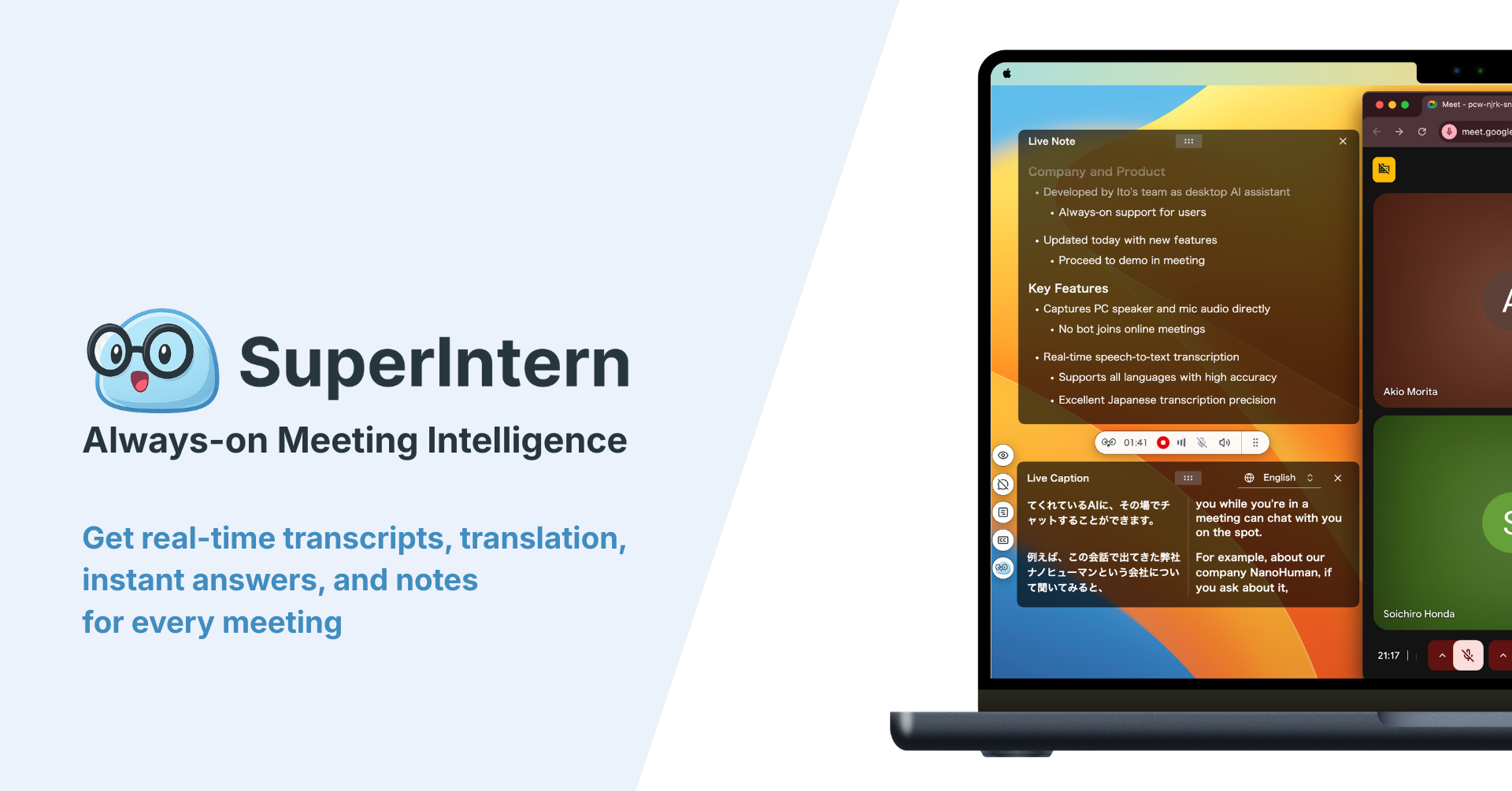
SuperIntern is a botless desktop app for Mac and Windows that captures audio directly from your device: no bot joins the call, so it works the same in Zoom, Google Meet, Microsoft Teams, Webex, and in-person conversations.

Three pieces do the heavy lifting for style work:
- The AI Canvas takes the notes so your attention stays in the room. It builds a structured live note (decisions, tasks, open questions) in whatever format you describe in plain language. Note-taking is where passive habits hide: the person writing the minutes never claims the floor. With the minutes handled, you have the attention to speak in time.
- Speaker-labeled transcripts turn style into data. The transcript records who said what, so the self-assessment stops relying on memory: count your disclaimer-openers, measure your airtime against the room, and check whether you actually voiced the disagreement you remember making. Reading yourself being passive, or interrupting more than you thought, recalibrates faster than any workshop.
- Post-meeting AI chat interrogates the pattern. Ask across your recent meetings: "where did I commit to something without pushing back?", "how did I respond when the timeline was challenged?". Patterns that are invisible inside one meeting are obvious across ten.
The honest limits: AI can show you your style, but the flexing is still yours to do, and the uncomfortable conversation stays uncomfortable. What it removes is the fog: no more debating what your default is when the transcript settles it. There's a free plan, so you can run the experiment on your own meetings at no cost.
Frequently asked questions
What are the 4 types of communication styles?
Passive (avoids expressing needs and disagreement), aggressive (expresses them at the other person's expense), passive-aggressive (agrees on the surface, resists indirectly), and assertive (expresses them directly and respectfully). Most people use all four in different contexts; the practical question is which one is your default under pressure.
Which communication style is most effective at work?
Assertive, in almost every situation: it's the only style that delivers the message clearly while keeping the relationship intact, which is what work requires repeatedly with the same people. That said, assertive doesn't mean one fixed tone; its form adjusts to context and culture while keeping clarity and respect constant.
How do I figure out my own communication style?
Use inputs that don't depend on self-image: a scenario-based self-check (what did you actually do last time a task landed on your full plate?), one honest question to a colleague who deals with you under stress, and, if you have meeting transcripts, a read of what you actually said. Memory alone flatters; most people discover they run different styles with peers than with authority.
What is the DISC model, and how does it relate to the 4 styles?
DISC describes temperament across Dominance, Influence, Steadiness, and Conscientiousness: what pace, detail level, and interaction style a person naturally prefers. The four-style model instead describes how honestly and respectfully a message is delivered. They combine well: DISC guides packaging, the four styles guide delivery.
Can a communication style be changed?
Yes, because styles are learned behavior, not fixed traits. The change unit is small and mechanical: replacing a "you" judgment with a fact, stating one opinion without a disclaimer, renegotiating one deadline out loud. Consistency matters more than intensity, and progress is measurable if you review real conversations or transcripts.
How do I deal with an aggressive communicator?
Stay factual, keep your calm as a deliberate signal rather than a concession, and name the behavior when it crosses a line: "I want to finish my point". Don't match the escalation, and don't capitulate to end the discomfort, because both reinforce the style. If it's persistent and hierarchical, document and escalate; that's a conflict management problem, not a phrasing problem.
What are the 7 communication styles?
Extended lists split the classic four into finer categories, typically adding styles like manipulative, submissive, or direct/analytical variants. They can sharpen training exercises, but the four-style model covers the decisions that matter in practice: whether the message is expressed, and whether it respects the other side.
Conclusion
Communication styles are a small model with unreasonable explanatory power: passive, aggressive, passive-aggressive, and assertive describe most of the friction a working week produces. The leverage is in three moves. Know your default under pressure, with real evidence rather than self-image. Read the styles around you and adapt the approach: the second ask for the passive colleague, calm facts for the aggressive one, explicit written agreements for the passive-aggressive one. And train toward assertive, one small mechanical rep at a time.
Start with the evidence step this week: your next meeting, on the record. What you find is rarely what you expected, and it tells you exactly what to train.
Try SuperIntern Free : Botless live meeting notes, so you can watch the conversation instead of the keyboard.