30 Icebreakers for Meetings and Workshops: A Practical Guide (2026)

An icebreaker gives people an easy way to start talking before a meeting or workshop. A brief introduction may be enough for a new team; a familiar group might prefer a quick check-in or simply getting on with the agenda.
Below are 30 activities to choose from, with time estimates and instructions. You'll also find advice on running them, adapting them for remote calls, and recognizing when an activity asks too much of the people in the room.
⚠️ This article was independently compiled based on publicly available information and user feedback as of September 2026.
Table of Contents
- What Is an Icebreaker?
- Choosing an Activity for Your Group
- 30 Icebreaker Ideas for Meetings and Workshops
- Which Icebreakers Suit Which Meetings?
- How to Introduce, Run, and Finish an Icebreaker
- Common Mistakes and How to Avoid Them
- Adapting Icebreakers for Online Meetings
- Taking Notes During the Discussion
- Frequently Asked Questions
- A Simple Starting Point
What Is an Icebreaker?
An icebreaker is a short activity that helps people feel more comfortable talking to one another at the start of a meeting, workshop, or training session. It might be a round of introductions, a question, or a game.
For a group meeting for the first time, introductions give people names and a little context about their colleagues. A question such as "What's one thing you'd like to learn today?" also gives the facilitator something useful to work with. For an established team, a brief check-in can help people settle into the meeting after other tasks.
Keep your expectations modest. Answering a light question may make the next contribution feel easier, but it won't resolve a disagreement or make people comfortable challenging their manager. How you respond to people during the rest of the meeting matters too.
An icebreaker is worth considering before a participatory session, such as a workshop or a brainstorming session. For a short status update with a team that already knows each other, you may not need one.
Choosing an Activity for Your Group
Start with the time available and the number of people. Then consider what would help this particular group: learning names, getting to know new colleagues, or having a moment to think before a discussion.
| Consideration | What to check | How it affects your choice |
|---|---|---|
| Time | Do you have 2 minutes, 5 minutes, or a longer workshop slot? | Use a short question for a brief meeting; reserve games with setup for longer sessions |
| Group size | Can everyone speak within that time? | Six people at 30 seconds each need at least 3 minutes, plus instructions |
| Purpose | Are people meeting for the first time, reconnecting, or preparing to share ideas? | Choose introductions, a check-in, or an open-ended question accordingly |
Before a brainstorm, try a question with several possible answers, such as "What would you change about our workspace?" At a project kickoff, ask how each person prefers to receive feedback. For a weekly meeting, one sentence about how the week is going may be enough.
As a planning guide, allow two or three minutes in a half-hour meeting, or about five in an hour. These are starting points, not strict limits. A longer team exercise belongs in the workshop agenda with its own time slot, including any discussion afterward.
30 Icebreaker Ideas for Meetings and Workshops
The first two groups need little preparation. The games take more explanation, and some require materials. Group timings below assume five or six people; where a time is listed per person, multiply it by the number taking part and allow time for instructions.
People should be able to pass on any prompt. For questions about personal life, offer a work-related alternative too.
Introductions for new groups
- Personal user manual (1 minute per person): Share one or two preferences that help colleagues work with you, such as "I like time to read a proposal before we discuss it" or "Chat is best for a quick question."
- Something you might not know about me (30 seconds per person): Invite each person to share an interest or a small fact about themselves. It doesn't have to be surprising or impressive.
- Names and nicknames (30 seconds per person): Say what you'd like to be called. Anyone who wants to can add a story about their name; explaining its origin is optional.
- Three keywords (1 minute per person): Choose three words that describe your work or interests, then explain them briefly. Give an example first so people know how broad the answers can be.
- Partner introductions (5 minutes in pairs, plus introductions): Give each person two minutes to interview their partner. Each then introduces the other to the group, sharing only what their partner is happy to have repeated.
- Career timeline (2 minutes per person, plus drawing time): Sketch a few turning points in your working life and talk through the ones you want to share. Allow a longer slot for this at an offsite; avoid asking people to explain personal highs and lows.
- A place you know well (1 minute per person): Share a local food, landmark, or recommendation from your hometown or another place you know. Using a place of their choice lets people answer without discussing where they grew up.
- Yesterday's highlight (30 seconds per person): Share one moment from the previous day. A good lunch or a finished task is enough.
- What you're enjoying lately (30 seconds per person): Talk about a hobby, a project, or something you've been reading. Leave follow-up conversations for the break if time is short.
- Name chain (5 minutes as a group): Each person repeats the names already shared, then adds their own. Keep name labels visible and let people help each other when someone forgets.
Quick questions for regular meetings
- Good & New (30 seconds per person): Share something good that happened or something new you noticed in the past day. If you're using it weekly, you can widen the prompt to the past week.
- A hypothetical question (30 seconds per person): Ask something like "What would you learn if you had a week free?" Give people a few seconds to think before starting the round.
- Weather check-in (15 seconds per person): Describe your mood as weather: sunny, overcast, or changeable. People can leave it at one word without explaining why.
- A useful find (30 seconds per person): Recommend a recent purchase, a free tool, or a tip you've found useful. Including free options makes the question easier to answer without discussing spending.
- Weekend in a sentence (30 seconds per person): Invite a brief weekend update, with "What are you looking forward to this week?" as an alternative. Don't press for details.
- Childhood dream job (30 seconds per person): Share a job you once wanted to do. People who prefer can name something they'd like to try now.
- Desert island pick (30 seconds per person): Ask which book or other item someone would take to a desert island, and why. Agree on a category first if you want to keep answers brief.
- Something worth watching or reading (30 seconds per person): Invite a book, film, show, article, or video recommendation. Keeping the category broad gives people more options.
- This or that (1 minute for everyone): Ask "Early bird or night owl?" or "Mountains or coast?" People answer with a hand, reaction, or chat message. Allow "both" or "neither."
- A small recent win (30 seconds per person): Share something that went well at work. It can be as small as solving a recurring problem or getting help from a colleague.
Games for workshops and team sessions
- Two truths and a lie (2 minutes per person): Each person shares three statements about themselves, one of them false. The group guesses which one, then the speaker reveals the answer. Ordinary facts work well; no one needs a remarkable backstory.
- Common ground (5 minutes in pairs or groups): Find three things everyone in the group has in common beyond working for the same organization. Ask each group to share one at the end.
- Birthday line-up (5 minutes as a group): Arrange yourselves by birthday, using month and day but no birth year, without speaking. For a seated alternative, arrange name cards together instead.
- Lose at rock-paper-scissors (3 minutes as a group): The facilitator shows a hand first. Everyone then responds with the hand that would lose to it. Once people have tried a few rounds, switch the instruction to winning or drawing.
- Questions in pairs (5 minutes): Play rock-paper-scissors; the winner asks a light question, such as "What's a skill you'd like to learn?" Swap roles after each question so both people have a turn.
- Drawing association chain (5-10 minutes): One person draws an object. The next draws something it makes them think of, and so on. At the end, ask people to explain the links. Paper or a shared online whiteboard will do.
- Forbidden word (10 minutes): Give everyone a common word to avoid during a short conversation. When someone says theirs, acknowledge it and continue without eliminating them. This suits an informal social session.
- Charades (10 minutes): Take turns acting out a familiar object or activity while the group guesses. Prepare simple prompts and offer a drawing option for anyone who would rather not act.
- Paper tower (15 minutes): Give each group the same amount of paper and ask them to build a tower that stands without support. Leave a few minutes to compare approaches and discuss what they changed along the way.
- Marshmallow challenge (about 20 minutes, plus discussion): Give each team equal amounts of dry spaghetti, tape, string, and one marshmallow. Ask them to build a freestanding tower with the marshmallow on top. Agree on a building time, then compare the towers and talk about when teams tested their designs.
Which Icebreakers Suit Which Meetings?
Use this table to narrow the list. The time budgets are suggestions for small groups; a round of introductions with a large team will need more time or smaller groups.
| Meeting | Ideas to consider | Suggested time | Facilitator's note |
|---|---|---|---|
| Regular team meeting | Good & New, weather check-in, a small recent win | 2-3 minutes | Keep answers short and check occasionally whether the group still finds it useful |
| Kickoff or first meeting | Personal user manual, three keywords, partner introductions | 5-10 minutes | Help people learn names and understand one another's work |
| Training or workshop | Common ground, partner introductions, marshmallow challenge | 10-20 minutes, sometimes longer | Budget separately for setup and a discussion of what happened |
| Online meeting | This or that, Good & New, drawing association chain | 3-5 minutes | Choose something people can join with the tools already available |
| Sales call | A relevant question about the person's work | 1-3 minutes | Follow their lead; they may want to get straight to the agenda |
| Interview | A welcome and an easy opening question | 1-2 minutes | Explain what will happen in the interview before asking substantive questions |
For a sales call, you might ask about a project the person mentioned previously. For an interview, a simple welcome and "How has your day been so far?" can be enough. Neither needs a formal game.
For help with the conversation that follows, see our guides to one-on-one meetings and meeting facilitation.
How to Introduce, Run, and Finish an Icebreaker
Explain what you're asking people to do before anyone starts. For a short round, your introduction can cover the purpose, prompt, timing, and option to pass in a few sentences:
"Before we discuss the project, let's introduce ourselves. Give your name, your role, and one thing that helps you work well with others. About 30 seconds each is fine, and you can skip the last question if you prefer. I'll start, then we'll go around the table."
Your own answer shows how much detail you expect. Keep it within the time you've asked everyone else to use.
When someone finishes, thank them and move to the next person. Avoid turning every answer into a follow-up interview. In a larger group, use pairs or written responses so a short opening doesn't become a long wait for a turn.
End when you said you would. A straightforward transition works: "Thanks, everyone. Let's look at the project goals." If an answer is relevant to the agenda, you can return to it during the discussion; you don't need to invent a connection.
Common Mistakes and How to Avoid Them
The activity takes more time than expected. Count the turns before choosing a prompt. Ten people speaking for a minute each already need ten minutes, before instructions or replies. Shorten the answers, use pairs, or choose a simultaneous response.
People are asked to share more than they want to. Questions about family, money, relationships, or personal setbacks can be uncomfortable at work. Offer a less personal alternative and accept a pass without comment.
Newcomers can't follow the conversation. An inside joke or reference to an old team event may leave new colleagues with nothing to add. Choose a prompt they can answer too, and explain any context that comes up.
Participation feels like a performance. "Tell us something fascinating about yourself" can be harder to answer than "What's something you've enjoyed lately?" Use ordinary examples and let people respond in chat if speaking feels uncomfortable.
The group doesn't want an activity. If people are pressed for time or ready to discuss an urgent issue, a greeting and a clear agenda may be enough. You can drop a planned icebreaker.
Adapting Icebreakers for Online Meetings
On a video call, make the prompt visible in chat as well as reading it aloud. Give people a few seconds to think, then explain how to respond. This also helps anyone who missed the instructions because of an audio problem.
For a large call, an emoji check-in or a this-or-that question lets people answer together. If you want conversation, use pairs or groups of three in breakout rooms, with a clear prompt and return time. Allow for the time it takes to enter and leave the rooms.
A shared whiteboard works for drawing activities, provided people know how to use it. If they don't, choose a chat-based prompt rather than spending the opening minutes troubleshooting access. Avoid making a camera essential when a spoken or written answer would work.
For multilingual teams, use short questions and allow extra thinking time. Wordplay and local cultural references can be difficult in a second language. Translated captions may help people follow, alongside the written prompt and the option to answer briefly.
Taking Notes During the Discussion
If you're facilitating and taking notes, decide before the meeting how you'll record decisions and follow-up tasks. An AI meeting assistant can help with the first draft of those notes.
SuperIntern is a desktop app for Mac and Windows that transcribes meeting audio without sending a bot into the call. It supports services such as Zoom, Google Meet, Microsoft Teams, and Webex, and creates live notes with automatic speaker identification.

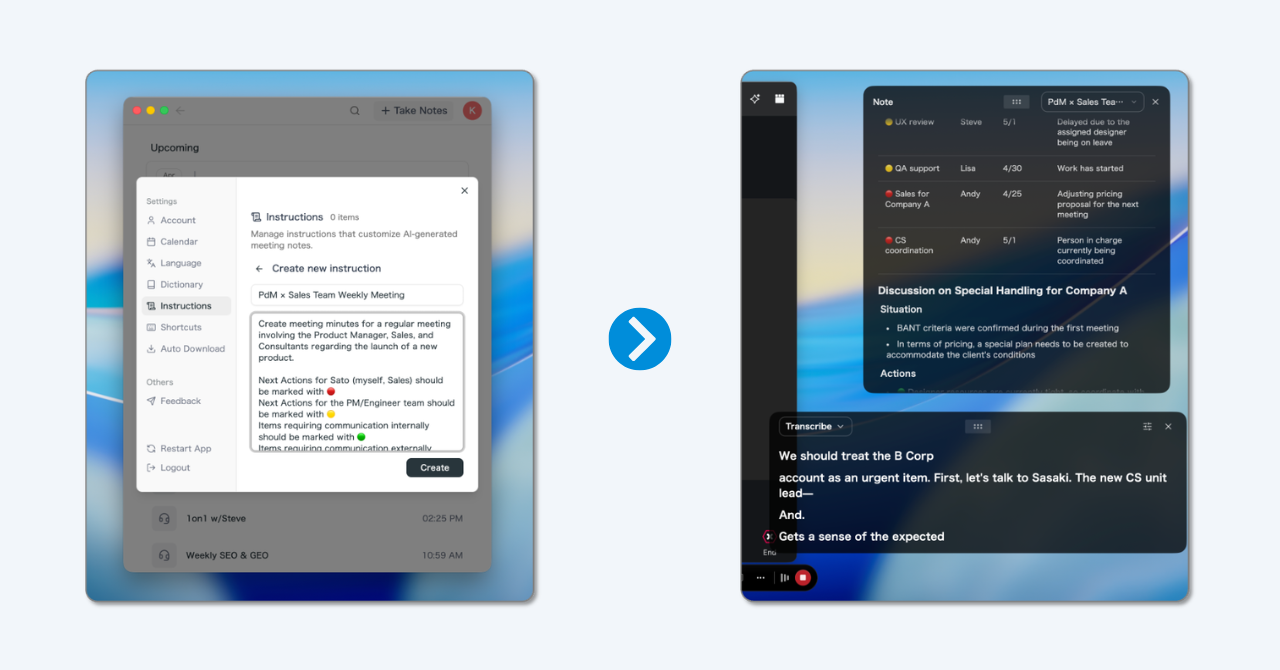
With AI Canvas, you can save an instruction such as "Organize the notes into decisions, open questions, and next steps." The notes then follow that structure during the conversation. Choosing what appears in the notes is separate from choosing when to start recording.
Afterward, you can use meeting chat to revisit what was discussed or group recorded ideas by theme. Check decisions and task owners before sharing the notes. For workshops with separate group conversations, plan how each group's discussion will be captured; a recording only covers the audio it receives.
SuperIntern also offers real-time translation in more than 50 languages and a free plan. It's useful here for documenting the meeting; choose an opening activity based on the people attending and the time you have.
Frequently Asked Questions
What does icebreaker mean in a business context?
It's a short opening activity that helps people begin talking to one another. Introductions, an easy question, or a brief game are common examples. The format should suit the meeting and the people attending.
How long should an icebreaker take?
For an ordinary meeting, start with two to five minutes. Multiply any per-person speaking time by the number of participants, then add time for instructions. Longer workshop exercises need a separate slot, especially if you'll discuss them afterward.
What are good icebreakers for virtual meetings?
Try an emoji check-in, a this-or-that question using reactions, or a short Good & New round. Breakout rooms are useful when you want people to have a conversation in smaller groups, but allow time to move between rooms.
Do small meetings and one-on-ones need icebreakers?
They don't need a formal activity. A brief follow-up such as "How did the launch you mentioned go?" may be a natural way to begin. If both people are ready to get to work, go ahead.
What if someone dislikes icebreakers?
Let them pass, without asking for a reason. A written response or a less personal prompt may be more comfortable. If the whole team finds a recurring activity unhelpful, change it or stop using it.
Should I use icebreakers in sales calls or interviews?
A little small talk can be appropriate, but follow the other person's cues. Keep the opening brief, avoid personal questions, and move to the agenda when they're ready.
A Simple Starting Point
For your next meeting, choose one question people can answer in a sentence. Say how long the round will take, give your own answer first, and make passing an option. Notice whether the group seems comfortable and whether you start the agenda on time. That will tell you more about what to try next than choosing an elaborate game.
Try SuperIntern Free: Create live meeting notes without a bot joining the call, and organize them in the format you need.