
How to Write Meeting Minutes in English: Template, Example and Phrases (2026)
Meeting minutes in English follow a simple pattern: who met and when, what was discussed under each agenda item, what was decided, and who will do what by when. If those four parts are clear, readers will forgive the occasional awkward sentence. If they are vague, perfect grammar will not save the document.
This guide is for anyone who has to write minutes in English, especially people who work in English as a second language or who run meetings in one language and report in another. You will find the standard structure, a template you can copy, a filled example, phrase tables for each part of a meeting, the mistakes that come up again and again, and a practical way to produce English minutes from a meeting that was held in Japanese, German, Spanish or any other language.
⚠️ This article was independently compiled based on publicly available information and user feedback as of November 2026.
Table of Contents
- What "minutes" means and the vocabulary you need
- The standard structure of English meeting minutes
- Copy-and-paste meeting minutes template
- Example: minutes of a weekly product sync
- Useful phrases for each part of the minutes
- 7 common mistakes in English minutes
- Formal minutes vs. action minutes
- Three ways to get English minutes from a non-English meeting
- How to create English minutes with AI
- Checklist before you send the minutes
- FAQ
- Conclusion
What "minutes" means and the vocabulary you need
"Minutes" is the standard English word for the written record of a meeting. It is always plural in this sense: you "take minutes", and "the minutes were approved". The word has nothing to do with time; it comes from the Latin for "small notes".
Several related terms overlap, and choosing the right one sets expectations for the reader.
| Term | What it suggests | Typical use |
|---|---|---|
| Minutes / meeting minutes | An official record | Boards, committees, client steering meetings |
| Meeting notes | A lighter summary | Internal syncs, one-on-ones |
| MoM (Minutes of Meeting) | Abbreviation of minutes | Common in India, Southeast Asia and email subject lines |
| Summary / recap | A short follow-up | Post-meeting email to attendees |
| Transcript | A word-for-word record | Raw output of a transcription tool |
One false friend deserves a warning. In German, Dutch and several other languages, the word for minutes looks like "protocol". In English, "protocol" usually means a procedure or diplomatic etiquette, so "the protocol of the meeting" will confuse native readers. Use "minutes".
The vocabulary below covers almost every set of minutes you will write.
| Concept | English term |
|---|---|
| List of topics | Agenda, agenda item |
| People who attended | Attendees, present |
| People who could not attend | Absent, apologies (British usage) |
| Person running the meeting | Chair, facilitator |
| Person writing the minutes | Minute-taker, recorder |
| What was agreed | Decisions |
| Follow-up tasks | Action items |
| Person responsible | Owner |
| Deadline | Due date |
| Topics without a conclusion | Open issues, parking lot |
| Miscellaneous topics | AOB (any other business) |
| Formal proposal for a vote | Motion |
The standard structure of English meeting minutes
Most English minutes follow the same order. Keeping to it helps readers find what they need without scanning the whole page.
- Header: meeting name, date and time, location or video platform, attendees, absentees, chair and minute-taker.
- Purpose: one or two sentences on what the meeting needed to achieve.
- Discussion by agenda item: short bullet points under each numbered agenda item.
- Decisions: a separate list of what was agreed, so nobody has to dig through the discussion.
- Action items: a table with owner, task and due date.
- Next meeting: date, time and any topics carried over.
Many stakeholders read only the decisions and action items. Keep the discussion section brief and make those two sections complete.
Copy-and-paste meeting minutes template
Replace the text in square brackets and delete any section you do not need.
Meeting Minutes: [Meeting name]

Date: [November 24, 2026]
Time: [10:00-11:00 EST]
Location: [Zoom / Conference Room A]
Chair: [Name]
Minute-taker: [Name]
Attendees: [Name, Name, Name]
Absent: [Name]

Purpose
[One or two sentences on what this meeting needed to decide.]

1. [Agenda item 1]
- [Key point discussed]
- [Key point discussed]

2. [Agenda item 2]
- [Key point discussed]

Decisions
- [What was decided]
- [What was decided]

Action Items
| Owner  | Task              | Due date      |
|--------|-------------------|---------------|
| [Name] | [What to do]      | [Dec 1, 2026] |
| [Name] | [What to do]      | [Dec 3, 2026] |

Open Issues
- [Topic that needs more information before a decision]

Next Meeting
[December 1, 2026, 10:00-11:00 EST]
For a quick internal sync, "Purpose" and "Open Issues" can go. For a client meeting, keep "Purpose": people who read the minutes weeks later will understand the context immediately.
Example: minutes of a weekly product sync
Here is the template filled in for a weekly meeting between a product team in San Francisco and engineers in Tokyo.
Meeting Minutes: Weekly Product Sync

Date: November 23, 2026 (PST) / November 24, 2026 (JST)
Time: 16:00-16:45 PST / 9:00-9:45 JST
Location: Google Meet
Chair: Emily Carter
Minute-taker: Ken Sato
Attendees: Emily Carter, Ken Sato, Yuki Tanaka, David Lee
Absent: Maria Gomez

Purpose
Confirm the launch date for the new export feature and agree on the beta plan.

1. Launch date
- QA found two critical bugs in the CSV export.
- Yuki said both fixes would be ready by November 27.
- The team agreed that launching on December 2 is still realistic.

2. Beta program
- David proposed inviting 20 existing customers to the beta.
- Emily asked whether support could handle feedback in Japanese.
- Ken confirmed that the Tokyo team will cover Japanese inquiries.

Decisions
- The launch date remains December 2.
- The beta will start on November 30 with 20 customers.

Action Items
| Owner       | Task                                   | Due date     |
|-------------|----------------------------------------|--------------|
| Yuki Tanaka | Fix the two CSV export bugs            | Nov 27, 2026 |
| David Lee   | Send beta invitations to 20 customers  | Nov 28, 2026 |
| Ken Sato    | Prepare a Japanese FAQ for the beta    | Nov 29, 2026 |

Open Issues
- Pricing for the export feature (waiting for input from Finance)

Next Meeting
November 30, 2026, 16:00-16:45 PST / December 1, 9:00-9:45 JST
When a meeting crosses time zones, writing both local dates and times prevents the classic "was that Monday or Tuesday?" confusion.
Useful phrases for each part of the minutes
Minutes describe a meeting that has already happened, so the discussion is written in the past tense. Action items describe future work and use "will".
Opening and attendance
| Purpose | Phrase |
|---|---|
| Start time | The meeting was called to order at 10:00. |
| Who chaired | Emily Carter chaired the meeting. |
| Previous minutes | The minutes of the previous meeting were approved without changes. |
| Absences | Apologies were received from Maria Gomez. |
Summarizing the discussion
| Purpose | Phrase |
|---|---|
| Topic covered | The team discussed the beta schedule. |
| Status update | Yuki reported that the fixes were on track. |
| Proposal | David proposed inviting 20 customers. |
| Concern | Emily raised concerns about support capacity. |
| Disagreement | Opinions were divided on the pricing model. |
| Question | Ken asked whether the beta would include admin features. |
Decisions and postponements
| Purpose | Phrase |
|---|---|
| Agreement | The team agreed to keep the December 2 launch date. |
| Decision by an authority | It was decided that the beta would start on November 30. |
| Postponed | The decision was deferred to the next meeting. |
| Conditional | A decision will be made once Finance provides the numbers. |
Action items and closing
| Purpose | Phrase |
|---|---|
| Assigned task | Ken will prepare the Japanese FAQ by November 29. |
| Follow-up check | David will confirm the customer list with Sales. |
| Next meeting | The next meeting will be held on December 1. |
| End time | The meeting was adjourned at 11:00. |
"Agreed" and "decided" are not interchangeable. Use "agreed" when the group reached consensus and "decided" when someone with authority made the call. The difference matters when someone later asks who signed off.
7 common mistakes in English minutes
These mistakes appear in minutes written by native and non-native speakers alike, but they are especially common when English is your second or third language.
1. Writing the discussion in the present tense
Minutes report what happened. "Yuki says the fix is ready" should be "Yuki said the fix was ready". Reserve "will" for action items and future dates.
2. Adding "about" after "discuss"
"Discuss" takes a direct object. Write "We discussed the budget", not "We discussed about the budget". The same applies to "mention".
3. Treating "minutes" as singular
In this sense the word is always plural: "The minutes were circulated." "A minute" means sixty seconds.
4. Using "consider" as a polite way to postpone
In many languages and business cultures, "we will consider it" is a gentle way of saying "not now". International readers take it literally and wonder who will decide and when. Replace it with an owner and a date: "Ken will review the options and recommend one by Friday."
5. Dropping the subject
Languages such as Japanese, Korean, Spanish and Chinese often omit the subject. In English minutes, "Will send the file" leaves readers guessing. Write "David will send the file."
6. Writing dates as numbers only
"11/12" is November 12 in the United States and 11 December in the United Kingdom and most of Europe. In minutes that cross borders, spell out the month: "November 12, 2026" or "12 Nov 2026".
7. Mixing name formats
Pick one convention and stick to it. Use the full name on first mention ("Yuki Tanaka") and the first name or surname afterwards. Add roles in parentheses if they help: "Yuki Tanaka (Engineering Lead)". Avoid honorifics from other languages, such as "Tanaka-san" or "Herr Müller", in formal minutes.
Formal minutes vs. action minutes
There are two broad styles of English minutes. Knowing which one you need saves a lot of rewriting.
| Aspect | Formal minutes | Action minutes |
|---|---|---|
| Typical meetings | Board meetings, AGMs, committees, regulated bodies | Team syncs, project meetings, one-on-ones |
| What is recorded | Motions, votes and resolutions, exactly as passed | Decisions and action items |
| Typical wording | "It was resolved that..." / "The motion was carried." | "The team agreed to..." / "Ken will..." |
| Approval | Approved and signed at the next meeting | Circulated; final if nobody objects |
| Voice | Mostly passive, no personal opinions | Active and concise |
Formal minutes may carry legal weight, so follow your organization's bylaws and ask your legal or company secretary team when in doubt. For a deeper look at board records, see our guide to board meeting minutes, and for an overview of styles, types of meeting minutes.
Three ways to get English minutes from a non-English meeting
Global companies often hold a meeting in the local language but share the minutes in English with headquarters or regional teams. There are three common approaches.
| Approach | Effort | Accuracy | Terminology consistency | Best for |
|---|---|---|---|---|
| Write local-language minutes, then translate them yourself | High | Depends on your English | Under your control | Small, high-stakes meetings |
| Write local-language minutes, then run them through a translation tool | Medium | Good sentence by sentence, weaker on context | Names and product terms often drift | Routine meetings you need to share quickly |
| Generate an English summary directly from the meeting audio | Low | Draws on the full conversation | Can be tuned with a custom dictionary | Teams with many meetings and fast turnaround |
Translating finished minutes looks easy, but it has two hidden costs. You still have to write the original minutes first. And whatever was vague in the original, such as a missing subject or a polite "we will consider it", survives translation and lands in English exactly as vague as before.
Generating English minutes directly from the audio skips the intermediate document. Because the AI works from the whole conversation, speaker attribution and context are easier to keep. You still need a human review: check every number, date, name and decision before you send anything.
How to create English minutes with AI
Create English minutes during the meeting with SuperIntern
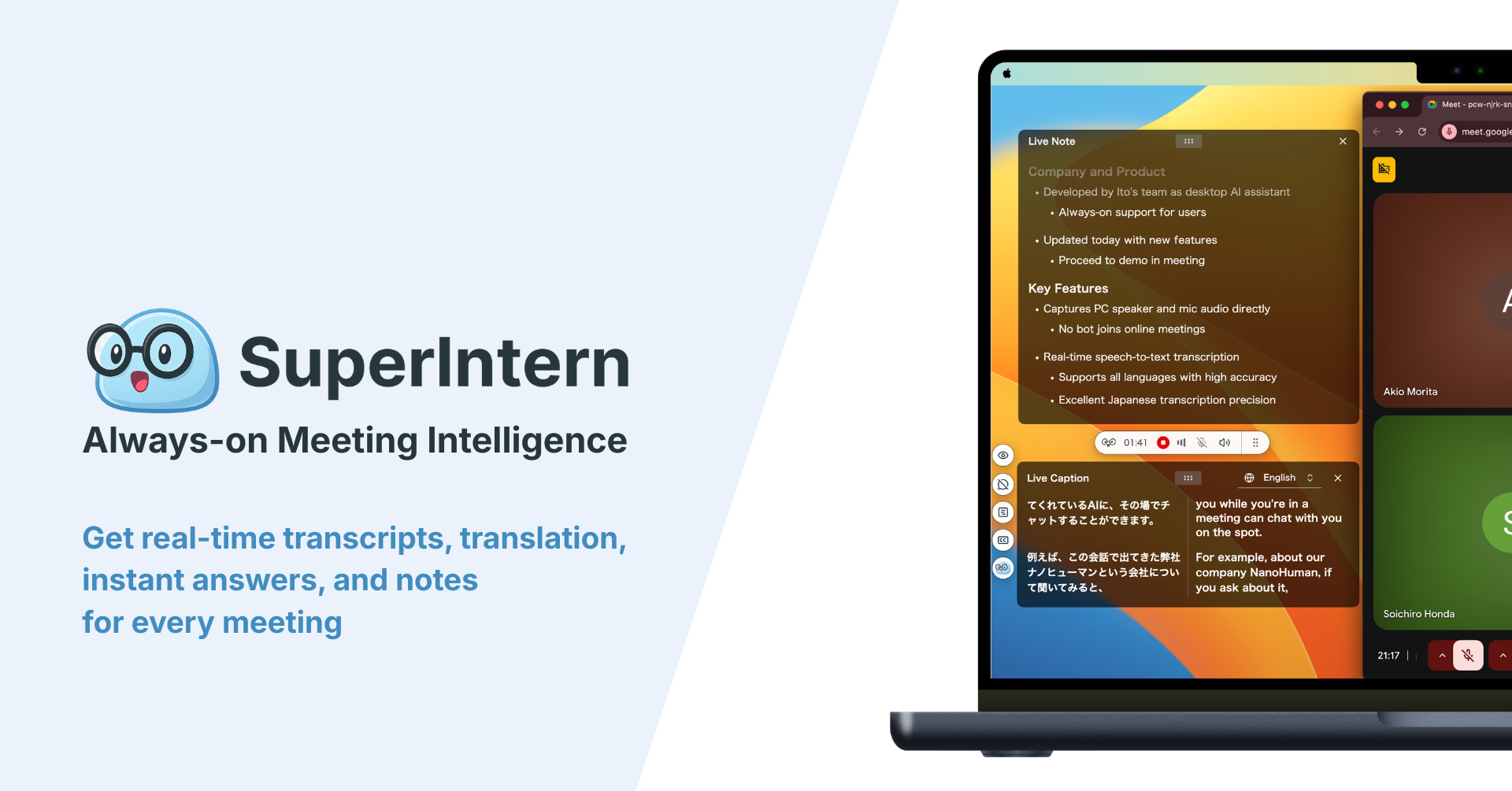
SuperIntern is a real-time meeting assistant from NanoHuman Inc. that works without a bot. It runs as a desktop app on macOS and Windows and captures your computer's audio and microphone directly, so it works the same way in Zoom, Google Meet, Microsoft Teams and in-person meetings. Because nothing joins the call, you can use it in meetings that a client or partner hosts.
The feature that matters most for English minutes is summary language. SuperIntern can write the summary in a language different from the one being spoken, so a meeting held in Japanese, German or Spanish can produce English minutes as it goes.
- Install SuperIntern and sign in.
- Set the summary language to English.
- In AI Canvas, define the sections of your minutes, for example "Decisions", "Action Items" and "Open Issues". The notes then fill in using the same structure as the template above.
- Add company names, product names and colleagues' names to the custom dictionary so spellings stay consistent.
- Join the meeting as usual and start a SuperIntern session.
- After the meeting, review the result and use the post-meeting AI chat for follow-ups such as "List only Ken's action items with due dates."
If some participants speak a language you are less comfortable with, real-time translated captions in more than 50 languages let you follow the conversation while the minutes are written in English.
SuperIntern has a free plan. Plus costs $20 per month and includes 100 hours of meetings. The desktop app needs to be running during the meeting, and it cannot record meetings you did not attend. You can also upload an existing audio file to get a transcript and summary.
Turn an existing transcript into minutes with ChatGPT or a similar tool
If you already have a transcript in another language, a general-purpose AI assistant can draft English minutes from it. A structured prompt keeps the output consistent.
The following is a transcript of a meeting held in [language]. Write English meeting minutes.

- Sections: Purpose / Discussion (by agenda item) / Decisions / Action Items / Open Issues
- Write the discussion in the past tense, one or two sentences per point
- Format action items as a table with Owner / Task / Due date
- If an owner or due date is not stated in the transcript, write "TBD". Do not guess.
- Write names in "First name Last name" order

[Paste transcript here]
Check your company's policy before pasting confidential meeting content into an external AI service. For a full workflow, see how to turn a transcript into meeting minutes.
Checklist before you send the minutes
- The subject line includes the meeting name and date (for example "Minutes: Weekly Product Sync, Nov 24").
- All attendee and absentee names are spelled correctly.
- Dates spell out the month, and time zones are shown where relevant.
- The discussion is in the past tense and action items use "will".
- Every action item has an owner and a due date.
- Decisions and open issues are listed separately.
- Vague phrases such as "consider" or "ASAP" have been replaced with a specific action and date.
- Numbers, amounts and product names have been checked against what was said.
- The content is appropriate for every recipient, including external guests.
Send the minutes the same day if you can. The longer you wait, the more corrections you will receive. For wording ideas, see our guide to the follow-up email after a meeting.
FAQ
Should I write "minutes" or "meeting notes"?
Both are correct. "Minutes" sounds more official and suits boards, committees and client meetings. "Meeting notes" fits internal syncs. If you are unsure, "minutes" is never wrong.
Should meeting minutes be written in the passive or active voice?
Action minutes read better in the active voice because it makes ownership obvious. Formal minutes traditionally use passive constructions such as "It was resolved that...".
How much detail should the minutes include?
Not a word-for-word record. Summarize each point in one or two sentences and note who raised any concern or proposal that shaped the outcome. Keep the full transcript separately if you need it.
Should bilingual minutes be written in two columns?
Two languages help when readers are split between them, but versions drift apart. Decide which language is authoritative and mark the other as a reference translation.
What tense should action items be in?
Use "will" plus the verb ("Ken will send the deck by Friday") or a short imperative in a table ("Send the deck"). Both are acceptable; just be consistent.
Can someone with limited English take minutes in English?
Yes. A fixed template and a set of standard phrases cover most of what you need. An AI tool that writes English summaries from the meeting audio reduces the effort further, as long as someone reviews the result.
Conclusion
Good English minutes are not about elegant prose. They follow a predictable structure, record decisions separately from discussion, and give every action item an owner and a date. Write the discussion in the past tense, spell out dates, and remove anything vague before you hit send.
If you regularly run meetings in one language and report in English, consider generating the English minutes directly from the conversation. SuperIntern does this in real time without adding a bot to the call, and you can start on the free plan.