
Keep Your Kintone Apps in Sync with What Was Said in Meetings, Using SuperIntern MCP
Your team runs its deals, projects, or support cases in Kintone apps. The meetings where those deals actually move happen somewhere else entirely. So after every weekly sales meeting, someone opens the deal management app, hunts for the right records, and retypes what was decided: new status, next action, updated close date.
When that retyping slips, the app quietly drifts away from reality. The record still says "Proposal sent" while the deal was verbally approved three days ago. Anyone who trusts the app is now working from stale data.
Connect SuperIntern MCP and the official Kintone MCP server to Claude, and you can hand that transfer work to an AI assistant. Claude reads the meeting notes, finds the matching Kintone records, shows you exactly what it wants to change, and is instructed in the prompts below to wait for your approval before writing.
⚠️ This article is an independent write-up based on public information and user feedback as of September 2026.
Table of Contents
- What changes with this setup
- How the pieces fit together
- Setup
- Demo 1: Update deal records right after the weekly meeting
- Demo 2: Log a new lead mentioned in a meeting, with a duplicate check
- Demo 3: Find stale records with a weekly cross-check
- Tips for running this safely
- Beyond sales: the same pattern for any Kintone app
- FAQ
What changes with this setup
Before: after each meeting, someone reopens their notes, searches the Kintone app for each customer, and manually edits fields record by record. On busy weeks, the updates arrive days late or not at all.
After: minutes after the meeting ends, you ask Claude to reconcile the meeting with the app. Claude pulls the AI meeting notes from SuperIntern, matches them to Kintone records, and proposes a field-by-field update plan. You review, adjust, approve. The records and a comment trail land in Kintone while the discussion is still fresh.
The meetings themselves need to be recorded in SuperIntern first. SuperIntern is a desktop meeting assistant that captures transcripts and AI meeting notes without inviting a bot into the call, so it works for online meetings and in-person conversations alike.
How the pieces fit together
Three parts divide the work, and each one stays in its lane.
| Component | Role |
|---|---|
| SuperIntern MCP | Provides transcripts, live transcripts, AI meeting notes, and meeting notes, read-only |
| Claude | Reads the meeting data, matches it to records, drafts the update plan, and executes it after approval |
| Kintone MCP server | Lets Claude search apps, retrieve and create and update records, and post record comments in your Kintone environment |
MCP (Model Context Protocol) is an open standard for connecting AI assistants to external tools. SuperIntern MCP is strictly read-only: Claude can read your meeting data through it, but nothing can edit or delete that data through this connection. It also only exposes meetings you can already see in SuperIntern.
On the other side, the Kintone MCP server is published by the Kintone team itself as open source. It gives AI clients tools to list apps, get, add, and update records, post comments on records, and update process statuses. All writes to Kintone are performed by Claude through this server, never by SuperIntern.
Setup
You connect the two servers to Claude separately.
1. Connect SuperIntern MCP to Claude
In Claude's settings, open Connectors, choose "Add custom connector," and register this URL:
https://mcp.app.super-intern.com/mcp
Sign in to SuperIntern and grant access. Personal workspaces need the Plus plan or higher; on Enterprise, an admin has to enable MCP access first. Full requirements and the Claude Code and Cursor steps are in the MCP setup guide.
2. Connect the Kintone MCP server
The Kintone MCP server runs locally. The easiest path on Claude Desktop is the packaged extension: download the .mcpb file from the releases page and drag it into Claude Desktop's extensions settings. You can also run it via npm (@kintone/mcp-server) or Docker (ghcr.io/kintone/mcp-server); the README shows the exact .mcp.json snippets for Claude Code and Cursor.
For credentials, prefer an app-scoped API token over your username and password. In Kintone, open the settings of the app you want Claude to touch, generate an API token with only the permissions you need (view and edit records for Demo 1, plus add records for Demo 2), and set it as KINTONE_API_TOKEN together with KINTONE_BASE_URL (such as https://example.kintone.com). Your Kintone plan must include REST API access; in the Japanese lineup, both the Standard and Wide courses include it, while the Light course does not.
Open the target app in your browser and find its numeric app ID in the URL, such as 123 in /k/123/. Replace 123 in the examples below with your own app ID. API-token authentication does not support listing apps by name, so provide Claude with the app ID as well as its name.
3. Check the connection
Open a new chat and ask:
List my 3 most recent SuperIntern meetings, and show the fields
of the Kintone app "Deal Management" (app ID: 123).
If both sides answer, you are ready.
Demo 1: Update deal records right after the weekly meeting
The weekly sales meeting is where deal statuses actually change. Right after it ends, ask Claude to turn the discussion into record updates. The key phrase is "show me the plan before writing anything."
Get the AI meeting notes and transcript of today's "Weekly Sales Meeting"
from SuperIntern. For every customer discussed, find the matching record
in the Kintone app "Deal Management" (app ID: 123; match by company name).
For each record, propose:
- new Status (only if it changed in the meeting)
- Next Action and its due date
- a one-line "Latest Update" note
Show me the full plan as a table first, with the supporting quote from
the meeting for each change. Do not write anything to Kintone until I
approve. After I approve, also post a record comment summarizing the
meeting decision, with the meeting title and date.
A typical response looks like this:
I found 4 customers discussed in the meeting and matched 4 records in Deal Management.
- Northwind Retail: Status "Proposal sent" → "Verbal agreement". Next action: send the order form (due Sep 16). Quote: "They said yes on the call, we just need the paperwork."
- Acme Logistics: no status change. Next action: schedule the security review (due Sep 19). Quote: "Their IT team wants a security session before signing."
- Blue Field Foods: Status "Negotiation" → "On hold". Quote: "Budget is frozen until their new fiscal year."
- Contoso Manufacturing: no matching outcome in the meeting; the record's next action is overdue. Flagging for your attention, no change proposed.
Approve all, or tell me which lines to adjust?
You reply with corrections ("change the Northwind due date to Sep 17, then go ahead"), and Claude applies the updates and posts one evidence comment per record.
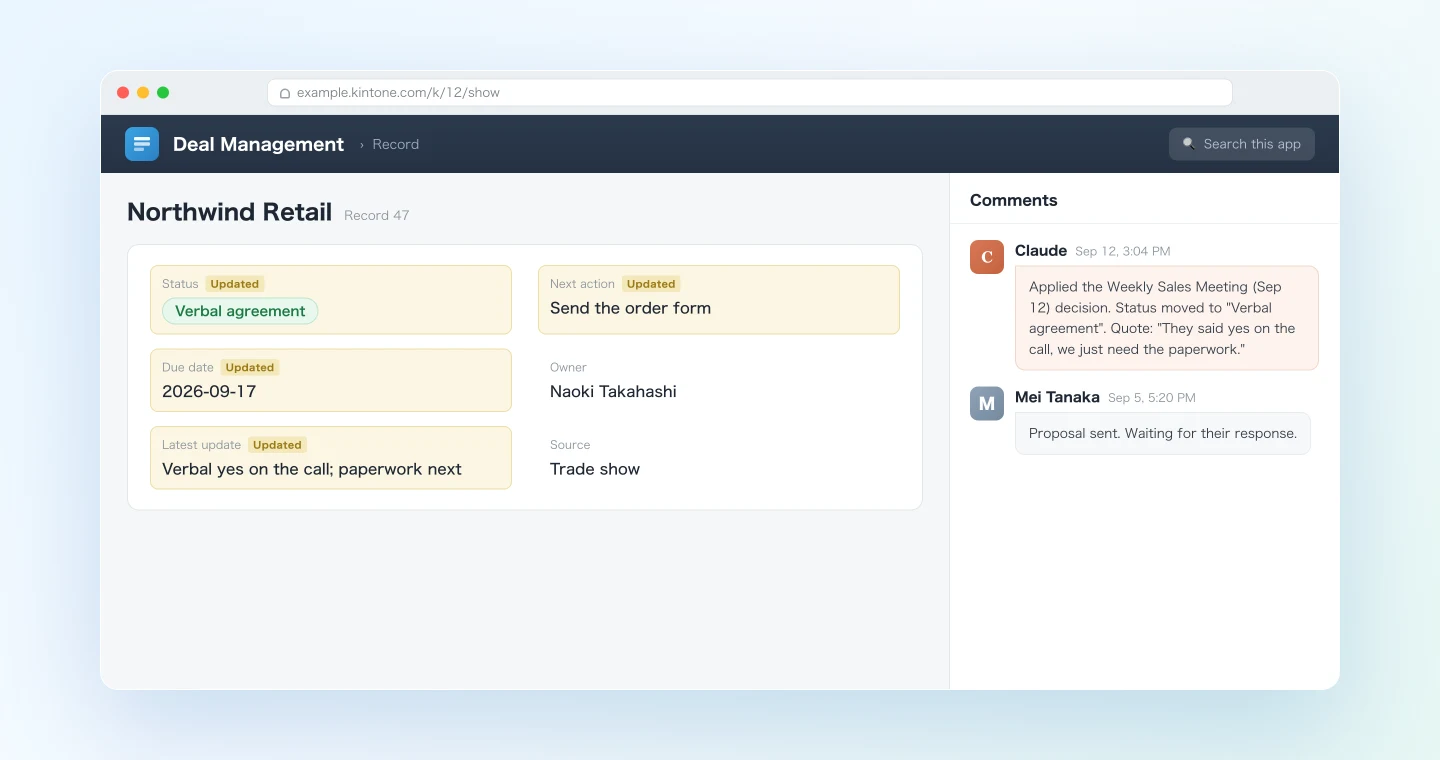
The comment trail matters as much as the field updates. Six weeks later, "why is this deal on hold?" is answered inside the record itself, with the meeting title and date attached.
Demo 2: Log a new lead mentioned in a meeting, with a duplicate check
New deals often enter the pipeline as a sentence in a meeting: "By the way, the Osaka branch of Fabrikam reached out." If nobody creates the record, the lead exists only in someone's memory.
From today's "Weekly Sales Meeting" notes in SuperIntern, list any
companies or deals that were mentioned but do NOT yet have a record
in the Kintone app "Deal Management" (app ID: 123). Search the app by company
name
first so we do not create duplicates. For each genuinely new one,
draft a record: Company, Contact (if mentioned), Source = "Meeting",
Status = "New", and a summary of what was said. Show me the drafts
and wait for my approval before adding records.
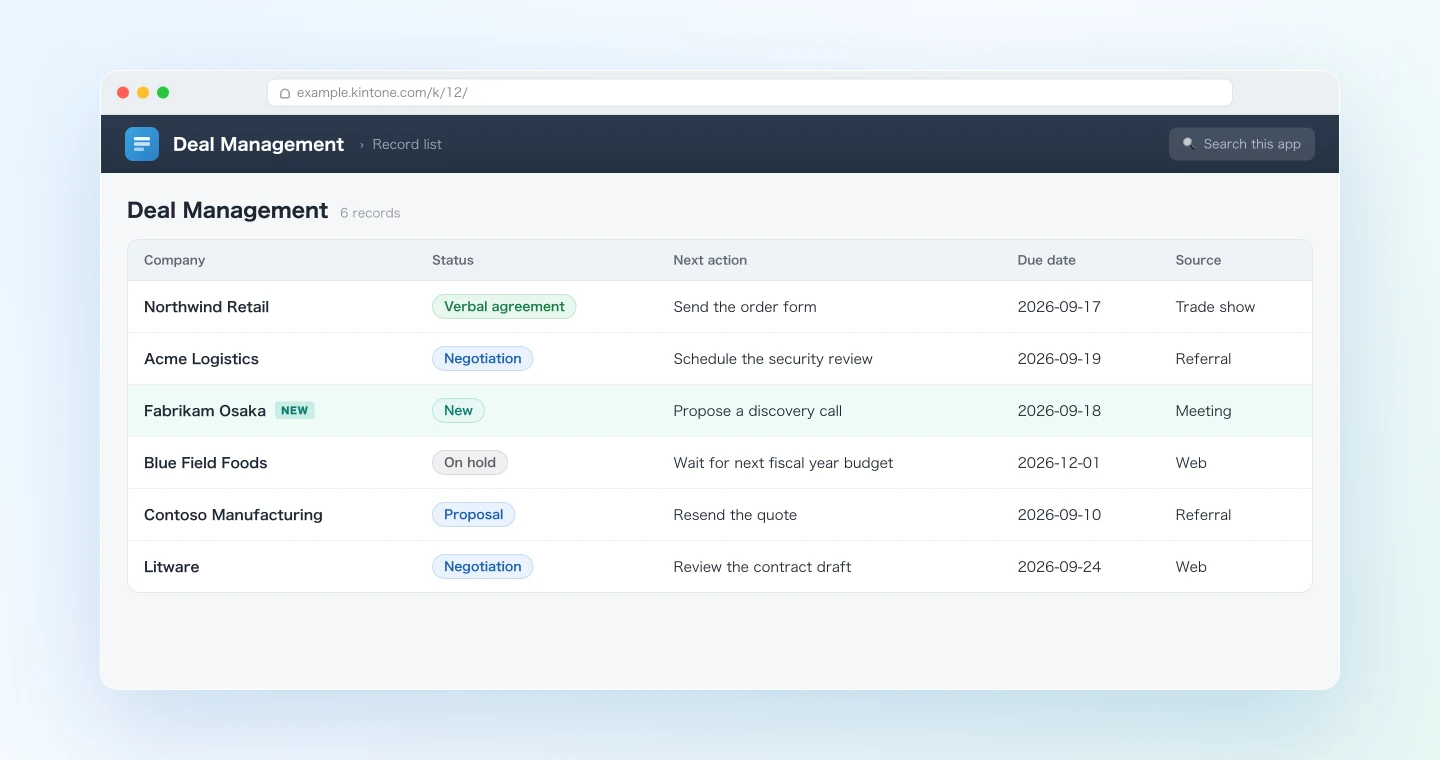
I checked 6 company names from the meeting against Deal Management.
- 4 already have records (no action).
- Fabrikam Osaka has no record. Draft: Status "New", Source "Meeting", summary: "Inbound inquiry via the Osaka branch, interested in the annual plan, contact person not yet named."
- Litware appears once, but the existing record "Litware GmbH" may be the same company. I did not draft a new record; please confirm.
Add the Fabrikam Osaka record?
The near-duplicate case is exactly where you want a human decision. Review existing matches even for leads marked as new. This can reduce missed duplicates, but variations in company names or another person adding a record after your check can still result in duplicates.
Demo 3: Find stale records with a weekly cross-check
Even with good habits, some updates slip. Once a week, run the reconciliation in the other direction: start from the app and ask which records fell behind the meetings.
Take all my SuperIntern meetings from the past 3 weeks up to today and the
records in
the Kintone app "Deal Management" (app ID: 123) that are not closed. Cross-check
them and give me three lists:
1) Records where a meeting this week decided something newer than the record
   shows (with the quote and a proposed field update)
2) Records whose next action date has passed with no related meeting
   this week
3) Records that were not mentioned in any meeting for 3 weeks or more
Use this week for lists 1 and 2, and the full past 3 weeks for list 3.
If any meetings or periods cannot be retrieved, report the gap as unknown
rather than concluding that a record was not mentioned.
For list 1, wait for my approval, then apply the updates and post an
evidence comment on each record.
List 1 is your catch-up queue, and lists 2 and 3 make Monday's pipeline review concrete: instead of scrolling the app hoping to spot drift, you open with "these five records need attention and here is why."
Tips for running this safely
Always propose first, write second. Every prompt that requests a write in this article ends with some form of "show me the plan and wait for approval." Keep that pattern. Reviewing the plan gives you a chance to catch errors, but a prompt is not a technical control that prevents writes. Check the target records, proposed values, and supporting evidence, then verify the results after execution.
Scope the API token to one app. The Kintone MCP server accepts app-scoped API tokens, so Claude only ever sees the apps you explicitly granted. Start with one app and view-plus-edit permissions for Demo 1; also grant add permission for Demo 2. Creating records requires record-add permission. Delete rights are not needed. You can register multiple tokens later as you extend the workflow.
Lean on Kintone's record history. Kintone keeps a change history on each record, so an incorrect update is visible and recoverable. Combined with the evidence comments Claude posts, you can always trace which meeting produced which change.
Match on stable keys. Company names in transcripts can be abbreviated or misheard. If your app has a customer code, tell Claude to match on that. Registering frequent customer names in SuperIntern's custom dictionary also improves the transcript side.
Mind attachment fields. The Kintone MCP server currently cannot set attachment fields when adding or updating records, and guest spaces are not supported. Keep file uploads as a manual step.
Beyond sales: the same pattern for any Kintone app
Kintone is rarely just a CRM; teams run all kinds of internal apps on it. The reconciliation pattern transfers directly.
- Support case app: after the weekly support review, update case statuses and log the decided workarounds as comments.
- Project task app: after a project meeting, update task owners and deadlines that changed in the discussion.
- Daily report app: at the end of the day, draft a report record from the day's meetings, then review and submit it.
If your team tracks deals in a dedicated CRM instead, the same meeting-to-record workflow exists for HubSpot, and for team task trackers there is a Linear edition.
FAQ
Q. Is SuperIntern MCP available on the free plan?
A. Personal workspaces need the Plus plan or higher; Team plan workspaces can use it as well. On Enterprise, it is off by default until an admin enables MCP access.
Q. Does SuperIntern write to my Kintone apps?
A. No. SuperIntern MCP only provides meeting data, read-only. All Kintone reads and writes are performed by Claude through the Kintone MCP server, using the credentials you configured.
Q. Can the AI modify or delete my meeting notes through this setup?
A. No. SuperIntern MCP has no write or delete capability, so meeting data cannot be changed through this connection.
Q. What do I need on the Kintone side?
A. A plan with REST API access (in the Japanese lineup, the Standard or Wide course; the Light course does not include the API), plus an API token and the target app ID. The MCP server itself is free, published as open source by the Kintone team. Note that it is outside the scope of Kintone's API support desk.
Q. What if Claude writes something wrong?
A. Reviewing the proposed changes can help you spot errors, but does not guarantee that incorrect updates are prevented. If a wrong value does land, Kintone's per-record change history shows exactly what changed, and you can correct it like any manual edit.
Q. We use HubSpot or Salesforce as our CRM. Is this article still relevant?
A. Use the HubSpot edition for a dedicated CRM. This edition is for teams whose system of record is a Kintone app, which often covers more than sales: support cases, projects, and daily reports follow the same pattern.
Start with one app and one meeting: run Demo 1 after your next weekly meeting and see how much of the retyping disappears. The app your team already trusts simply stops falling behind.