
Turn Interview Transcripts into Ashby Notes with SuperIntern MCP and Claude
The hardest part of interviewing is not the interview. It is the write-up you owe afterwards, usually started hours later, when three other meetings have already overwritten your memory of what the candidate actually said. By Thursday of a heavy interview week, feedback quality drops and submission times slip, and the hiring team ends up debriefing from impressions instead of evidence.
Connect SuperIntern MCP and Ashby to Claude, and you can draft interview notes straight from the transcript, with a quote from the candidate attached to every assessment area, then have them posted to the candidate's profile in Ashby. You review everything before it is written.
This guide covers setup plus three workflows: a draft right after the interview, a handoff memo for the next interviewer, and a weekly check for unsubmitted feedback.
⚠️ This article is an independent write-up based on public information and user feedback as of September 2026.
Table of Contents
- Today's Goal: Before / After
- How It Works: Three Roles
- Setup
- Demo 1: Draft Interview Notes Right After the Interview
- Demo 2: Hand Off to the Next Interviewer
- Demo 3: A Weekly Audit of Unsubmitted Feedback
- Tips and Caveats
- Going Further: Same Pattern, Different Tools
- FAQ
Today's Goal: Before / After
Before: after each interview, you reconstruct the conversation from memory and scattered notes, type an evaluation into Ashby, and hope you quoted the candidate accurately. After: minutes after the interview ends, a structured draft with verbatim quotes is waiting for your review, and one approval posts it to the candidate's Ashby profile.
The flow looks like this:
- Tell Claude which interview to use and what format you want.
- Claude reads the SuperIntern transcript and AI summary, then drafts notes organized by assessment area, each backed by a candidate quote.
- You review the draft, request edits, and approve.
- Claude posts the note to the candidate's profile through the Ashby MCP.
The interview needs to be recorded in SuperIntern first. SuperIntern is a botless desktop meeting assistant: no recording bot joins the call, so nothing extra appears on the candidate's screen. It works for both video interviews and in-person conversations.
How It Works: Three Roles
| Component | Role |
|---|---|
| SuperIntern MCP | Provides transcripts, live transcripts, AI summaries, and meeting notes, read-only |
| Claude | Extracts evidence per assessment area and drafts the note |
| Ashby MCP | Acts on Claude's requests: reads candidates, interviews, and submitted feedback, and adds notes to candidate profiles |
MCP (Model Context Protocol) is an open standard for connecting AI assistants to external tools. Through SuperIntern MCP, Claude can only see meetings you already have permission to view, and the connection is read-only: it cannot edit or delete your meeting data.
On the Ashby side, you use Ashby's official MCP server (beta). It can search candidates, jobs, and applications, read interview schedules and submitted feedback, and perform a small set of write actions including adding notes to candidates. Everything runs within the permissions your Ashby account already has.
Setup
You connect SuperIntern and Ashby to Claude separately. Both use sign-in based authentication, so there are no API keys to manage.
1. Connect SuperIntern MCP to Claude
In Claude's settings, open Connectors, choose "Add custom connector," and register this URL:
https://mcp.app.super-intern.com/mcp
Sign in with your SuperIntern account and approve access. Personal workspaces need the Plus plan or higher; on Enterprise, an admin has to enable MCP access first. For plan details and setup in Claude Code or Cursor, see the MCP setup guide.
2. Connect Ashby MCP to Claude
On the Ashby side, an admin enables the beta first: in Ashby, open Organization Setup, then Opt In Features, and turn on the MCP server beta.
After that, each user adds this URL as a custom connector in Claude and signs in with their Ashby account:
https://mcp.ashbyhq.com/mcp/v1
In Claude Code, register it with:
claude mcp add --transport http ashby https://mcp.ashbyhq.com/mcp/v1
According to Ashby's documentation, the server is in beta and available on Ashby plans other than analytics-only contracts.
Once both are connected, open a new chat and confirm access:
Show me my last 3 SuperIntern meetings and my upcoming Ashby interviews this week.
Demo 1: Draft Interview Notes Right After the Interview
Start with the interview you just finished. Specify the assessment areas and the quote format, and keep the review step explicit:
Get the transcript and AI summary of the "Backend Engineer - 2nd interview"
that just ended, and draft my interview notes. Show me the draft before
writing anything to Ashby.
- Use four areas: technical depth, communication, hands-on experience,
  and open questions
- Attach one verbatim candidate quote as evidence under each area
- Do not include a hire/no-hire conclusion; stick to facts and quotes
Once I approve, add it as a note on the candidate's Ashby profile.
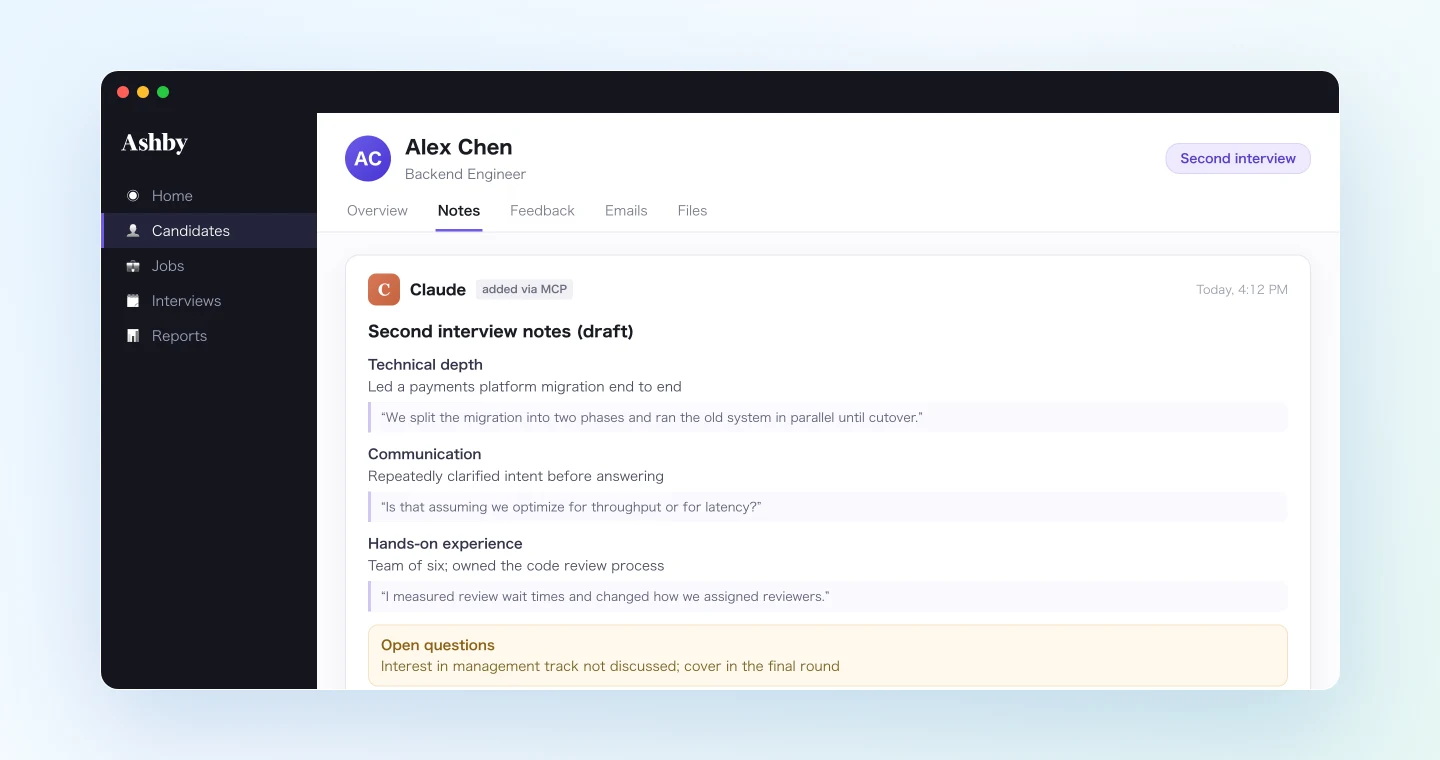
Here is a sample response, based on a fictional September 2026 interview. The screenshots are illustrative mockups.
Here is the draft from the second interview:
Technical depth: Led a payments platform migration end to end. Quote: "We split the migration into two phases and ran the old system in parallel until cutover."
Communication: Repeatedly clarified intent before answering. Quote: "Is that assuming we optimize for throughput or for latency?"
Hands-on experience: Team of six; owned the code review process. Quote: "I measured review wait times and changed how we assigned reviewers."
Open questions: Interest in management track was not discussed. Recommend covering it in the final round.
Should I add this as a note to the candidate's Ashby profile?
Review the draft, adjust the wording, and reply with your approval to post it.
Note what this workflow deliberately does not do: it does not submit your official scorecard. Use the note as your raw material, then submit the actual feedback form yourself in Ashby. You save the transcription time while the evaluation itself stays yours.
Demo 2: Hand Off to the Next Interviewer
Multi-round interviews have two chronic failure modes: candidates answering the same question three times, and important topics that nobody ever asks about. Cross-reference the candidate's previous rounds to fix both:
Pull the first and second interview records for candidate "Alex Chen"
from SuperIntern and draft a handoff memo for tomorrow's final interviewer.
- Covered topics: one line each with the key takeaway
- Not yet covered: phrase these as suggested questions
- Include questions the candidate asked and how we answered
Show me the memo first. When I approve, add it to the candidate's
Ashby notes titled "Final round handoff".
A sample response:
Here is the handoff draft from rounds one and two:
Covered: Reason for leaving (team downsizing). Salary expectations range. Payments migration project in detail.
Suggested questions: Start date is still listed as "flexible" with no specifics. Interest in people management. Status of other processes they are interviewing in.
Candidate's questions: Asked what the first 90 days would look like; we walked through the onboarding plan.
Add this to Ashby as "Final round handoff"?
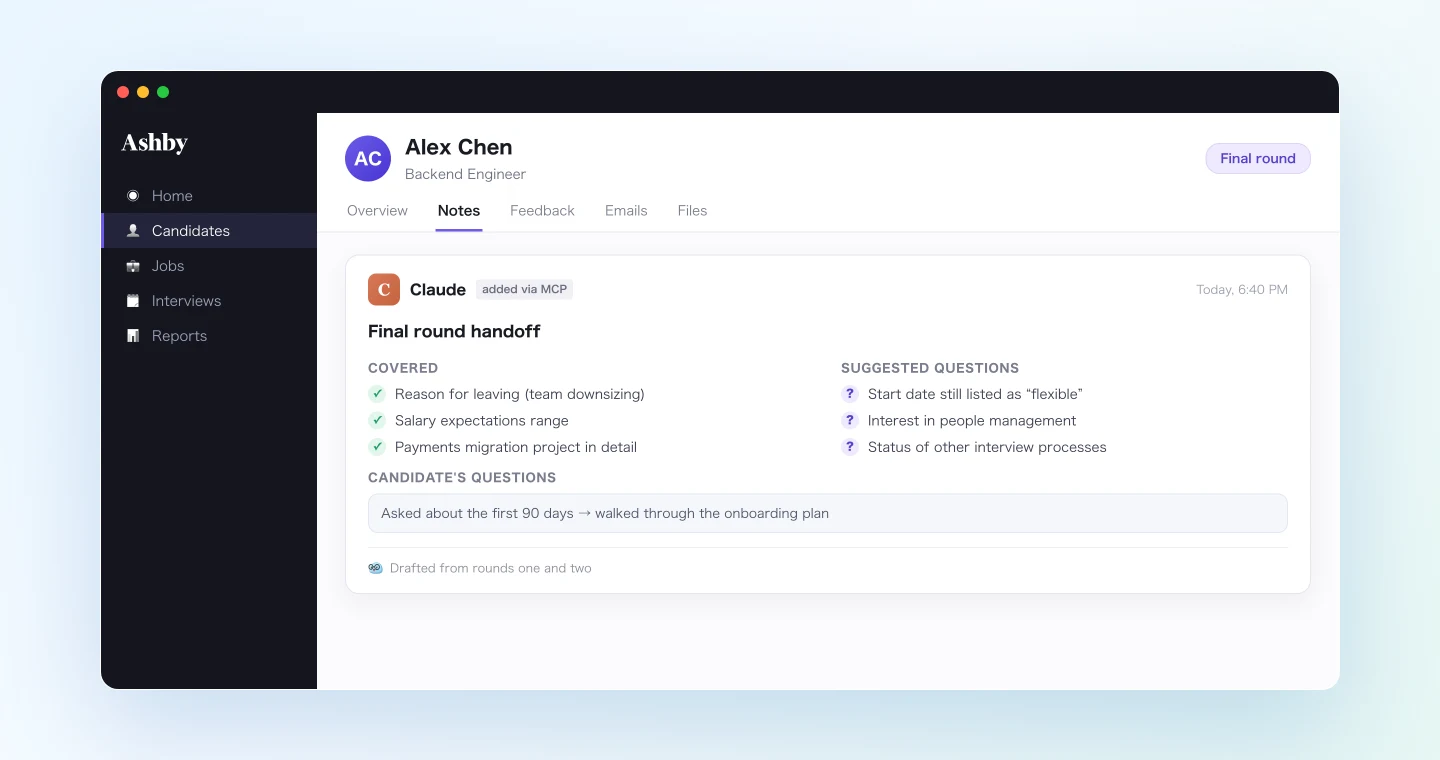
With the handoff sitting on the candidate's profile, the final interviewer can prepare in five minutes, and the candidate stops repeating themselves.
Demo 3: A Weekly Audit of Unsubmitted Feedback
In a heavy week, the bottleneck is often submission itself. At the end of the week, reconcile what was recorded against what was submitted:
List the interviews recorded in SuperIntern this week and cross-check
them against submitted feedback in Ashby. Show me only the interviews
where feedback is still missing. For the ones I conducted, draft notes
from the transcripts. For other interviewers, give me a list with
interview names and owners I can use for reminders.
Your own backlog turns into ready-to-review drafts, and everyone else's becomes a clean reminder list. Monday's hiring sync starts with decisions instead of chasing.
Tips and Caveats
Record interviews according to policy and with candidate awareness
Follow your company's recording policy and inform candidates appropriately before recording interviews. Being transparent about why you record is also part of a good candidate experience.
Keep conclusions out of the AI's mouth
Tell Claude explicitly not to write hire/no-hire conclusions. It organizes facts and quotes; the judgment is yours, and the official feedback form is submitted by you in Ashby. This keeps the accountability structure of your hiring process intact.
Never skip the review step
Notes on a candidate profile are read by the whole hiring team. Make "show me first, write after I approve" the fixed pattern in every prompt.
Access stays within your existing permissions
SuperIntern MCP only exposes meetings you can already view; Ashby MCP works within your existing Ashby permission level. Connecting the two does not widen anyone's access.
Check proper nouns
Misspelled candidate or company names hurt searchability later. Register recurring terms in SuperIntern's custom dictionary and verify names at the draft stage.
Going Further: Same Pattern, Different Tools
The same meeting data can feed other destinations after an interview:
- Claude Code + the pptx skill: turn interview evaluations into internal debrief slides; see the meeting slides guide.
- Google Calendar: schedule the next round straight from the meeting record; see the Google Calendar guide.
- Notion: build a meeting database beyond hiring; see the Notion guide.
Keep candidate-related records in Ashby, and route internal reports and general meeting archives elsewhere.
FAQ
Q. Can I use SuperIntern MCP on the free plan?
A. Personal workspaces need Plus or higher. Team plan workspaces are supported. On Enterprise, an admin needs to enable MCP access in workspace settings.
Q. Does SuperIntern write to Ashby?
A. No. Claude adds notes through the Ashby MCP. SuperIntern MCP provides interview records read-only.
Q. Can this submit my official interview scorecard?
A. No, and that is intentional. The workflow stops at candidate notes; you submit the official feedback form yourself in Ashby, so the evaluation of record always comes from the interviewer.
Q. Which Ashby plans support the MCP server?
A. According to Ashby's documentation, it is in beta and available on plans other than analytics-only contracts. An admin must enable it under Opt In Features first.
Q. What about candidate privacy?
A. Both MCPs operate strictly within the permissions you already have: SuperIntern MCP sees only meetings you can view, and Ashby MCP mirrors your Ashby role. Separately, make sure interview recording itself follows your internal policy and candidate communication practices.
Q. Does a recording bot join the interview?
A. No. SuperIntern is a botless desktop app, so nothing joins the call or appears on the candidate's screen.
Start with a single interview: draft the notes, compare them with what you would have written from memory, and post them. You get your evenings back, and your hiring team gets evidence instead of impressions.